 3 months ago
93
3 months ago
93
Rahib KhanEducation reporter

 BBC
BBC
This week the government has published its Schools White Paper, setting out sweeping reforms to the special educational needs and disabilities (SEND) system in England.
From September 2029, children's entitlement to Education, Health and Care Plans (EHCPs) will be reassessed as they move between education stages, and by 2035 will be reserved for children with the most complex needs.
New Individual Support Plans (ISPs) will be introduced, drawn up by schools and put into three categories: targeted, targeted plus, or specialist.
The government said it would also invest £4bn in SEND provision over the next three years.
Education Secretary Bridget Phillipson told the BBC she appreciated "the big challenges around support for children with SEND".
BBC News has been speaking to families, teachers, pupils and councils about their experiences of the current system, and their reactions to the government's proposals.
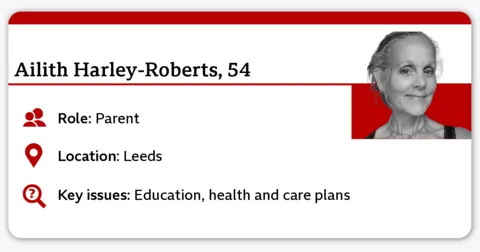
Ailith Harley-Roberts, whose daughter Thalia has Down's syndrome, says the government plans have prompted concern among parents she knows through her charity Sunshine and Smiles, which supports families like hers.
She says many have questions about how the government's changes to EHCPs will work in practice, after the government confirmed they would only be reserved for children with the most complex needs by 2035.
"Many of us feel that children's rights risk being eroded under these new proposals," says Harley-Roberts.
"By the time these proposed changes come into force, my daughter will be nearly 19 years old.
"I am deeply worried about what support she will receive between the ages of 19 and 25, particularly in relation to her EHCP. The plans I am making for her future could be placed at serious risk."
Harley-Roberts says she hopes the government will work collaboratively with families to clearly define what the reforms will look like in practice, and listen to parents and carers throughout the consultation.
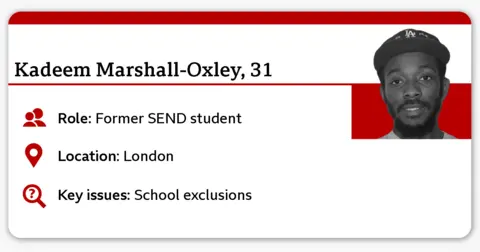
Former SEND student Kadeem Marshall-Oxley believes the reform plans could "compound challenges rather than resolve them".
He says he is particularly worried that neurodivergent children may lose personalised support because of the reassessments of EHCPs.
Marshall-Oxley was diagnosed with oppositional defiant disorder (ODD), a behavioural condition associated with frequent bouts of anger or irritability, when he was nine years old.
He believes the lack of support he received as a child led to his behaviour worsening, which ultimately saw him excluded from two primary schools.
It was only later, when he got more tailored help, that he felt his needs were addressed.
"The consistent, personalised approach made a meaningful difference during my time at school. Reducing that risks making children feel overlooked and anxious," he says.
Despite those concerns, Marshall-Oxley says he is positive about some of the plans, particularly the focus on SEND inclusion hubs in mainstream schools.
"Enabling children to remain with peers and avoid unnecessary transitions could be beneficial," he says.
"But for some, mainstream schools will never replace specialist settings."
He believes the key will be to prioritise understanding and supporting each child's needs to prevent behaviour challenges taking hold and reduce the risk of school exclusions.
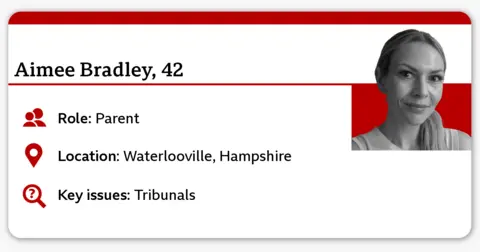
Aimee Bradley, who has three children with SEND, says she is concerned by the areas that she believes are lacking "concrete detail" in the government's White Paper.
"There are so many unanswered questions," she says.
"What would happen if there were a change in government? Would our children's rights and protections still be secure?"
Bradley, who went to a tribunal to secure SEND support for her son, says she is "particularly worried that the legal routes available to challenge or appeal decisions we disagree with" might be weakened.
"That safeguard is essential for families," she says.
Tribunals take place when there are disputes between local authorities, which provide SEND support, and parents who believe their child isn't getting the right help.
Under the new plans, parents will still be able to apply for EHCPs, which will be delivered by local authorities, and challenge the decisions made about what support their child can get at tribunal.
"While there are some positive elements in the proposals, they require further work and clarification," Bradley says.
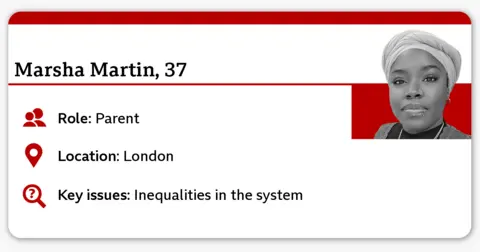
Marsha Martin and her three children are autistic and have ADHD.
Martin founded Black SEN Mamas in 2020, a peer support network which now supports thousands of parents across the UK and abroad.
She had wanted the government's reforms to include specific training for staff to help tackle racism and unconscious bias, which she believes can sometimes play a part in the way decisions are made about children's needs – though admits it is hard to prove.
She says she had also hoped the consistent protections of an EHCP would be retained for children throughout their time at school.
Martin says she is disappointed by the proposals set out within the White Paper, especially the plans to reassess EHCP entitlements after Year 6.
"The idea that children who have received a certain level of support throughout primary school and their early years could then have that support reduced or removed during secondary school is deeply concerning," she says.
She adds that secondary education is one of the most critical periods in a young person's life, and removing established support at that stage risks "destabilising a child".
Martin says many of the families she has spoken to through Black SEN Mamas have said they are unhappy with the proposals.
"The current SEND system is not meeting children's needs, and from what we can see, the revised proposals do not appear to address those shortcomings either," she says.
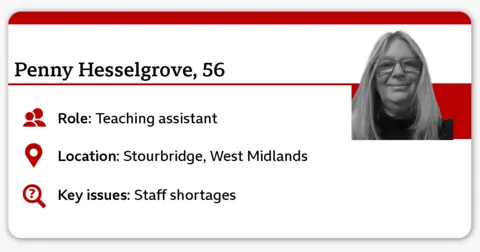
Penny Hesselgrove, who has worked as a teaching assistant in a mainstream primary school for over 22 years, says staff are currently "stretched beyond capacity".
She worries what this might mean if schools are expected to deliver new individual support plans (ISPs) for all children with SEND.
"Staff are leaving and not being replaced, so it is difficult to see how these proposed changes will be sustainable," she says.
Although inclusion hubs "may be a positive idea", she says many schools "simply do not have the physical space or staffing capacity to make them work".
Hesselgrove says she is concerned that the plans do not provide "real clarity" on how children's needs will be properly assessed and met.
In particular, she is worried about how children may be affected if they lose their entitlements to an EHCP after being reassessed.
"Without an EHCP, there is a very real risk that children will not get the provision they require," she says.
"My role as a teaching assistant is directly linked to EHCP funding, so if fewer children are issued EHCPs, it could ultimately put jobs like mine at risk."
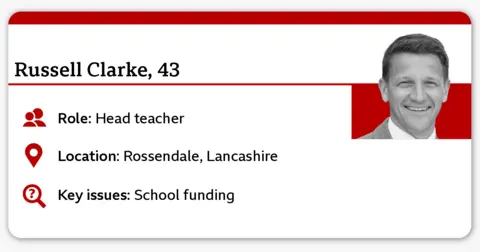
Russell Clarke, head teacher at Haslingden High School and Sixth Form in Rossendale, Lancashire, says he broadly welcomes the government's attention to supporting the most vulnerable young people.
"It's evident that the government is grappling with a highly complex issue," he says.
"The commitment of additional funding and the ambition to make the SEND system more inclusive for all young people are both positive steps."
But he believes the real challenge lies in how expectations are aligned with how reforms will be implemented in practice.
He says many parents can already be frustrated by the difficulty of securing an EHCP, "something that clearly needs attention," he adds.
With over 300 students on his school's SEND register, Clarke says there is a need for schools to be properly staffed and equipped to deliver the changes.
"Careful thought must be given to how the proposals translate into practical support - including recruitment and retention strong enough to meet growing needs," he says.
Overall, Clarke says he feels cautiously optimistic about the proposed changes highlighted in the White Paper.
"This is a complicated issue that will not be resolved overnight, but the government's ambition to improve the SEND system for young people and to make schools more inclusive is the right place to begin."
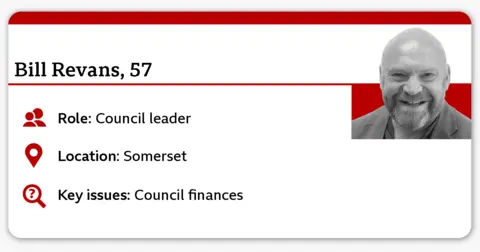
Cllr Bill Revans, leader of Somerset Council, has described the government's SEND proposals as "encouraging", but says he wants to see the proposals successfully move through Parliament in order to deliver meaningful change.
"The present SEND system is in crisis," he says.
"Doing nothing is not an option. Over the past 10 years an extra £30bn has been spent nationally, yet outcomes for children with SEND have not improved."
He says many families in Somerset feel let down by the system, adding that he has "heard their frustration and their heartbreaking experiences".
"The next 12 weeks must not become a talking shop," he says.
"We must grasp this opportunity for root-and-branch reform."
Revans says he backs the proposals to rebalance the EHCP system so that plans are reserved for those with the highest needs.
"The council spends about £8m a year maintaining EHCPs and currently has more than 1,000 awaiting completion, with demand up 47% in five years," he says.
He added that while the government has said it will take over SEND deficits from 2028, councils face at least two more years of intense financial pressure.
"The big prize here is improving outcomes and experiences for young people with SEND," he says.
"But the government must now ensure these reforms are delivered as promised - shifting to a more preventative, needs-led system of inclusive mainstream education."