 3 months ago
90
3 months ago
90
Ema Sabljak,England Data Unitand Jonah Fisher,Climate correspondent

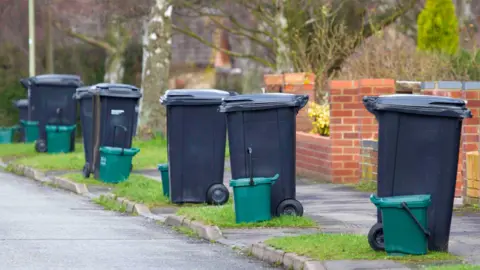 Planet One Images via Getty
Simpler Recycling legislation will make weekly food waste collections mandatory across England
Almost a quarter of English councils will miss an official deadline to introduce weekly food waste collections to all homes, a BBC investigation has found.
The Department for Environment, Food & Rural Affairs (Defra) said "every household in England" would get weekly food waste collections from next month under new legislation, but at least 71 councils told the BBC they would not meet that deadline.
Councils blamed the delay on demand for new specialist vehicles, as well as issues with funding despite more than £340m in grants from Defra.
Environment minister Mary Creagh said councils had also had a "significant uplift in this year's budget" to help "make this policy a success".
"Do it slowly, do it right but let's get on with it," she said. "We have been stagnating at these very low recycling rates for far too long."
Roughly half of councils were not collecting food waste weekly before the creation of the Simpler Recycling legislation, while some have had the collections in place for more than a decade.
It meant not all councils needed to make changes to meet the new rules, but the BBC approached each local authority responsible for waste collection to find out what was happening in their area.
At least 56 of those that will miss the deadline are aiming to launch their service for all households by the end of 2026. Nine could not give an approximate start date.
A further 31 councils have secured agreements allowing for a later start date for their weekly food collections, so will not be viewed as missing the deadline.
When those councils are factored in, more than a third of councils will still not be collecting food waste from all homes by March.
Shropshire Council said an April launch would place it under "significant financial risk".
Cabinet member David Vasmer said funds were provided for the purchase of vehicles, bins and the initial delivery, but the recent government financial settlement had "failed to provide any revenue funding for a weekly food waste service".
South Derbyshire District Council spokesperson said the supplier of food waste collection vehicles was experiencing "exceptionally high demand", making it difficult to get hold of them.
And East Hampshire District Council also confirmed availability of bin lorries was behind its delay, saying it did not yet have a date for when food waste collections would start.
Greg Ford, who lives in Buriton, East Hampshire, already separates his food waste for composting.
He said: "It makes you think about food waste, planning what to do with leftovers, so I think ironically collecting people's food waste is going to cut down on food waste.
He added the council should take as long as it needed "to get it right".
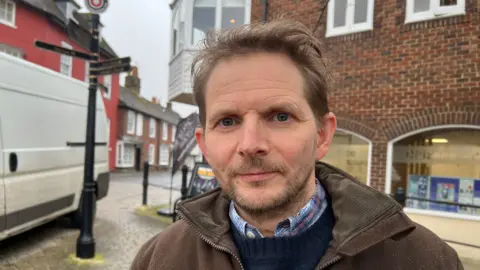
Greg Ford is the chair of trustees of the Petersfield Climate Action Network, which is run by local residents
Patricia Jepheson lives in Worcester where the council said the rollout of food waste collection would be delayed until spring 2027.
"It's just a lot of extra waste that could be disposed of in a greener way," she said.
"When areas with fewer resources managed to do it years ago, it's hard to understand why we're waiting until 2027."
Several councils are taking a phased approach that will delay the date when the service will be in place for all homes.
The Local Government Association has called for clarity about funding for day-to-day costs.
"It is important that all councils have local flexibility on how this service is delivered, alongside adequate funding and support," a spokesperson said.
"We are also asking government to commit to reviewing service costs after a year, to help plug any costs gaps."
'Postcode lottery' of rubbish
The Simpler Recycling policy aims to "remove the confusion" created by councils having different waste collection policies, which vary from just two bins to seven.
Adam Herriott, a senior sector specialist for sustainability charity Wrap, said the idea was to enable everyone to recycle the same material, "no matter where in England you are".
The default recycling collections across England will be paper and card, food waste and dry recycling including plastic, metal and glass.
A Defra spokesperson said it will "end the postcode lottery of bin collection".
Wrap's senior specialist for food waste, Rosemary Brotchie, said the change would help "maximise the value that food can have".
"You're keeping it out of your general waste bin, keeping it out of landfill, reducing those emissions that will come from that food rotting in landfill, but you're also keeping your waste clean to allow that to be recycled," she said.
Brotchie hopes the separate collection will impact daily habits and result in less waste being created.
She added: "If you are collecting your food in a caddy, you really get to see firsthand what you're throwing away. I think that can really prompt some rethinking."
How is food waste recycled?
The latest available data shows some local authorities recycle just a fifth of household waste.
Herriott said: "Food waste is generally pretty heavy because it's got quite a high water content."
Diverting those tonnages from landfill or incineration can "improve our recycling rate as a nation quite significantly", he explained.
Food waste is instead taken through a process called anaerobic digestion to create biomethane.
The food is pulverised and mixed with liquids, then left to digest in a tank for months.
Mark Barnfield, commercial director at Severn Trent Green Power, said the resulting gas was cleaned and either "injected into the gas grid" or converted to electricity.
The rest of the material produces digestate which can be used as fertiliser by nearby farms.
Barnfield believes it will benefit processing plants to not have every council start collection on the same date.
"If it was a light switch like that the system would be flooded and it would be difficult to cope, but the reality is that it will be more natural," he said.
In addition to being cleaner for the environment, he said it could be "cheaper to get rid of that waste through an anaerobic digestion plant" than other methods.
Additional reporting by Jonathan Fagg, Patrick Hughes and James Pearson