 3 months ago
109
3 months ago
109
Nikita Yadav and Abhishek Dey

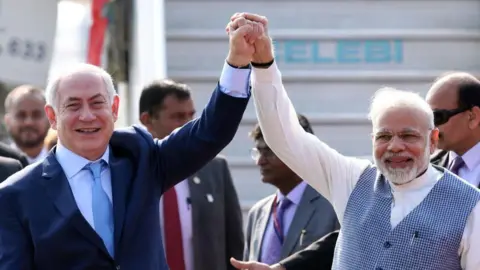 Hindustan Times via Getty Images
India and Israel's ties have expanded significantly in the last decade
Indian Prime Minister Narendra Modi is visiting Israel for a two-day visit, his first since the war in Gaza began.
Modi is expected to address Israel's parliament, the Knesset, and hold meetings with Prime Minister Benjamin Netanyahu and President Isaac Herzog. There is no meeting with Palestinian leaders on his schedule.
The visit comes as both countries look to strengthen ties in defence, technology and trade - a relationship that has grown significantly since Modi came to power more than a decade ago.
Analysts, however, say the visit will also test India's foreign policy as it tries to balance its ties with Israel and other Middle Eastern countries.
In 2017, Modi became the first Indian prime minister to visit Israel. The trip was widely seen as a turning point in the relationship.
The two countries work closely on counter-terrorism and defence. India is also among the biggest buyers of Israeli arms.
Israeli Prime Minister Benjamin Netanyahu has called Modi's visit a "historic" one.
"The bond between Israel and India is a powerful alliance between two global leaders. We are partners in innovation, security and a shared strategic vision. Together, we are building an axis of nations committed to stability and progress," he wrote on X.
Modi also responded by saying that India "deeply values the enduring friendship with Israel, built on trust, innovation and a shared commitment to peace and progress".
Foreign affairs expert Harsh V Pant said "India wants to show that it remains committed to the partnership it has with Israel", while also "attempting to balance its priorities" in the Middle East.
 Amir Ohana/X
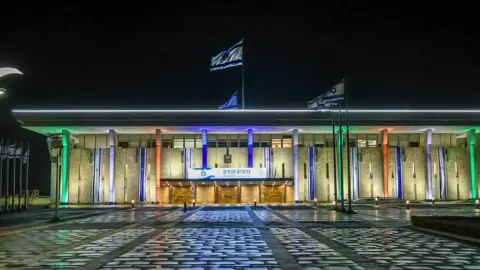
The Knesset has been illuminated in the colours of the Indian flag ahead of Modi's visit
India has condemned the deadly 7 October Hamas-led attacks and expressed solidarity with Israel, while also voicing concern over civilian casualties in Gaza and reiterating its support for a two-state solution.
However, the visit comes at a time of heightened regional tensions. One key concern is US President Donald Trump's threat of military action against Iran and fears that any escalation could trigger a wider regional conflict.
The US has been reinforcing its presence in the region in recent weeks, marking one of the largest US military build-ups in decades, to pressure Iran to curb its nuclear programme.
But analysts say the focus of Modi's visit will firmly be on bilateral engagement, and any discussion around regional tensions will probably remain behind closed doors.
This is along expected lines because Delhi also maintains strong ties with Iran and several other countries in the Middle East.
"India recognised Palestine in 1988. Politically, what could be done has largely been done... As per India's longstanding position, regional conflicts are for the region to resolve," said Kabir Taneja, executive director of the Observer Research Foundation think-tank's Middle East office.
"Just as India does not expect external interference in its own matters, it applies the same principle to the Middle East."
Modi will meet his Israeli counterpart shortly after arriving in Tel Aviv and will then travel to Jerusalem, where the rest of the engagements will take place.
Ahead of the visit, the Knesset was lit in the colours of the Indian flag. Modi shared the image on social media and said that he was looking forward to addressing lawmakers later on Wednesday.
However, his speech has become the subject of political controversy in Israel.
The opposition has threatened to boycott Modi's address to the Knesset unless Supreme Court President Isaac Amit is invited. His reported exclusion is linked to an ongoing political dispute over judicial reforms.
The Speaker of the parliament has reportedly planned to invite former lawmakers to fill any empty seats.
In India, opposition leaders have also criticised the visit.
Jairam Ramesh, spokesperson for the Congress party, has condemned the trip and accused the Modi government of abandoning the Palestinian cause.
Despite the criticism, analysts say the visit reflects India's long-term strategic calculations.
Taneja says Modi's visit is "largely driven by bilateral requirements".
"India's indigenous defence technology is still lagging on many fronts, especially as warfare becomes more automated and technology driven. Given tensions with Pakistan and China, India does not have the luxury of not seeking the best technological equipment, and Israel fits that requirement very well," Taneja said.
But he also added that regional stability in the Middle East is "critically important" for India's broader interests, including connectivity and energy security.
While Modi will praise India-Israel relationship, he will also be mindful of not disturbing India's long-standing relations with those partners in the Middle East who are critical of Israel.