 2 months ago
85
2 months ago
85
Evan DavisPresenter on Radio 4’s PM

 BBC
BBC
I know that not everybody is interested in the precise form of plumbing by which they heat their home, but it's a topic I've become obsessed with. That's partly because I have a French husband and we bought a very old, leaky house in northern France some years ago, which already had a heat pump installed.
I had never encountered one before. Quickly, it became apparent that the heat pump didn't work properly, but fortunately it was under guarantee and once it had been replaced it worked very well indeed. In fact, we went on to buy a second one for our loft extension.
The other reason I'm interested in this topic is because I'm excited by the prospect of witnessing a historic change - a horses-to-cars type moment. Since the stone age, people have typically kept themselves warm by burning things - wood or coal on a fire, or oil or gas in a boiler. A society-wide shift to electric heat pumps would mark a transformation to a whole new way of creating heat in the home.
This government wants Britons to embrace heat pumps (as did the last). But it's a shift that comes loaded with complicated questions in a country where electricity costs so much. Currently they're more expensive than a gas boiler to install, and can also end up more expensive to run. As a result, they're mostly aimed at the environmentally-conscious and better off.
The question is: can the figures ever add up so that it saves the average consumer money? And in a country where gas is so embedded as the norm, are heat pumps really the right technology for a greener future?
Emily and Stephen Boynton, who live in a leafy London suburb, decided to install a heat pump in their four-bedroom detached home during the pandemic. Emily had just turned 50 and was reflecting on life, her future, retirement, the environment - all sorts of questions.
"If you've got the money to do it, and you've got the space, then you should probably get on with it," she says now of her decision to buy a heat pump.
Installing one likely involves some new pipework, and often new radiators; it is not something you can just get one day when the gas boiler packs up. Emily and Stephen had decided to renovate their kitchen, so it was a good opportunity to get some disruptive work done.
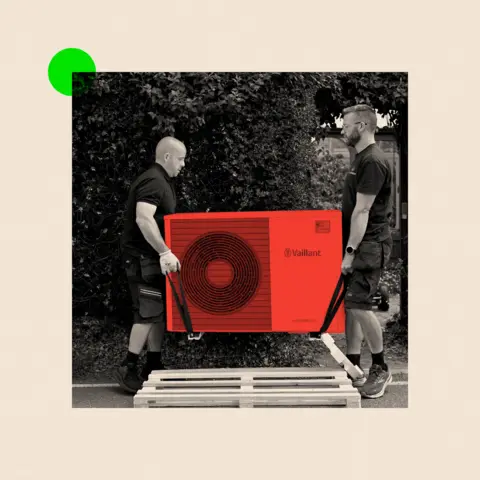
They have a big air source heat pump outdoors. It works with heat in the air, hence the name. It warms water which flows through buried pipes going indoors, feeding the radiators as well as their new underfloor heating in the kitchen.
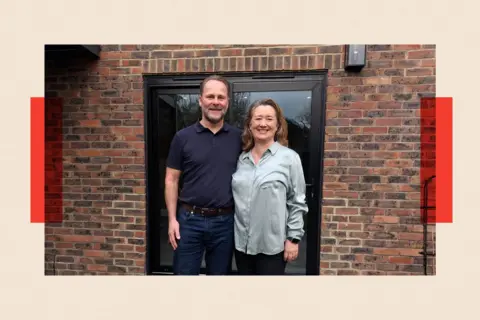
Stephen and Emily Boynton installed a heat pump in their four-bedroom detached house
Emily is the one who looks after the spreadsheets - and she shows me the cost. Like many customers, before installation they were advised to improve their insulation. That's because, as we will see, heat pumps usually provide a more gentle heat than gas boilers. That came to £5,000. Then they paid for the heat pump itself, and the under-floor heating.
In total they spent £17,000, though in return they received a £5,000 government grant.
It's a big capital sum. To put it another way, if you were to finance the cost by piling £17,000 on to a 25-year mortgage, at a 4.5% interest rate, your extra monthly mortgage payments would be about £100.
But then Emily showed me the spreadsheet where she has tracked their energy use, measured in kilowatt hours (kWh). In a recent year before the heat pump installation, the house consumed a total of 28,000 kWh, which would mostly have been gas heating. In the latest year, they used just 10,000, despite having had some adult children move home in that time. In other words, they've cut their energy use by almost two-thirds.
"I guess that reflects how much more efficient the heat pump is and also the impact of the insulation," Emily says.
Now, that is worth remembering - especially when you hear people pour vitriol on the whole idea of heat pumps. This technology delivers almost magical levels of energy reduction. They may be the subject of - pardon the pun - heated debate, almost religious in its fervour. But heat pumps are already used in hundreds of thousands of homes in the UK, and tens of millions across Europe. And it is not hard to find contented heat pump customers.
So how does a heat pump heat? And how does it save energy?
A heat pump basically runs a chemical - the refrigerant - round and round in a closed loop, going from hot to cold, gas to liquid, compressed to decompressed. Rinse and repeat.
At one end of the loop, when the refrigerant is in the form of a gas, the heat pump compresses it to make it super hot (rather as a bicycle pump heats up when you use it). Then it can use that heat to warm up water to run through your radiators.
As the gas gives its heat to the radiator water, it condenses into liquid form; this liquid then passes through an expansion valve (the decompression), which sprays it into a low-pressure area, causing its temperature to plummet.
This is where the magic happens: the liquid is now so incredibly cold that even freezing outside air is warm by comparison. The outside air can be used to boil the refrigerant, allowing the cycle to repeat: the compressor squeezes it and makes it super-hot again, ready to heat more radiator water. But the key is the free energy you obtain by letting heat from the air outside do much of the heavy lifting in boiling the refrigerant when it is cold.
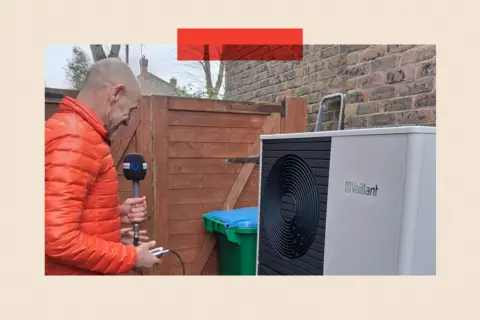
Evan Davis met the Boyntons whose heat pump works by cycling refrigerant through a loop, going from hot to cold and gas to liquid to generate heat
I still find it hard to get my head around the fact that you can take heat out of the air at -5C, to help warm water up to 50C.
So was the reduction in energy use that I'd seen at Emily and Stephen's house normal? Answer: yes, according to Richard Fitton, professor of building performance at the University of Salford.
He works at "Energy House 2", a laboratory at the University of Salford that contains new-build homes inside a huge, sealed, temperature-controlled warehouse. Their aim is to test different heating methods, including heat pumps. The houses even come furnished. Walking around is a pretty weird experience, like something from The Truman Show.
But the laboratory conditions mean they can test heat pumps accurately, measuring the exact energy in and the heat coming out.
"You're literally putting in one unit of energy, one kilowatt hour, and getting three out," Fitton tells me.
Gas wouldn't even be one out, for each unit put in. You can't repeat it enough: it's a transformation in energy efficiency.
There is an issue though.
As Fitton points out, for heat pumps to perform at their best, they need to operate at a low-ish temperature. Whereas a gas boiler might heat water to 70C to run round your radiators, heat pumps work better at 45C. And if your radiator is offering just that gentle warmth, you might find you need to expand your radiators, to get the room comfortable.
Dale Vince, owner of the electricity firm Ecotricity, puts it bluntly. He's used a heat pump for 20 years, but thinks companies need to be honest about their limitations. "The typical experience is coloured by the fact that heat pumps make colder water than gas boilers, and if you don't change your radiators your house will be cold," he says.
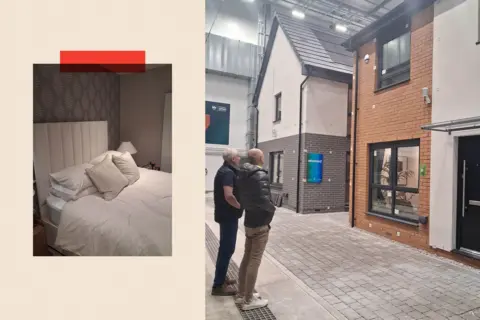
Evan visited "Energy House 2" at the University of Salford, a climate-controlled, "Truman Show-like" environment to test heat pumps
Faced with a chilly house, some users might then dial up the power on their heat pump - but if you do that, much of the efficiency advantage fritters away, he says.
Add to that, if your home is badly insulated, you'll need a lot of heat pump and a lot of radiator to prevent you losing heat as fast as the heat pump is making it.
There is a debate about whether a good heat pump really does lose that much efficiency, but it is generally best to think of the technology as offering a different, slower form of heating. With gas or oil, you can heat up a room very quickly. You might go out to work and let the house cool down; then return home and fire up the furnace. Not with a heat pump. It heats the room up too slowly, so you keep it running at a steady temperature.
"We don't touch it, and we don't think about it, which sounds bizarre," says Emily Boynton. "It just sits there, and the house is warm enough."
Remember that phrase, warm enough. On a cold day, a well configured heat pump system will keep you warm, but by my experience at least, it is unlikely to make the house toastie. If you want to be hot hot, you're perhaps best off getting some other additional top-up device for occasional use.
The right choice for Britain?
When it comes to whether heat pumps make sense as a wider national strategy, the big challenge comes down to some basic maths.
A really well-configured heat pump might use a quarter of the energy of its gas boiler equivalent. But in the UK, the cost of electricity per kilowatt hour is about four times that of gas. These are broad-brush figures, but how do you make heat pumps pay, given their generally higher up-front cost?
For a mass market in heat pumps to take off, electricity can be more expensive than gas, but not that much more expensive.
Now in France, it is different. At my French home, I pay about 18p per kWh most of the day for electricity (and less by night). In London, on my latest bill, I pay 28p per. That 10p difference is crucial.
Greg Jackson, the chief executive of Octopus - the biggest retail energy supplier in Britain and the biggest vendor of heat pumps too - is enthusiastic about the technology. "[We install] around 1,000 a month, typically," he says. "There's still quite a lot of policy barriers, but people who get them are very, very happy."
But he accepts the "crazy high" price of UK electricity is a problem. "In the UK, currently, electricity is about four and a bit times more expensive than gas. In Germany, it's three times, in France it's just over twice as expensive as gas. And in Scandinavia, it's in places almost at parity," he says.
"It's bad for heat pumps, it's not great for electric vehicles, and it's terrible for industry."
He points out that you can often save money by putting yourself on a better tariff and doing most of your heating off-peak.
Despite all the problems, he still broadly thinks Britain needs to embrace heat pumps. "The technologies of fossil fuels are mature - they're not getting any better," he says. "But the technology of electrification… is improving exponentially. If you lock your way into a fossil fuel world now, then in 10 or 20 years you'll truly regret it. Electrification gives us more energy security, and it's getting better all the time."
There's also the question of our national energy resilience - something particularly pertinent this weekend, amid surging European gas prices triggered by the Iran conflict. The truth is that heat pumps won't do much to boost our energy stability any time soon, because so much of our electricity is currently made from gas. But in the long term, if we can eventually wean ourselves off gas (and onto renewables and nuclear), then heat pumps will make us less dependent on turbulent international energy markets.
And this gets to a bigger question about the UK's net zero ambitions.
Obviously if you don't care about net zero, there's no problem to deal with. We just burn gas as long as we can - a version of US President Donald Trump's "drill, baby, drill" approach.
But if the government is serious about replacing the fossil fuels that dominate our national energy use - as they say they are - we will have to find a way of electrifying most of our heating and driving. And at the moment we have not really found a way of making that happen naturally.
Heat pumps will have to be a big part of that transition - and we'll need to find a way of making the sums add up, so it makes financial sense to an average consumer to buy one.
In fact, the high price of electricity is arguably a reason we do need heat pumps (if we're aiming for net zero), because we're unlikely to find another form of electrical home heating that uses less.
But like that transition from horse to car in the early 20th Century, it certainly won't be easy.

BBC InDepth is the home on the website and app for the best analysis, with fresh perspectives that challenge assumptions and deep reporting on the biggest issues of the day. Emma Barnett and John Simpson bring their pick of the most thought-provoking deep reads and analysis, every Saturday. Sign up for the newsletter here