
Kevin PeltonFeb 4, 2026, 09:15 AM ET
- Co-author, Pro Basketball Prospectus series
- Formerly a consultant with the Indiana Pacers
- Developed WARP rating and SCHOENE system
Though there's a long way to go before the WNBA and its players association reach a deal for a new collective bargaining agreement, after months of contentious negotiations, one thing seems certain:
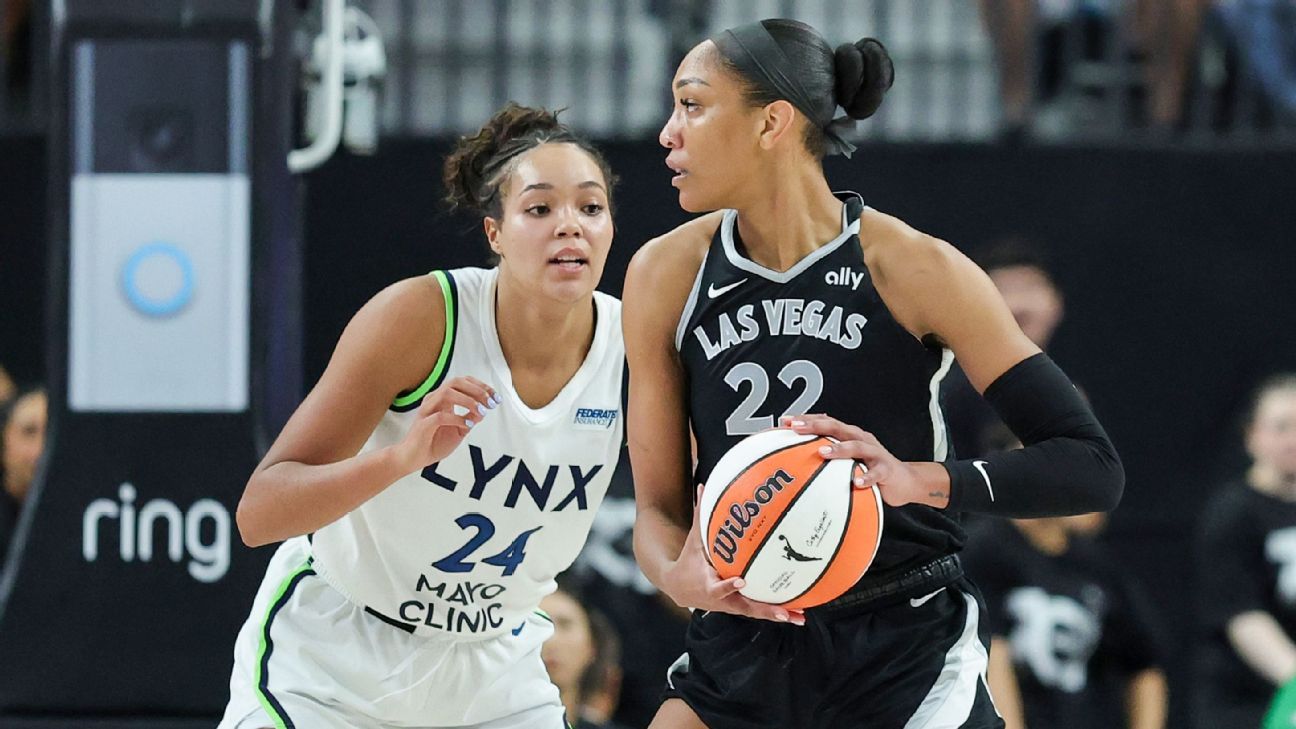
For the first time in WNBA history, a player will make a $1 million salary in 2026.
The league's most recent proposal calls for a $5 million salary cap -- a massive 230% increase -- that will produce some of the largest contracts for American women's professional athletes across any sport.
A proposed 20% max salary for individual players would produce base salaries up to $1 million, with additional escalators based on league revenue that the WNBA estimates would bring their full value to $1.3 million.
And those numbers could continue to climb. Negotiations are ongoing, with revenue share still a major sticking point between the two sides. But if a $5 million cap is the baseline, the increased salaries that will come along with it will be one of the key triumphs of this CBA.
With that in mind, let's take a closer look at the history of the WNBA and other leagues -- including the NBA, which owns and oversees the WNBA, and soccer's NWSL -- to put those increases into context, as well as understand why players still don't think they're being offered what they deserve.

WNBA salary cap history
Although the WNBA is heading toward its 30th season, the league only adopted a salary cap in 2003 as part of protracted negotiations on the league's second CBA. Before that deal, the league signed players to their contracts. From that point, individual teams agreed to contracts as part of the introduction of free agency.
The first salary cap was $622,000 per team, which the WNBA projects will be barely more than the average player makes in 2026 under its proposal. Getting there, however, took years of slow progress. The 2003 CBA defined annual increases of 4%, while a new CBA signed with little fanfare in 2008 increased it 6% that season and either 3% or 4% in subsequent years. By 2014, the WNBA had stagnated financially -- the salary cap actually went backward at the start of a new deal and grew just 2% annually. In 2019, the WNBA's salary cap was still less than $1,000,000.
That changed substantially in the most recent CBA, agreed to in January 2020. The cap jumped 30%, far and away the biggest single-season increase in league history to that point, though it went up just 3% each year of that deal. A revenue sharing component based on cumulative league revenue -- the target of which was based on the 2019 season -- never triggered, in large part because the WNBA went without ticket sales during the 2020 campaign, playing on a bubble campus due to the COVID-19 pandemic, and played in front of reduced crowds in many markets to start 2021.
In that context, the massive jump in the WNBA salary cap in this agreement is really a matter of catching up to the league's growth. In 2025, the WNBA broke its single-season attendance record, previously set in 2002 when there were 16 teams. Beyond that, new national TV deals set to begin in 2026 and signed jointly with the NBA's current deal will bring in more than $200 million in annual revenue before counting WNBA-specific deals with Versant and ION, an eightfold increase from what had been reported in 2019 when the previous CBA was negotiated.
The first $1 million WNBA salary
The WNBA has had a max salary since its inaugural CBA, albeit with the proportion of the cap changing dramatically over that span.
Initially, the max salary of $85,000 was set at 13.7% of the cap in 2003, but raises failed to keep pace. By the end of the 2008-13 CBA, the players' max was less than 12% of the cap, a limit that stayed in place through 2019. This made WNBA superstars easily the best value in sports. It also compressed pay scales for veterans -- a large percentage of the league's starters who had reached free agency made the max.
That changed in the current CBA, which elevated the WNBA's so-called "supermax" for qualifying players -- those who re-signed with their own team or changed teams via sign-and-trade -- to 16.5% of the cap. In the current proposal, max salaries stand to increase even more: The supermax would make up 20% of the cap going forward.
By comparison to the NBA's maximum salaries (which run from 25% to 35% of the cap, based on years of service), that seems paltry. But it's important to remember that the NBA has a soft salary cap as compared to the WNBA's hard one, meaning most teams exceed it. WNBA teams can only go over the cap in hardship situations.
The NBA's luxury tax line is a more appropriate point of reference. On average, NBA teams typically spend a similar percentage of the tax amount as the WNBA does the hard salary cap. The WNBA's 20% max would be equivalent to about 24% of the NBA luxury tax line, similar to the max for players with six years or fewer experience. (That's still not close to the most experienced, highest-paid players.)
One other notable comparison between the leagues is the spread between maximum and minimum. The NBA's ratio is a whopping 42.5:1 for the highest-paid players and the lowest. With the WNBA's most recent proposal, the ratio of max salary to minimum salary will be around 5:1. That's certainly higher than it once was (prior to the 2020 CBA, the WNBA's highest salaries were less than three times the smallest) but nowhere close to the NBA.
It's worth remembering that the NBA's salary cap wasn't introduced until the league had played longer (nearly four decades, starting with the forerunner BAA) than the WNBA has now. It has continued to evolve over decades. The WNBA's finances continue to make progress, and the results of these CBA negotiations will mark the biggest step forward yet.
Comparison to other leagues
Earlier this winter, soccer's NWSL beat the WNBA to the first $1 million salaries for women in American pro team sports. Sophia Wilson of the Portland Thorns became the first when she exercised a player option for 2026 in December. The NWSL approved a "high impact player" rule this offseason to help teams exceed the $3.5 million cap to pay stars more after several of the league's top players left for higher salaries in Europe. Trinity Rodman of the Washington Spirit was the first player to take advantage of that rule, signing a deal worth more than $2 million annually that makes her the highest-paid women's soccer star globally, her agent Mike Senkowski told ESPN.
WNBA salaries under the current proposal wouldn't get that high despite a larger salary cap than the NWSL because of the league's maximum salary, but player salaries crossing that threshold will be important symbolically nonetheless.
Athletes in men's team sports first began making in excess of $1 million a year in the late 1970s, after the advent of free agency but prior to the NBA salary cap. NBA stars Moses Malone and Bill Walton reached the mark in 1979-80, at the same time as Nolan Ryan became the MLB's first million-dollar player.
The modern history of the NBA salary cap starts in 1984-85, when it was introduced for the first time and set at $3.6 million. That came amid rapid growth of the league spurred by stars Larry Bird, Magic Johnson and Michael Jordan as well as the arrival of cable television as a source of revenue. Since then, the largest relative single-season jump in the NBA's salary cap came in 1995-96, when a new CBA produced a 44% increase. The 2016 cap spike that allowed the Golden State Warriors to add Kevin Durant and form a super team translated to a smaller increase, 34.5%, though at $24.1 million, it was easily the biggest change in dollar terms.
The big difference between the NBA in the 1980s and the WNBA over the previous CBA is that the league's revenue sharing model, which defines the cap as a percentage of so-called "basketball-related income," allowed rapid growth in successive seasons. So from 1984-85 through 1990-91, the first year of the NBA on NBC, the salary cap collectively grew 230%, nearly identical to what the WNBA's current proposal would provide relative to 2025.
The WNBA's proposal would introduce a model similar to the NBA, where players get 50% of net revenue after subtracting expenses. The big difference is that fixed costs like travel, support personnel and arena rent make up a higher percentage of income in the WNBA than the NBA.
As a result, the WNBPA estimates that the WNBA's proposal would provide them less than 15% of gross revenue. The WNBPA has countered with a proposal calling for 30% of gross revenues before considering expenses. The WNBA projects that would result in $700 million in operating losses over the course of the new CBA. Players counter by noting that those losses would be made up for by revenue from expansion fees with Cleveland, Detroit and Philadelphia set to enter the league by 2030.
Like their major pro sports counterparts, WNBA owners have benefited from skyrocketing team valuations over the course of the current CBA. Those have escalated many multiples beyond the relative amount that player salary will increase. For most of the WNBA's history, $10 million was the official sale price for franchises, and far less cash actually changed hands. In May, the New York Liberty sold minority shares at a $450 million valuation, representing approximately a 4,400% jump.