 3 months ago
151
3 months ago
151
David CowanScotland home affairs correspondent

 BBC
BBC
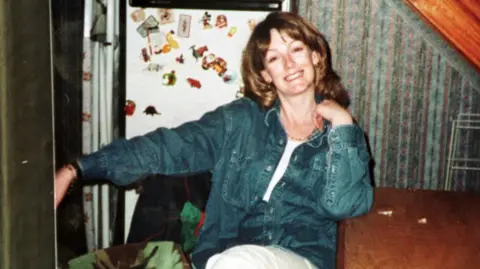
Arlene Fraser's family and friends said her disappearance was out of character
When Arlene Fraser vanished without trace after waving her young children off to school, detectives had a suspect with a motive - but precious little else.
Her husband Nat was a jealous and violent man who had been accused of attempting to murder Arlene just five weeks earlier.
Their marriage was on the rocks, and on the day she went missing Arlene had been due to meet a solicitor to discuss a £250,000 divorce.
But when police started to investigate, they found what one officer described as "a daunting absence of clues".
No crime scene, no signs of a disturbance, no forensics, no eye witnesses, no CCTV.
Arlene's empty bungalow in Elgin, in the north of Scotland, was compared to the Mary Celeste.
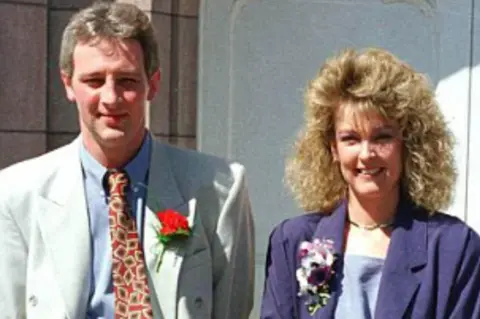
Arlene had been due to meet a solicitor to discuss a divorce
The house was unlocked, the ironing board was out, the hoover plugged in, washing was hanging on the line outside, the medication she needed for Crohn's disease had been left behind.
Her family and friends said her disappearance was completely out of character; she wasn't the kind of person who would abandon her much-loved kids and leave home.
Almost 30 years on, Arlene's body has never been found.
Nat Fraser was twice found guilty of her murder during a tortuous 14-year legal process, and will soon become eligible for release from prison.
Arlene's family hope a new law will prevent him being given parole unless he finally says what happened to his wife's body.
Carol Gillies: 'This is the final chance... before the truth is gone forever'
The last time anyone heard from Arlene was at 09:41 on 28 April 1998, when she phoned her children's school to ask when her son would be back from a trip.
At 02:00 the next morning, police told her sister Carol Gillies that the 33-year-old was missing.
"That's where the nightmare began," she tells a new BBC documentary, Murder Case: The Hunt for Arlene Fraser's Killer.
"I lived in Erskine at the time. It's a 200-mile journey.
"I literally could not speak. The words just wouldn't come out."
Police soon focussed on Nat Fraser – but the inquiry ran into two major problems.
The first was that he had a rock-solid alibi for the morning Arlene went missing.
The second was his popularity.
Looking back at the case which dominated his career, retired Det Supt Alan Smith says fruit and veg wholesaler Fraser was a jack-the-lad with no shortage of friends in the Moray town.
Many locals refused to countenance the possibility that he had anything to do with Arlene's disappearance, preferring instead to believe that a mum who doted on her two kids had deserted them to start a new life elsewhere.
"He was feeding a narrative, as were his close circle of friends, that she had simply upped stick and gone missing," said Smith.
"In many ways he was playing the victim and portraying her as a villain.
"Typically, if you've got a murder investigation, people are queuing up to help you. We were getting doors slammed in our face."
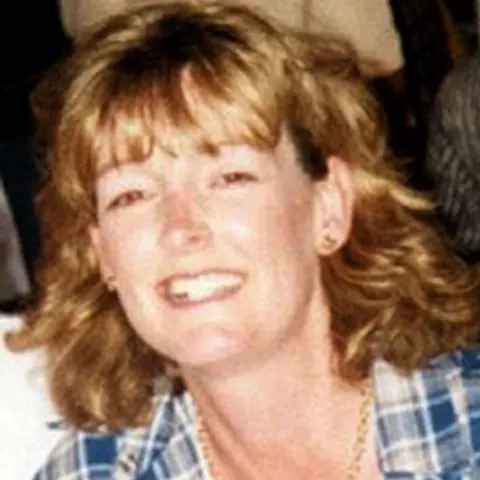
Arlene was last seen waving her young children off to school
After a nervous and gray-faced Fraser appeared at a news conference, woodenly appealing for Arlene to get in touch, detectives spent the best part of a year finding the evidence which proved she was no longer alive.
A breakthrough came when police learned one of Fraser's closest friends, Hector Dick, had bought a Ford Fiesta the night before Arlene went missing, paying the seller £400 for the car and £50 to keep quiet.
Arlene's own car had been destroyed in a suspicious fire weeks earlier.
Dick ultimately pled guilty to perverting the course of justice and was jailed, but at the time stayed silent about the car and any link with Arlene.
Fraser followed him to prison after admitting a reduced charge of assaulting Arlene to the danger of her life, a decision which neutralised the single most compelling piece of evidence against him.
Under Scots law, a suspect's previous convictions are normally kept from juries.
 PA Media
Nat Fraser was found guilty of murder at two separate trials
Nat Fraser was tried twice over Arlene's murder, and both times the jury could not be told that he had attacked her just before she vanished.
"If you have got evidence of a previous assault which shouts out motive and gives the jury a complete understanding of why he might want to kill his wife, of course it's massively frustrating that you can't take that in front of the jury," said Smith.
"But it's important that Scots law has that protection for the innocent until proven guilty."
In the end, it didn't make any difference.
Each time Nat Fraser faced a jury over Arlene's murder, they believed the case against him had been proved beyond reasonable doubt; he had orchestrated his wife's murder.
The first trial in 2003 saw Hector Dick give evidence against Fraser. He claimed Fraser told him he paid a hitman to kill Arlene, and then burnt and scattered her remains.
Dick said he had bought the Fiesta for Fraser, then scrapped it afterwards.
 PA Media
Hector Dick claimed Fraser had told him he paid a hitman to kill Arlene
A centrepiece of the prosecution case concerned the mysterious reappearance of Arlene's gold eternity ring, diamond and gold wedding ring, and a sapphire engagement ring.
A member of the family said she found them in the bathroom in Arlene's home, eight days after she went missing. They had not been there before.
Nat Fraser had been in the house that day. The implication was that he had placed them in the bathroom.
Fraser was found guilty and jailed for life, only for the UK Supreme Court to rule in 2011 that his trial had been unfair, a decision which enraged the then First Minister Alex Salmond.
Fraser was convicted a second time in 2012 and handed another life sentence, with a minimum 17-year jail term.
 Getty Images
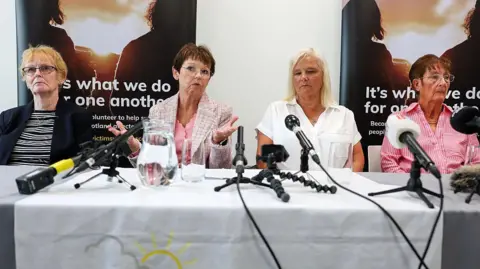
The families of Arlene Fraser and Suzanne Pilley campaigned for changes to the law
When he comes up for parole in October 2028, at the age of 69, Fraser will face a new obstacle in his bid for freedom.
Suzanne's Law is named after Edinburgh book-keeper Suzanne Pilley, who disappeared in 2010 after breaking off an affair with a work colleague.
Last year, the Scottish Parliament passed legislation which means the parole board must take into account a murderer's refusal to reveal what became of their victim's body.
Alan Smith stayed in touch with Arlene's family long after the court process came to an end.
He would like to see killers like Fraser serve a consecutive jail term for hiding their victims' remains, once their life sentence has been completed.
 Sean De Francesco/Firecrest Films
Alan Smith says the new legislation could be a legacy for Arlene
Failing that, he hopes Suzanne's Law will delay Fraser's release for years.
"I've seen the torture that Arlene's family have had to endure through Nat's choice not to give up her body," he says.
"He could do that tomorrow if he wished and of course the motivation in this murder investigation was obvious to me - it was control.
"The final piece of control that Nat has, is giving up that 28-year secret as to where Arlene is now.
"I doubt he will ever give up that secret, knowing how the man ticks, and this legislation may not unlock that secret.
"The family know that, but they want the legislation for future cases. That could be a form of legacy for Arlene."
Carol Gilles said she had thought long and hard before deciding to take part in the documentary.
"It certainly is not something I enjoy or particularly want to do, and I am sure other participants may have felt the same, but we all see this as an opportunity to raise public awareness on important matters," she said.
 Sean De Francesco/Firecrest Films
Carol Gillies has described Fraser's refusal to say what happened to Arlene as a form of mental torture
"I believe part of Nat Fraser's plan was that people would soon forget about Arlene.
"I feel he is counting on us tiring or giving up, but until Arlene's remains are located, I see it as my responsibility to ensure that Arlene is never forgotten."
Carol has described Fraser's refusal to reveal what happened to Arlene as a form of mental torture.
"You spend the whole time just trying to think of a way to get Arlene back, and Nat's the only one that knows.
"The clock is ticking with us because of Nat Fraser's parole date."
She says Suzanne's Law gives Nat Fraser a choice.
"Tell us where her remains are, or go back to your cell.
"It's the final chance of getting to the truth, because if the parole board can't do anything to help us, then he'll get out and the truth will be gone forever."