 2 months ago
93
2 months ago
93

 Getty Images
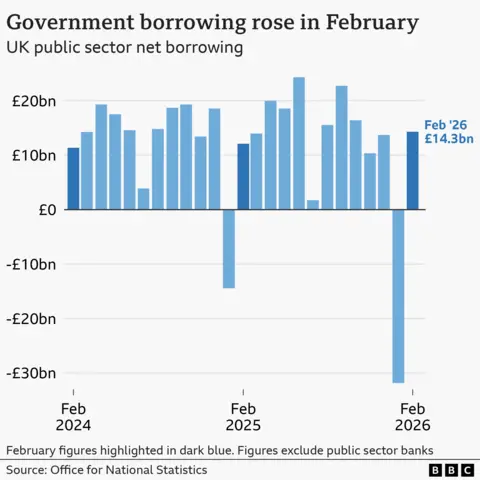
UK government borrowing rose unexpectedly to £14.3bn in February to the second highest level for that month since records began, official figures show.
The Office for National Statistics (ONS) said borrowing was £2.2bn higher than in February last year and much higher than the £8.8bn economists had expected it to be.
An increase in government tax receipts was outweighed by a rise in spending and the timing of government debt interest payments, the ONS said.
However, across the 11 months of the financial year to February, government borrowing was down.
The figures, which measure the difference between total public sector spending and tax income, is for the month before the start of the US-Israel war with Iran.
Ruth Gregory, deputy chief UK economist, at Capital Economics said: "We doubt there is scope for a large-scale fiscal support package like that seen in 2022, even in more extreme scenarios in which the conflict in the Middle East escalates further."
The Treasury said it had the "right economic plan" and added "we are better prepared for a more volatile world".
Nabil Taleb, economist at PwC UK, said the increase in borrowing for February "partly reflects the timing of payments, with some interest due at the end of January falling into February because of the intervening weekend".
The leap to the second highest borrowing for February on record, a number not adjusted for inflation, is a sharp change from the record surplus in January.
Lindsay James, investment strategist at Quilter, said the about-turn in public sector finances was "largely due to record levels of interest payable, highlighting the sheer scale of debt interest the government is now facing".
She said there were some "glimmers of hope that government borrowing was beginning to be reined in as tax rises helped to create the largest January surplus on record".
"The latest data out this morning, however, has put a swift end to that picture," James said.
The ONS provisionally estimated debt to be at 93.1% of the size of the UK economy at the end of February 2026, which means it remains at levels last seen in the early 1960s.