 2 months ago
80
2 months ago
80
Jonathan Head,South East Asia correspondent, Bangkokand Sen Nguyen,Bangkok

 VIETNAM NEWS AGENCY/HANDOUT/EPA/Shutterstock
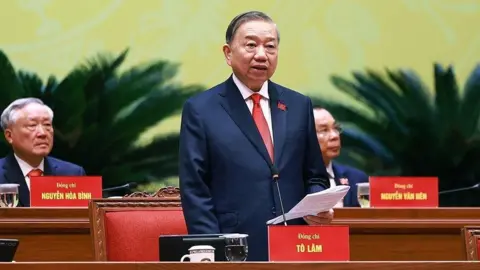
To Lam will lead the party and country for the next five years
Welcome to the new era of "national rise"!
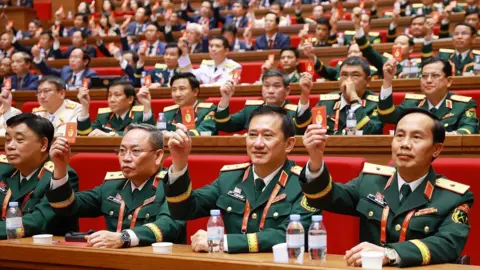
That was the pitch made by Vietnam's most powerful figure, Communist Party General Secretary To Lam, as he faced the nearly 1,600 delegates at the party congress, which gathered this week to determine the country's path for the next five years, and who leads it.
On Friday it picked To Lam Vietnam to be party chief, the post he currently holds, for the next five years, giving him another term to achieve his ambitious targets for Vietnam's economy.
The party congress, which was scheduled to end on Sunday, was cut short to Friday, signalling either a strong consensus or stifled opposition to To Lam's growing powers.
Communist Party congresses are strictly choreographed, and most of the leadership positions in the Politburo and the larger Central Committee are worked out behind closed doors well in advance.
To Lam's re-appointment to the top job was widely expected, but what remains to be seen is how this plays out in the congress, whose balance reflects the long-standing rivalry between To Lam's public security faction and the military.
What makes the congress this year "unusual" is that "this is the strongest concentration of power in one individual that I've seen since 1991", Edmund Malesky, a professor of political economy at Duke University, told the BBC.
 EPA
EPA
Some 1,600 communist party delegates met this week to choose new leaders
Dramatic change of direction
To Lam took over 18 months ago on the death of his predecessor Nguyen Phu Trong, an old-style communist ideologue who had presided over a sweeping and disruptive anti-corruption drive.
As head of Vietnam's main security agency, the Ministry of Public Security, To Lam had led the purge of officials tainted by corruption allegations, but after he got the top job he announced a dramatic change of direction.
The new focus was on reform, and growth, and To Lam's plans were the boldest the country had seen for 40 years. First, he announced a complete overhaul of Vietnam's administration, slashing layers of bureaucracy, cutting the number of provinces from 63 to 34, and laying off more than 100,000 government employees.
Then came Resolution 68, passed on 4 May last year at a meeting of the politburo, the highest decision-making body between party congresses.
In another country, its statement that the private sector will be "the most important driving force of the national economy" would be unremarkable. It was a barely noticeable change from the government's previous stance that it was "one important driving force".
But in officially socialist Vietnam it marked a sea change, for the first time putting privately-owned businesses on the same level as state-run companies, which in the past had always been extolled as the bedrock of the economy.
The meeting in May also announced breathtakingly ambitious targets for the economy: double digit annual growth, doubling the number of private businesses by 2030, and by 2045, the centenary of Vietnam's declaration of independence from French colonial rule, to have created an upper-income, knowledge- and technology-based economy.
In other words, to break out of the so-called "middle income trap". No other large South East Asian country has managed to do this.
Leading 'cranes' v 'geese'
A central part of his strategy is to back national champions in the private sector – "leading cranes" in the party's words – companies big enough to compete on the global stage. In the last Fortune 500 list of top companies in South East Asia only eight of the 100 largest were Vietnamese, and of those only half were privately-owned.
Most private companies are very small; only 2% employ more than 200 people. To Lam's goal is to have 20 globally competitive private companies by 2030, following the South Korean model in the 1970s of state-supported conglomerates known as chaebol, which led to the creation of global giants like Hyundai and Samsung.
Vietnam's astonishing economic progress over the past 30 years has won it admiration around the world. Its record in poverty reduction is formidable. It turned an isolated, state-run economy which could barely feed its people into one of the world's manufacturing powerhouses. Yet behind these impressive achievements are some big limitations.
One is the size of the state-owned sector. Even today, after all this frenetic change and growth, there are 671 state-owned enterprises accounting for 29% of Vietnam's GDP. Their advantages, getting preferential access to licences, government funding and resources like land make it difficult for private companies to compete and thrive.
Even after Resolution 68 appeared to put them in second place, a new Resolution, number 79, was passed earlier this month, presumably after pushback by conservatives inside the party.
 Getty Images
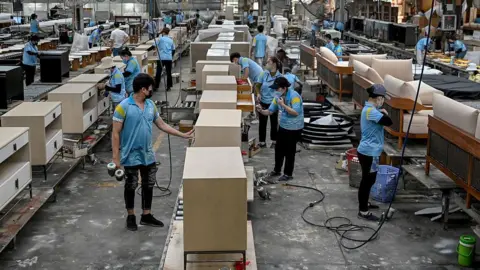
Vietnam's economy is fuelled by export-led manufacturing, which makes it especially vulnerable to Trump's tariffs
This stated that state-owned enterprises could also be "leading geese", and proposed the startlingly ambitious target of seeing 50 from Vietnam reaching the Fortune 500 list for the region by 2030. So much for boosting the private sector.
Another is the dependence of many Vietnamese industries on foreign investment, foreign technology and overseas markets. Vietnam has become an efficient, low-cost manufacturer of other countries' products.
To Lam himself spoke of this in January last year: "What percentage of the value do we contribute here? Or are we at the lowest end of the value chain, mainly doing outsourcing for foreign companies? If a shirt is sold with the design, fabric, dye, thread and buttons all sourced from someone else, what do we get? Perhaps only labour costs and environmental pollution."
In fact the largest manufacturing company there is South Korean, Samsung, and it relies heavily on imported components and technology to make its phones and other electronic goods.
This is the challenge faced by most South East Asian countries. Like Vietnam, they saw their economies grow at breakneck speeds as they joined an increasingly complex global supply chain from the 1980s onwards. Poverty fell as people moved to the cities to take up low-end manufacturing jobs.
Yet today countries like Thailand, Malaysia and Indonesia are stuck, seemingly unable to move up the value chain and break out of economies dependent on natural resources and manufacturing components for foreign products.
Growth is stagnating, and in Thailand the population is aging quickly. Their largest home-grown companies are in banking, property, energy, telecoms and food. There is no Thai, Malaysian or Indonesian tech giant on the horizon.
Could Vietnam be different?
It does have one impressive tech company, FPT, which is now winning contracts with clients like Airbus and several large car manufacturers to help manage and upgrade software.
It is reporting revenue of more than $1bn a year, employs 80,000 people across 30 countries and has even built its own university to ensure it has enough graduates with coding and English-language skills to call on. FPT is one of the "leading cranes" To Lam is hoping will take Vietnam out of the middle income trap.
Yet FPT is dwarfed by the biggest of the "leading cranes", Vingroup, Vietnam's largest private company, which is much more like the traditional, family-owned conglomerates that dominate the economies of other South East Asian countries.
Vingroup is massive. There are Vin homes, Vin hospitals, Vin schools and universities, Vin resorts and amusement parks, Vin solar farms. Vingroup builds expressways, and was the main bidder to build a new high-speed 1,500km (930-mile) railway from Hanoi to Ho Chi Minh City, until it pulled out last month.
Then there is Vinfast, the company taking on China to build world-beating electric cars. So far its attempts to break into the US and European markets have been a flop, with its models dismissed as inferior to their competitors.
Vinfast is thought to have lost as much as $11bn since 2021, but Vingroup is so big, its founder Pham Nhat Vuong so rich, it is willing to keep subsidising its EV experiment.
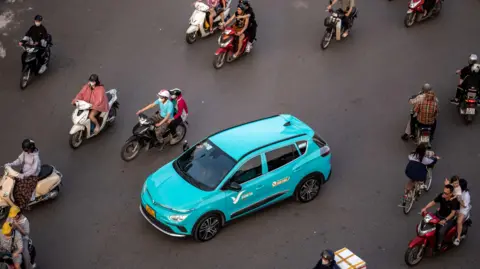
Vinfast does well at home, thanks to political support from the Communist Party, like the recent ban on all combustion-engined motorbikes in Hanoi and Ho Chi Minh City - Vinfast is the dominant player in electric two-wheelers.
 Getty Images
Although Vinfast cars are yet to break into US or European markets, they are popular in Vietnam
Vingroup will be the biggest of the national champions under To Lam's grand project. But it has so far done well only in its home market, where its political connections have given it significant advantages. As it has discovered with its cars, succeeding as a global player is much harder.
"The main challenge remains unchanged: how to create globally competitive firms without spawning politically-connected rent-seekers", says Nguyen Khac Giang at the ISEAS – Yusof Ishak Institute in Singapore. "
"To Lam's approach risks replacing one form of rent-seeking with another. If poorly executed, Vietnam could transition from inefficient state-owned enterprises extracting resources through monopoly positions, to private conglomerates doing the same through political connections. This would crowd out the small-medium enterprises that generate the most employment and innovation."
No-one doubts the extraordinary drive and industriousness of the Vietnamese people, nor To Lam's determination to break out of the middle income trap.
Without urgent reform we should expect failure, he said in June last year. Yet he is embarking on this journey at an especially difficult time.
No other South East Asian country is as reliant as Vietnam on access to the US market, which is now uncertain after President Donald Trump's tariffs.
Vietnam's famous "bamboo diplomacy", attempting to be friends to all, enemies to none, will also be sorely tested in the fraught international relations of the Trump II era.