
Ryan O'HanlonDec 12, 2025, 06:00 AM ET
- Ryan O'Hanlon is a staff writer for ESPN.com. He's also the author of "Net Gains: Inside the Beautiful Game's Analytics Revolution."
The U.S. men's national team, it seems, is back to a good place.
The Nations League and Gold Cup eliminations for the U.S. have faded into the past. There's no more feuding between the team's best players and the manager. The Americans are undefeated in five matches, all against World Cup-qualified opposition. They've outscored those opponents 12-4, and there finally seems to be a plan: either a clear back three or a back four that morphs into a back three because one of the fullbacks is more of a center back. It's similar to what Mauricio Pochettino did in his one year at Chelsea, and it has coincided in an uptick in both performances and results for the World Cup co-hosts.
But what about the broader player pool? Pochettino has done a fantastic job of expanding it -- there's a much bigger collection of players who seem capable of contributing than there was a year ago. But a national team manager can only have a minor impact on the true quality of the players at his disposal. We learn a lot more about them when they're at their day jobs: playing for club teams.
So with the European season fast approaching its midway point and the MLS just recently wrapped, it's time for one last edition of the USMNT Player Performance Index before the end of 2025.
What is the USMNT PPI and how does this ranking work?
For the unfamiliar or forgetful, this is our way of trying to rank the performance of every American professional soccer player in the world. I use the word "trying" because it's not perfect -- ranking soccer players, especially across multiple competitive contexts, is impossible -- but it's useful.
To come up with the rankings, we use a combination of talent, playing time, team quality and ... that's it. Simple, but effective.
For talent: The metric is Transfermarkt's estimated market value for every player. This isn't a one-to-one match for talent, but it's close enough, and having it as part of the input ensures that the rankings don't stray too far from what the world thinks of a given player.
For playing time: We simply take the percentage of available minutes each player has played for his team in their domestic league.
For team quality: We use Opta's power rankings, which rate every professional club team in the world. These ratings aren't perfect either -- MLS teams are ranked a little too highly, for one -- but they offer a uniform way of assessing the quality of the teams every American plays for.
And so, the rankings work off a simple premise: if you're playing a lot of minutes and your team has a high rating, then you're likely contributing valuable performance to your team.
For the current edition, the market value makes up 15% of the rating, minutes played makes up 20%, and team quality makes up the remaining 65%. I've also added a 10%-of-minutes threshold, and that means Cole Campbell (1.8% of minutes for Borussia Dortmund) and Antonee Robinson (4.5% of minutes for Fulham) both miss out.
Some other notable absences: Norwich City's Josh Sargent, Orlando City's Alex Freeman, and Real Salt Lake's Diego Luna didn't make the top 50. Were I doing this more subjectively, Luna still wouldn't be in the top 50, I don't think -- he's been way better for the USMNT than in MLS over the past year. Freeman, however, would easily be top 50 because he was probably the best fullback in MLS. And Sargent also would be somewhere on the list. But none of their club teams were good enough for them to make the cut in this edition of the USMNT PPI.
Now, to the list ...
- O'Hanlon: Why Christian Pulisic is having his best season ever
- Predicting the USMNT's starting lineup at the World Cup
- How Roldan went from USMNT afterthought to Pochettino fave
 1. Chris Richards, center back, Crystal Palace
Ten years ago, Richards would've been playing for a Champions League team in Italy, Spain or Germany. Instead, he's playing 99.5% of the minutes for, well, the fourth-place team in England.
Even if you don't think Crystal Palace will be there come season's end, the team is currently rated as the 12th best in the world by Opta. Such is the financial might of the Premier League that Palace, according to these ratings, would be the second-best team in France, Italy, and Germany, while they'd be behind only Barcelona and Real Madrid in Spain.
More simply, Palace is the best team any American is currently playing for, and Richards is playing every minute of every game.
 2. Malik Tillman, attacking midfielder, Bayer Leverkusen
After a nightmare start that got Erik ten Hag fired as manager before the transfer window had even closed, Leverkusen has stabilized. After Bayern Munich, Leverkusen is battling it out with RB Leipzig and Borussia Dortmund to be the second-best team in Germany. And outside of his injuries, Tillman has been close to an automatic first-choice starter under both of his managers.
There's not really much in the way of notable statistical production on the ball -- he's making a lot of defensive plays, playing a lot of passes, completing a lot of passes, and not doing much else. But he moved for a major transfer fee over the summer, and he's starting for a Champions League-quality side. That's enough to get him to No. 2.
 3. Christian Pulisic, right winger, AC Milan
Unfortunately, Pulisic no longer qualifies for FBref's leaderboards after dipping slightly below the one-third-of-the-minutes threshold. But after his two goals earlier this week, he's now averaging 1.82 non-penalty goals+assists per 90 minutes. That's almost half a goal/assist more than Harry Kane, who leads Europe's Big Five top leagues (among qualified players) with 1.36 per 90.
 4. Tyler Adams, defensive midfielder, AFC Bournemouth
He's sort of the "is the dress blue or gold?" of U.S. fandom.
If I told you that Adams had played nearly 90% of the minutes for a good Premier League team so far this season, you probably would have one of two reactions: (1) Wow, that's such good news for the World Cup! Or (2) Oh my god, no, he's going to get hurt before the World Cup.
 5. Sergiño Dest, right back, PSV
He's first in progressive passes and second in progressive carries for a team that has beaten the defending English and Italian champs by a combined 10-3. Given Antonee Robinson's injury problems and Weston McKennie's inconsistent call-ups, it seems as if there's now a core four of close-to-irreplaceable players for the USMNT ahead of next summer: Richards, Pulisic, Adams and Dest.
 6. Johnny Cardoso, central midfielder, Atletico Madrid
It started off well -- kind of. He played a lot for Atletico at the beginning of the season, but Atletico was bad to start the season. Then he stopped playing, and now Atletico is pretty much as good as it always is, again.
Since the end of August, Cardoso has played only 71 minutes for Atletico across all competitions. If you thought this move seemed like too big of a jump for a player with a solid season and a half in Spain, then nothing about the first few months of this season will have convinced you otherwise.
 7. Weston McKennie, central midfielder, Juventus
It happened again. McKennie wasn't playing for Juventus to start the season and everyone freaked out. And then his new manager eventually realized his team is better when McKennie is on the field. Despite the slow start, McKennie has played nearly two-thirds of the Serie A minutes for Igor Tudor. And as always, he's just doing a little bit of everything, everywhere:
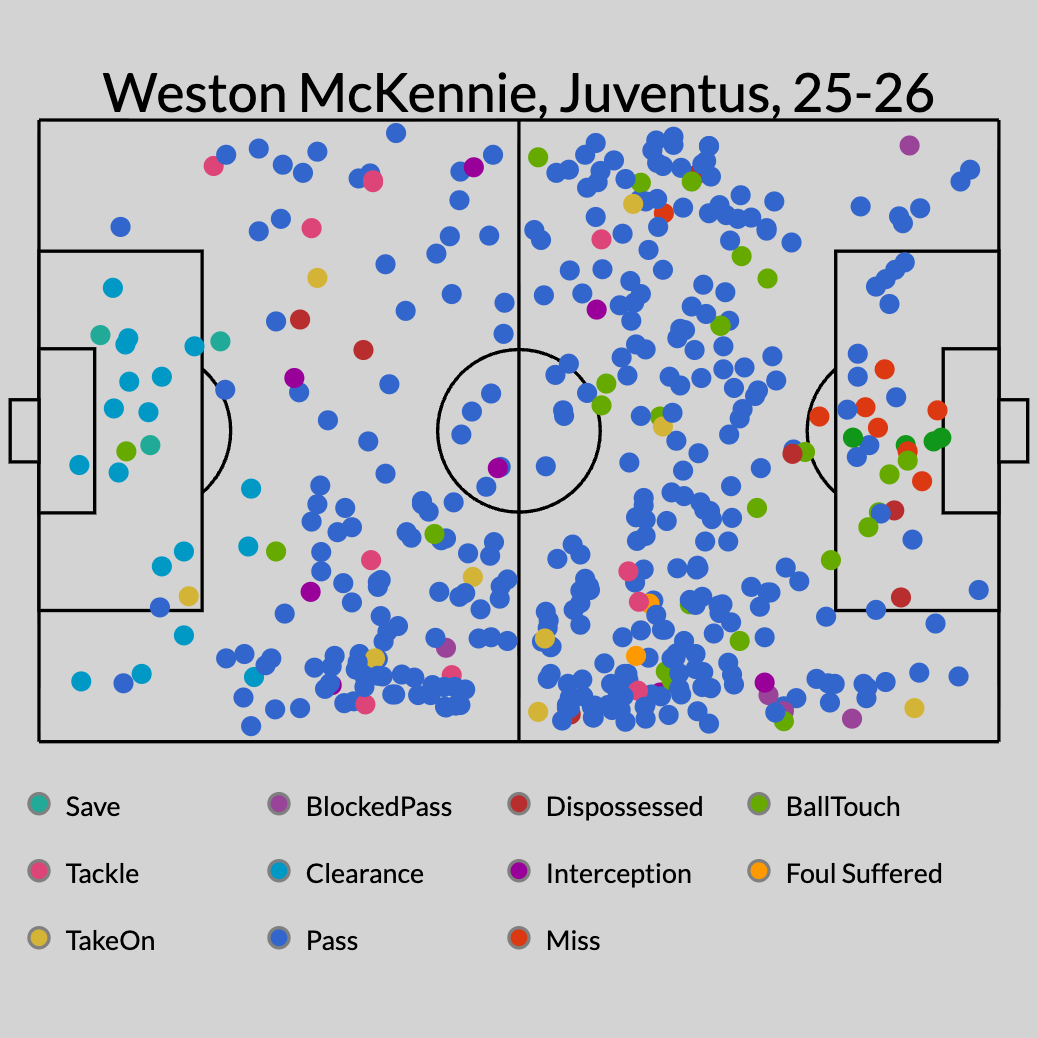
Juventus is in seventh in Serie A -- that's why he's not higher here -- but the team's expected-goal differential is second-best in Italy after Inter Milan. I'd expect Juventus to gradually rise up the table over the next few months, and the same thing should happen to McKennie the next time we do these rankings.
 8. Timothy Weah, winger, Olympique Marseille
What Weah is getting on loan at Marseille: more minutes than he got at Juventus.
What Weah is not getting on loan at Marseille: any minutes at his preferred position of wing.
Marseille could give Paris Saint-Germain a genuine title challenge this season -- its expected-goal differential is not far behind the European champs -- and that's happening mostly with a lineup in which Weah plays either as a fullback or a wingback. But that might not be as big of a problem for the U.S. as it once seemed.
No one in Europe thinks Weah is a top-class winger even though he mostly has been one of the starting wingers for the U.S. over the past half-decade. But with this new system, Pochettino has leaned more toward inside-forward types rather than pure wingers as the two players next to his striker. That doesn't suit Weah at all, so his path to a starting spot with the U.S. might be as a wingback after all.
9. Ricardo Pepi, forward, PSV
He's no longer putting up Messi-like per-minute numbers for PSV anymore -- and that's a good thing. Why? Because it means he's no longer just coming in during garbage time and pummeling Eredivisie clubs that are way worse than PSV.
Pepi still isn't first choice at PSV, but he already has 515 minutes in the league this season. Last season, he finished just south of 700.
 10. Tanner Tessmann, defensive midfield, Olympique Lyonnais
I don't think Tessmann is a future star or anything -- he's already 24 -- but he is a solid starting midfielder for a fringe Champions League team in France. Here's how he fares compared to his peers in Ligue 1, per the various grades from Gradient Sports:
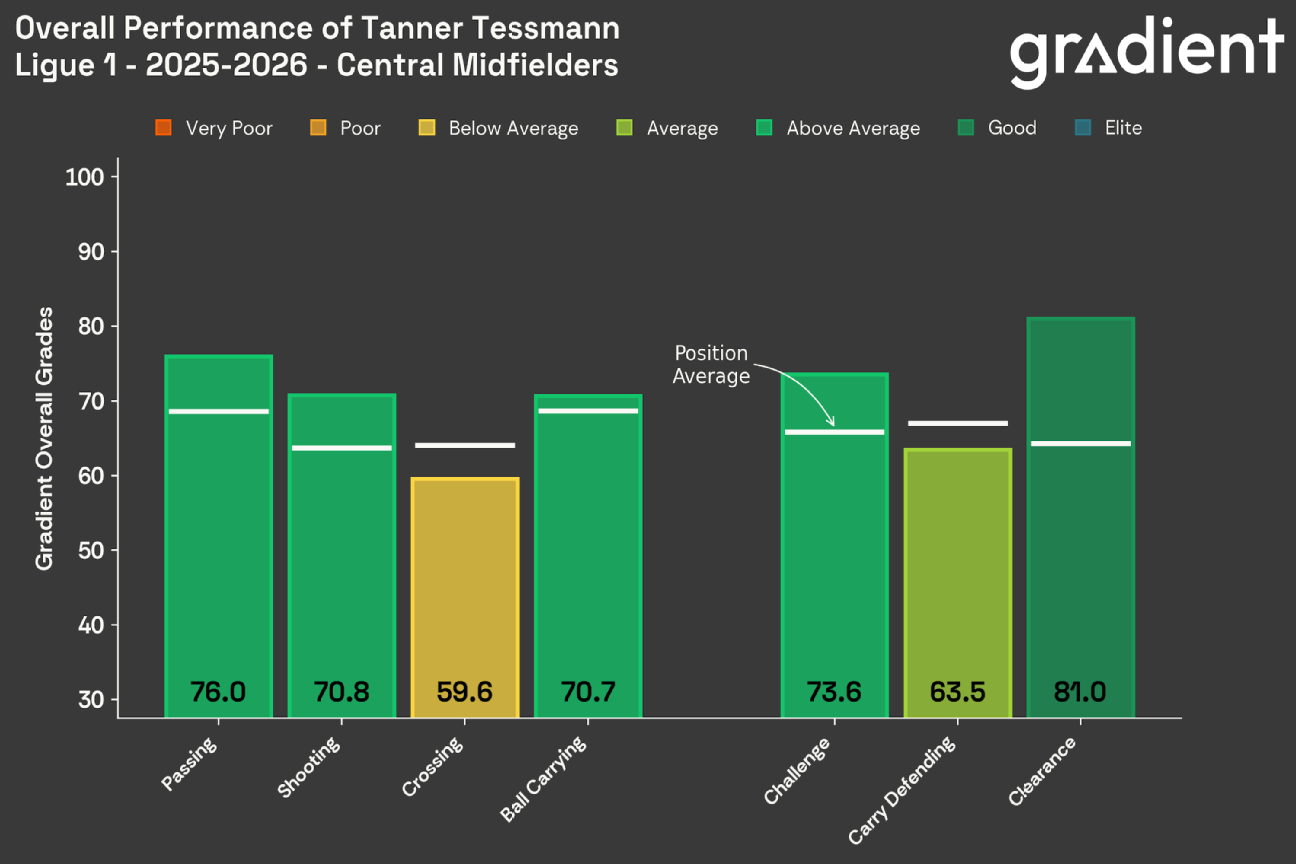
With that level of play, he should be in the mix for the starting spot in the midfield next to Adams next summer.
 11. Yunus Musah, central midfielder, Atalanta
It has been a terrible season for the two young American midfielders on Champions League clubs and Pochettino doesn't seem to like them. Musah even made this list only because he'd played 90 minutes in a match for Milan before moving to Atalanta. With his new club, he has played 60 total minutes and hasn't appeared in a league match since before Halloween.
 12. Folarin Balogun, forward, Monaco
0:38
Folarin Balogun scores in 3rd straight UCL game
Jeff Carlisle recaps Folarin Balogun's big night for Monaco in the Champions League.
 13. Brenden Aaronson, attacking midfielder, Leeds United
 14. Mark McKenzie, center back, Toulouse
 15. Haji Wright, forward, Coventry City
 16. Joe Scally, fullback, Borussia Monchengladbach
 17. Cristian Roldan, central midfielder, Seattle Sounders
I like how such a simple rating system can discover the same thing Pochettino has found out over the past couple of months: Roldan is very good at soccer.
 18. Mark Delgado, central midfield, LAFC
 19. Sebastian Berhalter, central midfield, Vancouver Whitecaps
20. Timothy Tillman, central midfield, LAFC
 21. Cameron Carter-Vickers, center back, Celtic
22. Jesús Ferreira, forward, Seattle Sounders
 23. Justin Haak, center back, New York City FC
Delgado, a midfielder, and Haak, a midfielder-turned-defender, haven't been called up by Pochettino and probably won't be any time soon, but they've both played a ton of minutes for two of the better teams in MLS. In the past, they'd probably be in the mix for one of the final few roster spots, but now this pool has guys who play for Champions League clubs such as Atletico Madrid and Atalanta and probably won't even make next summer's roster, either.
24. Ryan Hollingshead, fullback, LAFC
25. Tristan Blackmon, center back, Vancouver Whitecaps
26. Paul Rothrock, winger, Seattle Sounders
 27. Alejandro Zendejas, winger, Club America
28. Jackson Ragen, center back, Seattle Sounders
29. Matt Freese, goalkeeper, New York City FC
30. Emmanuel Sabbi, winger, Vancouver Whitecaps
31. Tate Johnson, fullback, Vancouver Whitecaps
32. Auston Trusty, center back, Celtic
 33. Brian White, forward, Vancouver Whitecaps
It's funny that perhaps one of the best MLS teams of all time that relied heavily on Americans is also the one that plays its home games in Canada. White, Sabbi, Berhalter and Blackmon combined to play all but one minute of the 3-1 MLS Cup loss to Inter Miami.
 34. Max Arfsten, wingback, Columbus Crew
 35. Kristoffer Lund, fullback, Köln
36. Nkosi Tafari, center back, LAFC
 37. Noahkai Banks, center back, Augsburg
I don't want to alarm anyone, but Banks was 18 at the beginning of the season, and he's now just a full-time starter for a team in the Bundesliga at a position that peaks later than average and typically favors older players. The main problem is that Augsburg isn't very good. In fact, the team is very bad: a minus-9.2 expected goal differential, worst in the Bundesliga. But Augsburg has been a lot better -- a roughly average side -- in the minutes when Banks has played.
It's all really promising, and if you were going to pick one out-of-nowhere player to not only make the World Cup roster, but start next summer, then Banks would be your guy. As long as he keeps playing, I'd be very surprised if he doesn't get a call-up to the next full camp.
 38. Roman Celentano, goalkeeper, FC Cincinnati
 39. Aidan Morris, central midfield, Middlesbrough
40. Sean Zawadzki, central midfield, Columbus Crew
 41. Luca Bombino, fullback, San Diego FC
42. Patrick Schulte, goalkeeper, Columbus Crew
43. Danny Musovski, forward, Seattle Sounders
44. Luca de la Torre, central midfield, San Diego FC
 45. Erik Palmer-Brown, center back, Panathinaikos
It feels as if he moved to Manchester City just last year, but he's somehow already 28 years old.
Palmer-Brown never lived up to the hype after he debuted for Sporting Kansas City as a teen, starred at the 2017 under-20 World Cup, and signed with the best club team in the world. But now he's quietly just a starter for one of the biggest clubs in Greece, where he's managed by ... (cleans off glasses in a theatrical fashion that suggests I am familiar with the meme of Tobey Maguire in "Spider-Man") ... Rafa Benitez.
46. Miles Robinson, center back, FC Cincinnati
47. Aziel Jackson, attacking midfield, Columbus Crew
 48. Lennard Maloney, defensive midfield, Mainz
 49. James Sands, defensive midfielder, St. Pauli
A quick shoutout to Sands, who recovered from a gruesome ankle break earlier in February to become one of St. Pauli's most reliable ball-winners this season.
50. Giovanni Reyna, attacking midfielder, Borussia Monchengladbach
Though he hasn't played particularly well, at least he's playing -- sometimes. Reyna has zero goals or assists through 255 league minutes for Gladbach, but he's already fewer than 100 minutes shy of his entire minutes haul with Dortmund last season.
The question for the rest of this season: Can he start playing more often? And a not-unrelated question to that: Can he start having more of an impact when he gets out there?