 3 months ago
99
3 months ago
99
Brian WheelerPolitical reporter

 PA Media
Darren Jones shows off a prototype of the government's digital ID
Cabinet Office minister Darren Jones has said the government's revamped digital ID scheme will make it easier access public services on your smartphone.
Ministers ditched plans, announced in September, to make digital ID compulsory for everyone starting a new job after a backlash from the public.
It has now been relaunched as a voluntary scheme, which Jones said could eventually allow people to do everything from managing their childcare to filling in tax returns on a "one stop" app.
He said the final shape of the system would be decided with input from the public - but the Conservatives attacked it as a "costly vanity project".
When digital ID was announced last year by Sir Keir Starmer, it was touted as a way to crack down on illegal working in the UK.
Critics - who signed a three million strong petition against the plans - were also concerned about security risks and a creeping "Big Brother" state intruding into people's lives.
Now ministers have switched to promoting digital ID, which will be held in a wallet on smartphones, as a way to make life easier for people using public services.
Jones said: "People too often dread their interactions with public services. Endless telephone calls, complicated printed forms and having to tell your story multiple times to different parts of government.
"I want to change that and make public services work for you. The new digital ID will make that possible, allowing you to log on and prove who you are to access public services more quickly, easily and securely."
He said the original intention of cracking down on illegal working still stood because digital right-to-work checks would become compulsory by the end of the current Parliament, in 2029.
But digital ID will not now be the only way of proving your identity to employers - people could choose to use other documents, such as passports or eVisas, instead.
Jones said he had taken to the unusual step of setting up a "people's panel", bringing together 100 individuals from across the country with different backgrounds to advise on the scheme.
The cost of the digital ID scheme will not be revealed until after the consultation, but Jones insisted it could save taxpayers "billions" in the long run by cutting red tape.
He also insisted the government "will not leave people behind" with the rollout and promised it would "help those who are less confident in technology or don't have other forms of ID, like a passport".
The Conservatives and Liberal Democrats scrapped Labour's first attempt at an ID scheme, which was based around physical cards and a centralised database, when they came to power in 2010.
The two parties have criticised Labour's latest proposals - but have not said they will block it provided it does not become mandatory.
Conservative shadow Cabinet Office minister Mike Wood said: "This consultation is another step towards a digital ID scheme that has become nothing more than a costly vanity project."
He added: "The Conservatives are completely opposed to any move towards mandatory digital ID and will stand firmly against it."
Lib Dem Home Affairs spokeswoman Lisa Smart told MPs: "People should not be forced to turn over their data simply to go about their daily lives."
She said any ID scheme must also "ensure privacy" to prevent misuse or surveillance.
Reform UK's deputy leader Richard Tice said the Gov.uk portal worked well but warned it must not be used to bring "a digital ID card system through the back door".
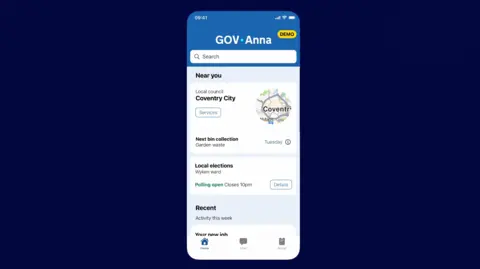 Cabinet Office
A mock-up of what the government says the digital ID app could eventually look like
Elizabeth Anderson, chief executive of the Digital Poverty Alliance charity, said: "International experience shows that so-called voluntary digital ID systems can quickly become essential in practice, as both public and private services begin to rely on them.
"When this happens, offline alternatives can become slow, complex, or difficult to access, effectively creating barriers for people who cannot engage digitally."
Digital ID will be based on two government-built systems - Gov.uk One Login and Gov.uk Wallet.
One Login, is a single account for accessing public services online, which the government says more than 12 million people have already signed up to.
Gov.UK Wallet has not yet been launched but it could eventually allow citizens to store their digital ID - including name, date of birth, nationality and residence status, and a photo - on their smartphones.
Users will need a Gov.UK One Login to access the wallet.
The system will be built in-house by the Government Digital Service, rather than being outsourced to private companies, Jones said.