 2 months ago
80
2 months ago
80
27 minutes ago
Jessica Parker and Kostas KallergisBBC News , Evros, Greece
Police in Greece have been recruiting migrants to violently push other migrants back across its land border with Turkey, according to wide-ranging evidence uncovered by the BBC.
We have seen internal police documents in which guards describe how the recruitment of so-called mercenaries was ordered and overseen by senior officers.
Our findings reveal allegations of brutality, with witnesses reporting migrants being stripped, robbed, beaten and even sexually assaulted. It has been claimed that mercenaries have been unofficially employed on the border since at least 2020.
The Greek prime minister told the BBC he was "totally unaware" about allegations of the use of migrants for pushbacks, while the country's authorities have not responded to our written detailed requests for comment.
Pushbacks - forcing migrants and asylum seekers back across borders without due process - are generally considered illegal under international law.
Claims that they were being carried out in Greece by foreign masked men were reported in 2022 by the Netherlands-based news organisation, Lighthouse Reports.
Our own investigation - carried out in collaboration with the Consolidated Rescue Group (CRG) - began last autumn, when we were sent disturbing video allegedly showing migrants being mistreated by mercenaries.
It was shared with us by a smuggler, who claimed to have become disgruntled with his associates. We have not been able to verify the content but it mirrors accounts we have gathered from other independent sources.
We have since pieced together information from migrants, former mercenaries, police sources, official documents and leaked transcripts:
- One border guard told a disciplinary hearing they had information, reported to their superiors, that mercenaries had been raping female migrants
- Two migrants and an ex-mercenary say they saw extreme violence by both mercenaries and Greek police, including people being beaten until they passed out
- A migrant says a masked man took off her daughter's nappy in the hunt for valuables
Greece has seen well over a million migrant arrivals since 2015 - chiefly through sea crossings but also along its land border with Turkey.
This frontier runs 200km (124 miles) along the Evros River. It marks the outer edge of the European Union, separating Greece's Evros region and the Turkish territory of East Thrace.
Refugees or illegal migrants crossing the river into Greece enter a heavily militarised restricted zone, dotted with watchtowers.
A police source in the region told us that mercenaries have been used to push back as many as hundreds of people a week.
"There is no soldier, police officer or Frontex (EU border agency) officer serving here in Evros who does not know that pushbacks are taking place," they added.
We have found that the mercenaries are themselves migrants, recruited from countries including Pakistan, Syria and Afghanistan, and that they can be rewarded with cash and mobiles looted from other migrants, as well as papers that, in effect, allow passage through Greece.

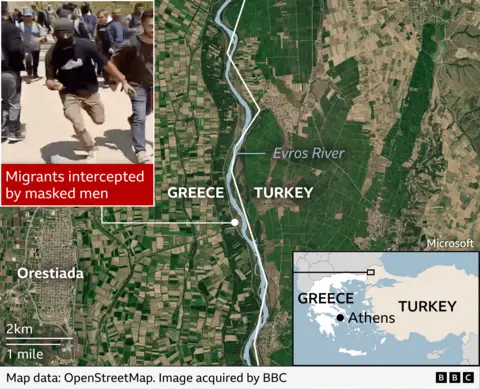
The BBC has been shown footage from 22 June 2023 in which a group of migrants, who had just crossed into Evros and wanted to claim asylum, were ambushed by masked men.
A report into this incident by the Fundamental Rights Office, an independent investigator within Frontex, found that - based on the available evidence - between 10 and 20 "third-country nationals" had been acting under the instruction of Greek officers.
It said they subjected the migrants to physical and verbal abuse including "death and rape threats, intrusive and sexualised body searches," as well as beating, stabbing, restraining and theft of personal property.
The report said that the migrants were then forcibly transported back to Turkey, in violation of EU human rights law.
The Greek authorities have denied that any migrants from this group were found in the area on that day.
This is just one of several reports by the Fundamental Rights Office, investigating allegations of pushbacks involving masked foreign men over recent years.
Jessica Parker speaks to Greek prime minister Kyriakos Mitsotakis
Our findings could amount to an "extremely significant" abuse of human rights, says Maria Gavouneli, the president of Greece's human rights commission (GNCHR). The organisation has itself recorded more than 100 incidents of alleged forced returns in Evros, dating back to 2020.
While it says cases have been declining, dozens of these alleged incidents have involved non-Greek, third country nationals - most recently in October 2025.
In a brief exchange with the BBC in March, the Greek prime minister, Kyriakos Mitsotakis, said he was unaware of allegations about the use of mercenaries.
However, he said that Greece was protecting its borders, and added that European leaders were clear they would not repeat past "mistakes" by allowing in a "massive influx" of migrants and refugees.
Frontex has rejected any suggestion it turns a blind eye to rights violations, saying it helps ensure borders are managed lawfully, while supporting countries under strain.
We have spoken to two Syrian migrants who claim to have been forced back to Turkey, across the River Evros.
Amal (not her real name) showed us videos and documentation of her family in Greece, where they had applied for asylum.
Her family, she says, was unexpectedly detained by police in 2025 while walking through the city of Orestiada, in northern Evros.
They were handed to two masked men who demanded they surrender their phones and IDs before driving them to the border in a windowless white van.
A further search at the river was far worse, she says.
"My daughter was wearing a diaper, they took it off," Amal says. "She was screaming in fear."
Next, she says, the masked men, who now numbered roughly seven, herded them and about 20 others down a track, using sticks to keep them in line.
Amal says the mercenaries' actions left her daughter "screaming in fear"
"As we were walking, there was a young man... they beat him so much that he fainted."
She says her daughters, who witnessed this, "were in a state of shock, terrified, crying".
When we meet them in Turkey, Amal's youngest daughter is visibly traumatised.
Another Syrian migrant, Ahmad, has told us that he was beaten to the point of unconsciousness by Greek police, after being picked up in Evros.
He says that the next day he was among dozens of migrants who were loaded into a truck: "Because of the crowding and the smell, people were suffocating. We couldn't breathe."
Ahmad says the police brought the migrants to the River Evros and lined them up in groups. They were then handed over to five or six mercenaries who stripped the men and searched them before using sticks to beat anyone who tried to hide money.
The migrants were loaded into rubber dinghies, he says, and rowed halfway across the river. He says the mercenaries didn't dare go any further because of fears that Turkish border guards would shoot.
If migrants didn't jump from the boat, he claims, they were thrown out: "The water could sweep people away. They didn't care at all."
Both Amal and Ahmad undertook dangerous, unlawful journeys to reach Greece, but Ahmad argues he, like others, faced no choice.
"I was dying slowly in Syria," he says. "People didn't leave their homes for no reason - they lived through the worst torture, oppression, and injustice."
Claims that Greek police used mercenaries were made in a 2024 disciplinary hearing, excerpts of which have been seen by the BBC.
Five border guards are awaiting trial on corruption charges (which they deny). In the extracts we've seen, some openly acknowledged the use of mercenaries, or as they called them, "boatmen."
One guard told the hearing that in 2020 he was told to find boatmen to carry out pushbacks, because Covid, and tensions with the Turkish authorities, were making it more dangerous for police to do the job themselves.
The guard, from northern Evros, says his superior mentioned that this system was already being employed in the region's south.
Guards communicated via the Viber messaging app, with a coded phrase to signal plans for a pushback: "X persons to the operation by Special Team", according to the testimonies.
They also said that there was information these "illegal migrant boatmen" had been "taking migrants to the woods, raping the women and taking their money" - something they claim to have raised with higher-ranking officers.
Separately, the BBC has met a lawyer who says she has lodged a case at the European Court of Human Rights, on behalf of an Afghan woman who alleges she was raped by a masked man who spoke Farsi, just prior to a pushback in 2023.
There have been differing claims about whether the mercenaries in Evros are recruited willingly or under duress.
Marwan (not his real name), a Moroccan we spoke to in Paris, insists he was given no real choice but to accept in 2020, and says he felt like a captive.
Plucked from a jail cell full of fellow migrants caught entering Evros, he recalls being asked by a Greek officer: "You seem like a good guy and you speak some English. Do you want to work with me?"
Marwan says he "felt forced to say yes" because he was afraid that otherwise he would be beaten.
He found himself living in an old prison cell with other mercenaries, led by an Afghan who he says bore a grudge against Syrians and liked to beat them.
Marwan says he spent about 10 weeks working at the border. His tasks included ferrying people back to Turkey, checking boats for punctures and burning any leftover migrant belongings in order to "destroy" evidence.
His recruiting officer dropped by regularly to collect phones or euros, he says. Mercenaries were allowed to keep Arabic or Turkish currency.
This officer even offered to take the mercenaries to prostitutes, Marwan claims.
He believes he was based around Soufli, a municipality in central Evros: "I heard the Afghans say Soufli many times."
Marwan says the way migrants were treated left him "completely destroyed". He says that many of them were thirsty, starving or had rotten feet after journeying into Evros.
The Moroccan is adamant that he never beat anyone, but says he witnessed frequent violence at the hands of both Greek officers and mercenaries - the worst of it down by the River Evros.
When we challenge him about his complicity in the alleged operation, Marwan says: "I am deeply sorry... I was under threat."
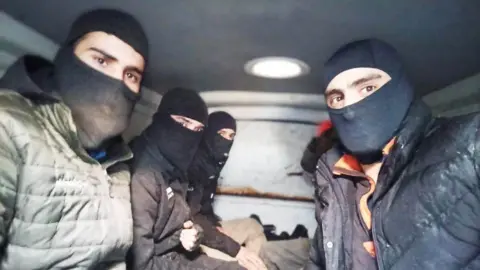 Supplied to BBC
A photo of alleged masked mercenaries was supplied to the BBC by a people smuggler
Further evidence that migrant mercenaries operate within the Evros region is provided by a photo we have been shown of a group of masked men in plain clothes inside a van. The photo was shared by the smuggler who sent us the video of migrants being mistreated.
We cannot say for certain that all the men pictured are mercenaries but the way they are dressed is notable and facial recognition technology reports an average 90% match between the individual on the right and four images of a Syrian man known as "Mike". According to several sources, he is a former leading mercenary. Five people have confirmed Mike's identity to the BBC and he is referenced in internal police documents.
When we contacted Mike, via a social media account, he did not personally respond but we received a letter from his lawyer that warned against the publication of his image and "unproven" allegations.
Names have been changed to protect identities.
Additional research by Paul Brown at BBC Verify and Serene Muhammed at BBC Arabic