 2 months ago
125
2 months ago
125
45 minutes ago
Ruth CleggHealth and wellbeing reporter

 Getty Images
I did not see myself as an avid supplement taker, but then I took a good look in my cupboard.
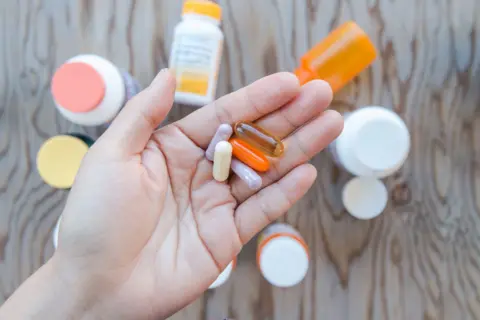
Without realising it, I had accumulated several pouches of creatine, vitamin D, magnesium, collagen, an all-in-one green supplement, and some tablets designed to help with the ups and downs of perimenopause.
I had thought I was immune to the constant ads on social media, but apparently not.
Comments like: "I can't get over how these supplements have made me feel!" had clearly got under my (questionably) collagen-enhanced skin.
While supplements can play a vital role in enhancing our wellbeing when needed, some experts are warning we have become so eager to optimise our health, we are now at risk of endangering it.
They have told the BBC they are seeing a growing number of patients and clients with liver, kidney and gastrointestinal issues which they say have been caused by people taking a growing number and range of supplements.
One nutritionist tells me it's "insane" how many supplements people are using.
"Some are beginning to think that taking a pill is better than eating food," she says. "It is not."
 Ginger Smith
Ginger thought supplementing was helping her - but her health took a turn for the worse
When Ginger Smith started taking supplements three years ago, she thought she was enhancing her health.
As a brand influencer, various boxes of complimentary products would regularly land on her doorstep in Seattle. The 30-year-old would take the pills, powders and gels, and then extol their benefits online.
"I was on high doses of vitamin C, vitamin D, turmeric, a special de-bloat supplement and I would regularly drink water with electrolytes in," Ginger explains.
For a couple of years, she says she felt healthy and energised. Little did she know she was putting her kidneys under immense strain.
After experiencing intense lower back pain, she went to her doctor, who ran a couple of blood tests. Within days, Ginger was told she needed an ultrasound.
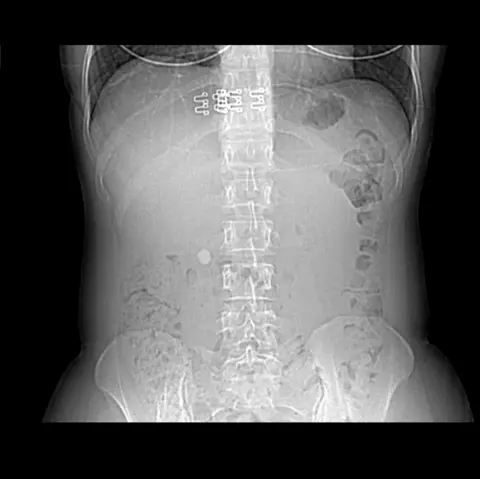
"I was a bit worried, but I did not expect to be told that I had a massive kidney stone. So big, they told me that they were going to have to operate to remove it."
The kidney stone measured between two and three centimetres and had been caused, Ginger was told, by the cocktail of daily supplements she was taking.
"I never would have thought that by trying to improve my health, I would end up in such a bad way," she says. "Luckily, I had insurance.
"It still cost me $6,000 (£4,500) - but it would have been $35,000 (£26,000)."
 Ginger Smith
Ginger Smith's X-ray showing a large kidney stone
Gastroenterologist Dr Pedro de Maria Pallares from the Hospital Universitario La Paz in Madrid, says increasing numbers of patients are coming to him with liver problems caused by herbal supplements.
"We ask the patient if they are on medication. 'No', they say.
"We then have to do a process of elimination. Once we have ruled everything out, we ask again, and they say: 'Oh well, I do take a number of different supplements.'"
Those which are particularly toxic to the liver when taken in high doses include vitamin A, glutamine, ashwagandha and green tea extract.
The liver can recover, but prolonged use can cause chronic conditions.
The British Liver Trust says although there is little data here in the UK, it is seeing cases of liver injury due to over-supplementation, and is asking people to consider "whether the potential benefits outweigh any possible risks".
"Supplements can be positively life-changing," Dr Karan Rajan, an NHS surgeon who makes health and science content for social media, says. "But every supplement deserves scepticism until proved otherwise."
Over recent years, Rajan says he has become more open-minded about supplements - so much so he has launched his own brand of fibre supplement - and believes they can have a place in people's diets when used wisely.
"I've seen the evidence grow when it comes to different supplements," he says. "We know our soil is not as nutrient dense as it was decades ago - so a carrot in the 1950s will be far more nutrient-rich than a 2026 carrot."
Rajan takes vitamin D, a prebiotic, protein, fibre and creatine - in what he describes as a "supplement stack" - to target areas where he could have a deficiency.
He says the balance works for him, but there are risks to mixing supplements and GPs are now regularly seeing patients taking multiple supplements who ask for advice about which to take.
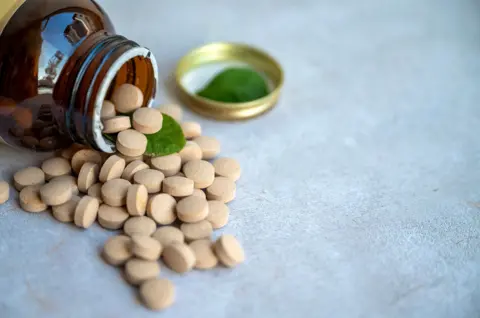 Getty Images
Ashwagandha and green tea extract can be toxic to the liver when in high doses
"Patients may not realise they are duplicating ingredients, exceeding recommended amounts, or taking products that could interact with prescribed medicines," says Prof Victoria Tzortziou Brown, president of the Royal College of GPs. "More is not always better."
For example, taking a multivitamin, along with a vitamin B6 supplement could lead to a double dose - and too much vitamin B6 over a long period of time can result in nerve damage.
Taking a cocktail of iron, calcium and magnesium together can reduce absorption rates.
And some vitamins, like A, D, E and K, are fat soluble so the body stores them for longer, so it might not be necessary to take them on a daily basis.
"Social media is convincing people they need these supplements to achieve health," says UK-based nutritionist Kristen Stavridis, who feels she is fighting a losing battle, "but more often than not, it's just not true."
For an adult with no underlying health conditions, she recommends a balanced diet, with vitamin D supplements in the winter months, and perhaps a multivitamin and fish oil if needed.
For some women, who are more likely to be iron deficient, supplements can help, but they should only be taken over a short period of time until levels have bounced back.
Stavridis' main message is to prioritise food, and if you do think you are deficient in a certain nutrient, consult a doctor, as you shouldn't assume a supplement will fix it.
Make sure you look at the recommended daily amounts (RDAs) on the label, she adds, and check your supplements are not clashing with any prescription medication.
It took several months for Ginger to recover from the operation to remove the kidney stone. She's feeling healthy again and is back at work.
"The funny thing is," she says, "I feel just as energised and healthy as I did when I was taking all those different supplements.
"Now I just take one multivitamin a day - and hopefully that's good enough."