 3 months ago
117
3 months ago
117

 PA Media
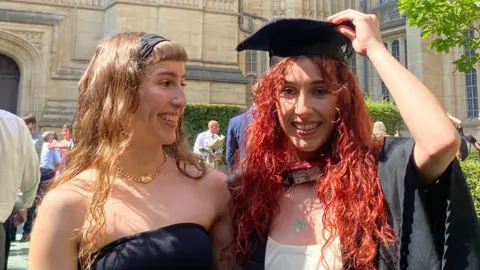
Caitlin, who studied psychology, and Grace, who studied neuroscience, both went to the University of Bristol
Two sisters who believed they were fraternal twins discovered they were in fact identical - after one of them was diagnosed with leukaemia at the age of 23.
Caitlin and Grace Leggett, from Cardiff, were extremely close growing up, sharing many of the same hobbies, and both went to the University of Bristol, where they shared a student house.
They had always believed they were dizygotic twins – created from two separate eggs that were fertilised by two different sperm.
But when Caitlin was diagnosed with leukaemia last April and Grace prepared to donate stem cells, they were told by doctors they were monozygotic - identical - twins, created when a fertilised egg splits into two.
 PA Media
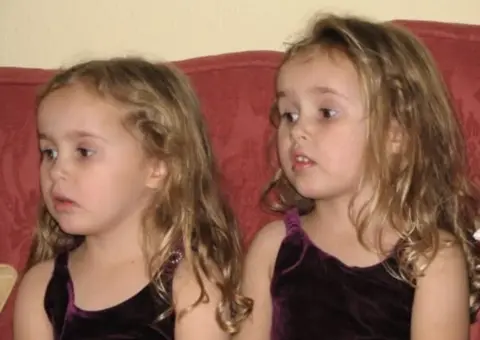
Caitlin and Grace were in different amniotic sacs in the womb, so their parents believed they were fraternal twins
The sisters said being identical was "a bit cooler" than fraternal twins but the discovery complicated Caitlin's treatment as Grace was unable to donate stem cells. They are now appealing for more people to sign up as stem cell donors.
"It can happen to anyone, really," Caitlin said of her diagnosis. "Obviously I didn't expect anything to happen to me."
After graduating, Caitlin had planned to join the Army as an intelligence officer and had booked her medical assessment for April.
But in March, she developed a rash that did not improve despite using creams from a pharmacy.
Blood tests arranged by her GP led to an urgent call the following day instructing her to go to A&E.
She was referred to the Teenage Cancer Trust unit at the University Hospital of Wales in Cardiff, where she was diagnosed with acute myeloid leukaemia (AML), an aggressive cancer affecting white blood cells.
Her treatment plan included chemotherapy followed by a stem cell transplant to replace the cancerous cells destroyed by treatment with healthy stem cells.
Both sisters had registered as donors with DKMS several years earlier, and family members were tested to see if any could be a match.
Initially, Grace was told that she would fit the bill - being her sibling, there was a high chance that her stem cells would be accepted by Caitlin's body and would aid her recovery.
"I had to go to one of the hospitals in Cardiff and they did all the checks - my weight, they took around 15 little vials of blood to test for all different diseases and everything, checked heart rate and lungs," Grace explained.
"Everything was fine, so they gave me a little pamphlet with all the information.
"And then I just had to wait."
 PA Media
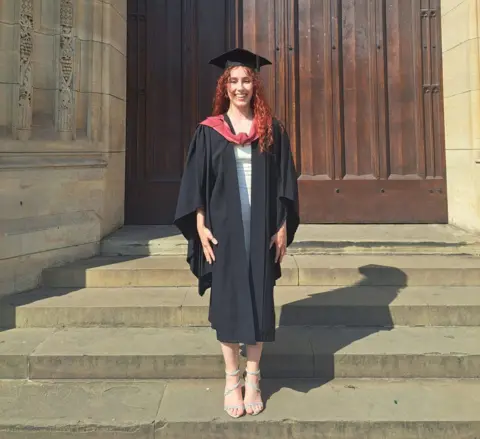
Before her leukaemia diagnosis, Caitlin had planned to join the Army as an intelligence officer
But doctors then made a surprising discovery. Caitlin said her consultant told her that after "triple checking", they realised that "every single marker that we've looked for is exactly the same".
They concluded the sisters were identical twins.
"I always wished I was an identical twin - I liked being a twin, but being an identical twin is a bit cooler," Grace said.
Caitlin and Grace were in different amniotic sacs in the womb, so their parents believed they were fraternal twins. However, identical twins can, and often do, develop in separate amniotic sacs.
While the news came as a surprise, it also complicated Caitlin's treatment. Doctors advised Grace could not donate stem cells because a successful transplant relies on the body recognising donor cells as foreign so they attack any remaining cancer cells.
Since Caitlin and Grace have near-identical DNA, Caitlin said "the whole concept of the transplant wouldn't work".
The transplant, which had been planned for August, was cancelled while doctors searched for another donor. During this time, Caitlin learned the leukaemia had spread to her skin and joined a clinical trial in Manchester to treat it.
Although the trial was successful, the cancer returned shortly before a second transplant date in December, meaning she required additional full-body radiotherapy.
"The radiation was probably the worst," Caitlin said.
"I didn't feel anything from chemo initially, but the first day of radiation, oh my God, I thought I was dying. It was crazy.
"I had, like, all the side effects on one day, but then by the second day, I got used to it, so I felt alright."
In December, she underwent a successful stem cell transplant from an anonymous donor.
Both sisters are now encouraging others to register as stem cell donors.
"It takes maybe six hours maximum (to donate), and then for someone else, it changes their life," Grace said.
"So I don't see why you wouldn't do it."