 3 months ago
91
3 months ago
91
Bernd Debusmann Jrin Doral, Florida

 Getty Images
For years, Florida resident Rosana Mateos had a recurring dream about the fall of Nicolas Maduro in Venezuela.
"I always dreamt that I'd find out in the early hours of the morning," said the Venezuelan expat, who has been in the US since 2012. "We always figured that if something were to happen, it'd be around then."
Before dawn on Saturday, US special forces broke into Maduro's compound and spirited him and his wife away.
"My phone was off and I was asleep," Ms Mateos recalled. "But then my husband woke me up and told me that they caught Maduro. I could not believe it."
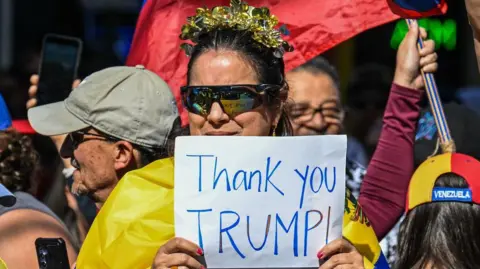
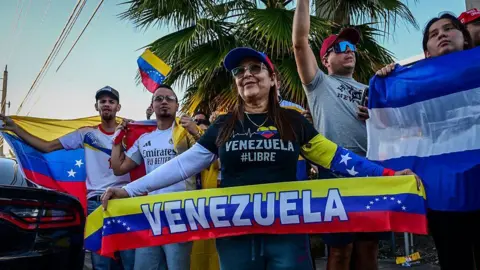
Several hours later, she was one of hundreds of Venezuelan expatriates and Venezuelan Americans who gathered in the Miami suburb of Doral - the hub of South Florida's Venezuelan community - to celebrate.
More than 40% of Doral's residents are of Venezuelan origin, the largest concentration in the US. Many fled economic troubles and insecurity in their country after Maduro took office in 2013, while others fled that of his predecessor, Hugo Chavez.
A significant number fiercely oppose Maduro - and on the streets of Doral, it showed.
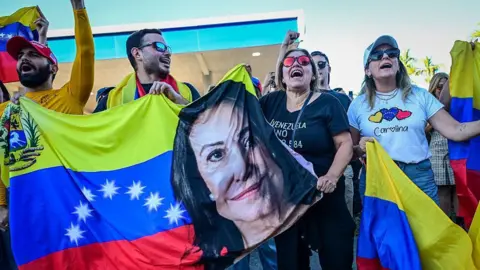
Even before the sun came up on Saturday, many flocked to El Arepazo, a Venezuelan restaurant and community hub in the area. By noon, the crowd had swollen to hundreds, blasting music, chanting, with motorists honking horns and waving flags on nearby roads.
Many expressed relief that Maduro, whom they blame for Venezuela's economic and political woes, is no longer in power.
Among them was Bryan Marquez, a native of the agriculturally rich Venezuelan state of Tachira, on the country's western border with Colombia. Mr Marquez, who emigrated just two years ago, becomes emotional when discussing his home.
Watch: "I'm so happy" - Venezuelans in the US react to Maduro's capture
"I don't even know how to put it into words," he told the BBC, speaking Spanish in the melodic, fast-paced accent of Venezuela. "We suffered under them [Maduro]. It was humiliating. That's why so many of us left. The economic situation was bad, there was insecurity. We just wanted a better life."
Like many at the celebrations in Doral, Mr Marquez believes that one man is responsible for giving many Venezuelan exiles what they have wanted - US President Donald Trump.
"It's an indescribable feeling," he added, emotion clearly audible in his voice. "He's really helped us... I don't know what to say, except thank you."
 Bernd Debusmann Jr/BBC News
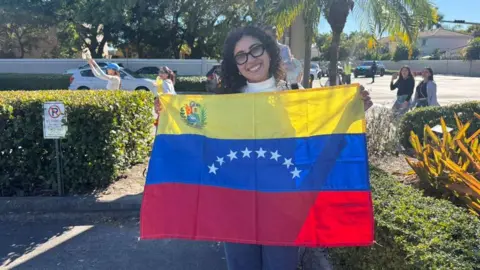
Doral resident Rosana Mateos said she questions any future government that includes officials from the Maduro government.
Others see Maduro's abrupt and violent exit from Venezuela's politics as, perhaps, an opportunity.
"Trump has really done this for the Venezuelan people," said 21-year-old Luis Atristain, who despite being born in Miami spent part of his youth in Venezuela.
Mr Atristain - wearing a red Make America Great Again hat - said he expects Maduro's fall will bring economic relief for millions of Venezuelans after years of hyperinflation and shortages.
"Venezuela is one of the world's richest countries, in resources," he explained. "They [the US] are going to go in, restart the industry. The oil alone is worth billions, or trillions. It will help the country build up again."
Many Venezuelans in the US, he predicts, will go back.
"There will be money pumping in," he said. "There will be a lot of opportunities."
 Getty Images
While idolised by many Venezuelan exiles in Florida, Trump said that opposition leader María Corina Machado "doesn't have the support within or the respect within the country" to govern.
While mostly elated at Maduro's downfall, some Venezuelans in Doral also expressed uncertainty about what comes next.
Confusion rose during Trump's press conference on Saturday. He said the US "is going to run" Venezuela through "a team that's working with the people of Venezuela to make sure that we have Venezuela right".
"I don't know what that means, or what level of involvement," said Ana Maria, a Doral resident. "We will see. But for now, we're just glad Maduro is gone."
Even more puzzling to some was Trump's remark that Venezuelan opposition leader María Corina Machado "doesn't have the support within or the respect within the country" to govern.
Ms Mateos, for example, bristled at the suggestion that Venezuelan Vice-President Delcy Rodriguez or any member of the Maduro regime would play a role in Venezuela's future.
 Getty Images
Over 40% of Doral residents are of Venezuelan origin, making it the largest hub in the United States.
In a televised address on Saturday, Rodriguez said that she would be willing to work with the US going forward.
"I hope that's very clear [to the Trump administration]. We do not accept a government of Delcy Rodriguez, or anyone that was part of the Maduro regime," Ms Mateos said.
"They are dirty and corrupt. We support María Corina Machado, as well as [former opposition candidate] Edmundo González. That's what the Venezuelan people want, which we've already said at the ballot box."
Mr Marquez, for his part, said that he and his friends remain dubious of Rodriguez.
"Those in Venezuela's government also have relatives outside the country," he said of Rodriguez. "But for them it's different. They have power. They haven't struggled like we have struggled."
As the sun began to set over the celebrations in Doral, a few expressed doubts that any of the key players in Venezuela - Machado, Rodriguez or Gonzalez - would be able to effectively govern in the short-term.
"None of them will be able to grab power," said a local marketing professional named Elkin, who declined to give his surname.
"Donald Trump will have to do it for now... he will be the one that moves Venezuela towards a more inclusive transition."