 3 months ago
79
3 months ago
79
Jayne McCormackpolitical correspondent, BBC News NI

 Reuters
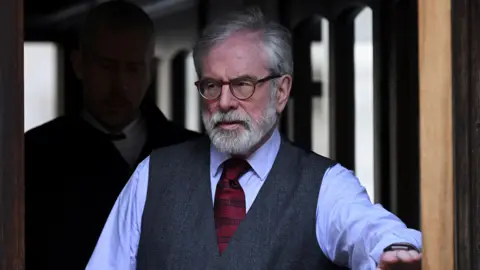
Gerry Adams is being sued over IRA car bombings in the UK in 1973 and 1996 which he strenuously denies any involvement in.
A former British Army colonel, who was an was an intelligence officer during the Troubles, has alleged Gerry Adams had been on the ruling IRA army council when it sanctioned bomb attacks in the Great Britain.
The claim is contained in the witness statement of retired British Army colonel Richard Kemp, who was giving evidence in the civil trial against the former Sinn Féin leader.
Three IRA bombing victims are seeking a ruling that Adams is personally liable for decisions to plant car bombs in London and Manchester in 1973 and 1996.
Adams strenuously denies any involvement in those attacks and has denied ever being a member of the IRA or sitting on its ruling army council.
On Wednesday, the court heard that Kemp was an intelligence officer between 1992 and 1994 and then again from 2002 until 2005. He served 30 years in the Army.
Kemp's witness statement says that in those years, he was "privy" to detailed intelligence that spoke to Adams' historic and current activities in the IRA.
It added that the intelligence named Adams as a member of the IRA Army Council and noted his presence at council meetings, and that his understanding was that any bomb attacks in Great Britain would have required sign-off from the Army council, including the 1996 London Docklands bomb and the Manchester bombing.
It was put to Kemp that he had "no direct evidence" that Adams was involved.
Under cross-examination from Adams' barrister, James Robottom, Kemp said he believed Sinn Féin and the IRA had "worked hand in glove".
When it was put to Kemp that his interest in the case was not just personal but political, due to his vocal support for veterans, Kemp replied: "The evidence I'm giving is neither political nor personal, it's simply the facts as I understood them at the time."
Kemp's witness statement says the intelligence named Adams as a member of the IRA army Council and noted his presence at council meetings.
It said his understanding was that any bomb attacks in Great Britain would have required sign-off from the army council, including the London Docklands and the Manchester bombings.
Kemp's witness statement added that it was "inconceivable" that Adams would not have been involved in the authorisation of the bombs.
Evidence 'neither political nor personal'
It was put to Kemp that he had "no direct evidence" that Adams was involved.
Under cross-examination from Adams' barrister, James Robottom, Kemp said he believed Sinn Féin and the IRA had "worked hand in glove".
When it was put to Kemp that his interest in the case was not just personal but political, due to his vocal support for veterans, Kemp replied: "The evidence I'm giving is neither political nor personal, it's simply the facts as I understood them at the time."
Kemp served seven tours in Northern Ireland between 1979 and 2001.
He told the court had the intelligence he was receiving been "incorrect it would not have been maintained".
"Generally speaking if you have reason to believe the intelligence is not accurate then it's withdrawn."
He said he could not remember any occasion when any piece of evidence or intelligence about Adams had been withdrawn.
'Only concerned about truth'
Earlier, a former IRA bomber who gave evidence in the case denied he holds "personal animosity" towards the former Sinn Féin leader.
Shane Paul O'Doherty, an author and blogger, served 14 years in prison for a letter bomb campaign in London in the 1970s.
O'Doherty was questioned about his long-running blog and the court heard he had published 145 pieces about Adams.
It was put to him that his blog was a "campaign" against Adams and that he was "extremely hostile" towards him and Sinn Féin.
O'Doherty stated that was incorrect and he had never received a "single complaint" about the accuracy of what he had written.
He said that he had no personal dislike of Adams and that he was "only concerned" about truth.
He told the court: "I don't have any personal animosity towards him as a person, I pray for his repentance pretty regularly."
O'Doherty also confirmed that he had never personally met Adams, had never spoken to him and had never been at a meeting he attended.
Under cross-examination from Adams' barrister he said that Tuesday was the first time in his life he had ever been in the same room as the former Sinn Féin leader.
'It's about accountability'
Adams is being sued for "vindicatory" damages of £1 each by John Clark, Jonathan Ganesh and Barry Laycock, who were injured respectively in the Old Bailey attack in 1973 and the London Docklands and Manchester bombings in 1996.
It has been alleged in court that Adams is as "culpable" for the attacks as those who planted and detonated the bombs.
Adams' lawyers have claimed the case is built on "an assortment of hearsay evidence" and have criticised the timing of the case, which is being brought several decades after the attacks.