 3 months ago
192
3 months ago
192
23 minutes ago
Judith Moritz,Special correspondentand Daniel Wittenberg,Senior producer

 Carlos Jasso/AFP via Getty Images
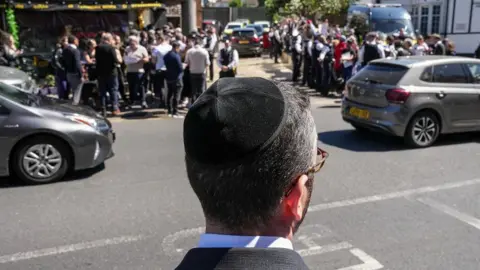
The scene in Golders Green earlier this week during a visit by the PM
For the first time in his life, Derek has decided to conceal his Jewish skullcap - known as a kippah - when out in public.
"I went shopping yesterday and bought a baseball cap," says Derek, who lives in Edgware in north London and did not want to give his full name. "I never wear a baseball cap.
"I felt that to go on the underground, as a religious Jew, was just too problematic."
Every Friday night, Derek and many other Jews across the world mark the end of the week by ushering in the start of the Jewish sabbath - Shabbat. Families light candles and gather around the table for Friday night dinner, sharing the comforts of food and conversation. On Saturday morning, they go to synagogue, to pray and reflect on the week that's just passed.
This Shabbat is no different. The candles were lit. The synagogues will be busy. Yet at the same time this weekend the ritual will feel different for every Jew in Britain.
Although he's covering up his kippah in public, Derek says he will attend synagogue as usual - but that it will feel especially intense.
"Unsurprisingly, this week we are going to have even more security. My synagogue is like a prison. And it's a small synagogue."
He adds: "I have never experienced - not the levels of hate, but the deafening silence of a community, of a country in the wake of such virulent antisemitism."
Adam Wagner, a prominent human rights lawyer, is one of those who have been agonising over whether to stick to his usual routine.
Like many Jews, Wagner prepares for Shabbat by going to buy a challah, a braided bread, from a kosher bakery. But the thought of going to a Jewish site in Golders Green fills him with fear.
"In the back of my mind, I'm thinking how to keep myself from being stabbed in the queue," he says.
Wagner has also been wrestling over whether to wear a kippah when walking to synagogue this week. His child has surprised him by asking him to promise not to do so.
"I still haven't decided," he says. "I will need to have a discussion with them on the day. I would prefer to wear it."
But these concerns won't stop Wagner from going to synagogue - though he knows the experience bears little in common with that at other religions' places of worship.
"I will be spending this Shabbat as I spend most - at my synagogue, behind high walls, volunteers wearing stab vests, specially installed car-ramming prevention barriers and professional security guards," he says.
This will be a similar scene at every synagogue.
Jonathan Romain, the former rabbi of Maidenhead synagogue in Berkshire, now regularly spends his Shabbat mornings standing outside it on guard duty.
"After many years of being inside the synagogue, leading services and being protected by others, I now repay the debt I've owed to others for so many years. I was on last Saturday, and I'll be thinking of them this Saturday," he says.
"I shall be worrying about copycat attacks to the one in Golders Green. I hope these new random street attacks will not suddenly multiply."
For some Jewish people, it simply feels too frightening to go to synagogue at all.
"In an ideal world, we would take our baby to shul [synagogue]," says Ben, a lawyer from north London.
He adds: "I had an experience of leaving my shul with my dad and being shouted by a bunch of young boys, 'free Palestine'.
"My own personal experience, combined with what happened in Manchester last year, means that we are staying away. That saddens me massively and showed that our way of life has been hugely affected and trampled on as a result of these threats. So now, I try to do as much [of the prayers] as I can from home."
This week, Ben and his wife also made a big life decision. On the day of the stabbings, they decided they'd had enough of antisemitism in the UK.
"It was this week's attack that has made us decide to move to Israel. Seeing innocent Jewish people being stabbed - that pushed it over the edge for us," he says.
But many Jews say they have no intention of going anywhere.
Judith Nemeth, who hid behind a fence as the attack unfolded on Golders Green Road, is preparing to make the same walk down the same road to visit family and friends this Shabbat.
"Nothing has changed," says Nemeth, who attends the synagogue where the two men were praying before they were stabbed.
"You will find across the community that we will carry on business as usual, carry on leading our Jewish lives during the week and on Shabbat, just as usual.
"I'm very grateful that, though I was there on the scene, I was not hurt," she adds.
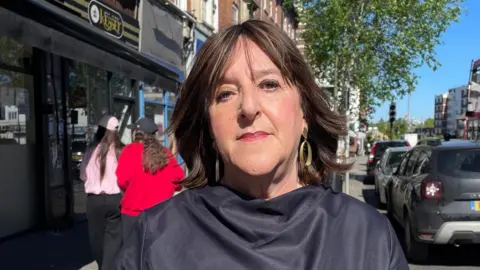
"I thank God that I am here and able to live as a Jew for another day," says Judith Nemeth
Those who were affected by the Golders Green attack will be in the thoughts and prayers of worshippers at many synagogues across the UK.
And she adds: "We will pray for the wisdom of our leaders, locally and nationally, of all religions, and of course, we will pray for a full and lasting peace throughout the world - as we do in every service.
"Ultimately the message I hope our community will take from this Shabbat is one of continued resilience."
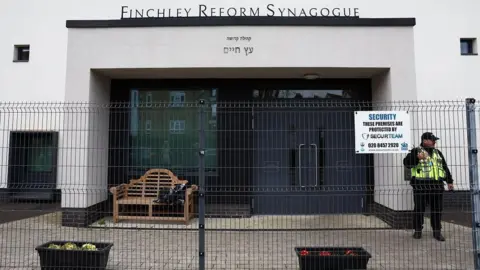 Getty Images/Toby Shepheard
Finchley Reform Synagogue, which is protected by security guards, was targeted in an attempted arson attack last month
The day after the Golders Green attack, Sir Keir Starmer, who has spoken of participating in regular Friday night dinners with his Jewish wife and father-in-law, announced a series of measures aimed at reassuring the Jewish community.
He said the government would strengthen the "visible police presence" in communities, increase investment in Jewish security services, and introduce stronger powers to shut down charities that promote antisemitic extremism and prevent "hate preachers" from entering the country.
Lord Richard Hermer, the attorney general and one of the most senior Jewish politicians in the country, tells the BBC: "The fear in my community is palpable, and understandable."
"This Friday night, just like every other, my family will gather for Shabbat - with the wonders of technology adding on screen those at college or travel," he adds.
"At times of sorrow or fear, there is an added comfort in ritual and family. In my home, as the prayers end, we wish each other 'Shabbat Shalom' (a peaceful Sabbath), stand and hug each family member in turn, telling them we love them.
"I suspect Jewish parents around the country will find themselves hugging their children a little tighter tonight."
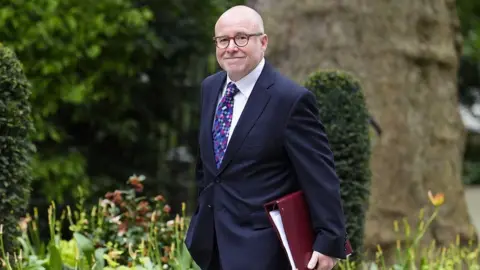 PA Media
Lord Hermer has been attorney general since 2024
Many in the Jewish community in recent days have expressed frustration with what they see as a lack of government action on hate speech, and have renewed calls for Iran's Islamic Revolutionary Guard Corps to be proscribed.
A group suspected of having Iranian links has said it was behind the attack, but did not provide any proof. Iran's embassy in the UK says it "categorically rejects any allegations" of the country's involvement in "violent activities or incidents in the United Kingdom".
"The problem is coming from several different directions at once - extreme right, extreme left and Islamists," says Rabbi Romain.
He says solutions should include the government regulating anti-Jewish hate at protests and on social media.
"Although this is a very painful moment for us both in that it is physically dangerous and emotionally worrying, in the sweep of Jewish history it is not new but a return to how life used to be for Jews.
"After the Holocaust, we were protected by the revulsion that swept the world, but that has gradually become thinner and thinner, to the extent that I now understand what it must have felt like for my great-grandparents."
Adam Wagner has urged the government to treat this as an emergency, take risks and act with speed.
However, he says the problem extends beyond politics.
"The whole of society needs to look inwardly and understand why anti-Jewish hatred has been allowed to grow to such an extent that there are people trying to kill Jews on the streets.
"This is not a problem that has come from nowhere. It been enabled and encouraged by hateful rhetoric and a permissive attitude towards political violence, for example people abusing Jews and Israelis on the streets and online, and smashing up property in Jewish areas supposedly in the name of a conflict thousands of miles away."
For cantor Zoë Jacobs, her message is one of resilience: "We are a tiny minority in England, but we are determined to do everything we can to leave the world better than we find it... There can be no more important work for any of us."
Additional reporting by Gabriela Pomeroy.