
Kyle BonaguraJan 6, 2026, 10:00 AM ET
- Covers college football.
- Joined ESPN in 2014.
- Attended Washington State University.
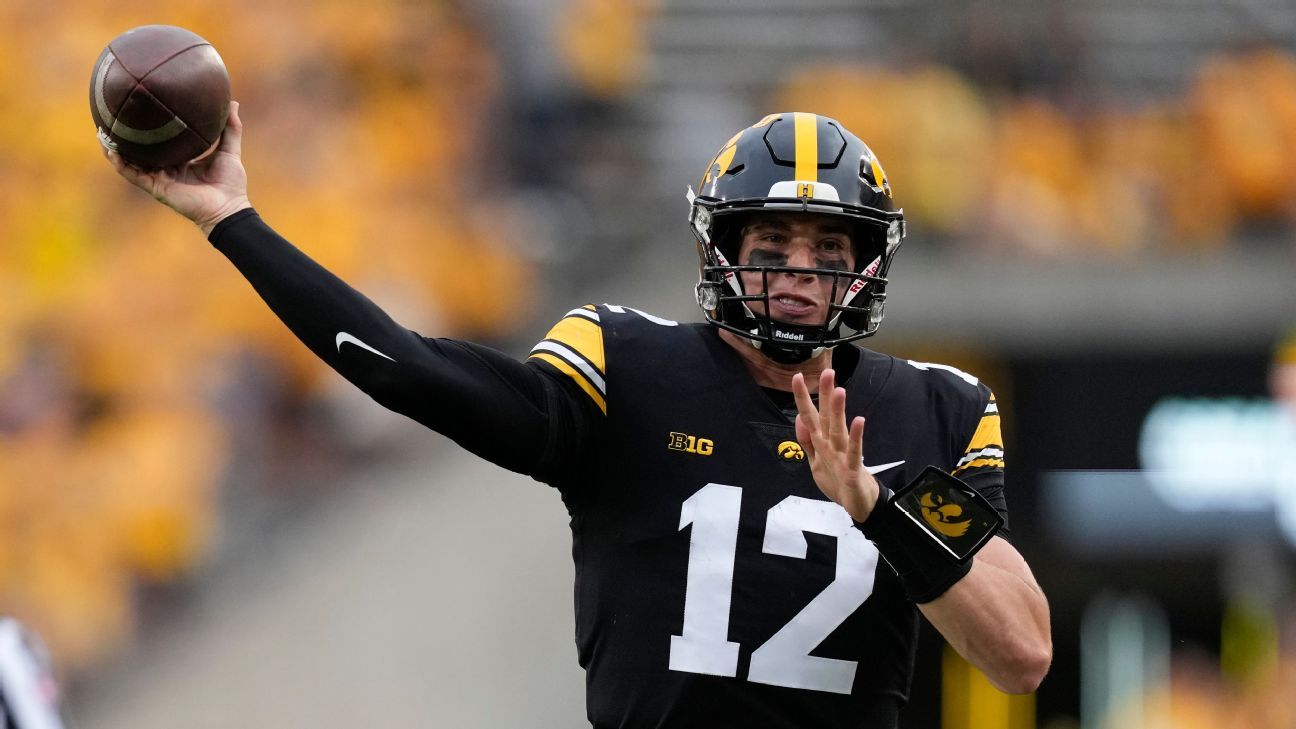
BERKELEY, Calif. -- Cal quarterback Jaron-Keawe Sagapolutele is a college football conundrum.
His debut for the Golden Bears in August defied traditional expectations for a true freshman. He was composed. He was accurate. He showcased his big arm and the physical attributes -- at 6-foot-3, 225 pounds -- that made him one of the most coveted high school quarterbacks in the 2025 class. For anyone who remembered Jared Goff's debut in Berkeley over a decade earlier, the feeling was familiar. Here was a player for which college football would serve as a pit stop to the NFL.
In another era -- like with Goff, not that long ago -- Sagapolutele's arrival would have translated into optimism about the future. If he was this good already, what will he look like as a junior or senior? How good will the team be once he develops?
Sagapolutele's emergence, though, was processed differently. It was still natural to wonder about how he would progress, but it was accompanied with inevitable speculation: Can Cal keep him?
From the beginning, Sagapolutele said what Cal fans wanted to hear.
"This is where I want to be. I want to be at Berkeley. I want to be a Bear," he told ESPN in September. "And going forward, I just hope everyone knows that. This is where I want to be. This is my home."
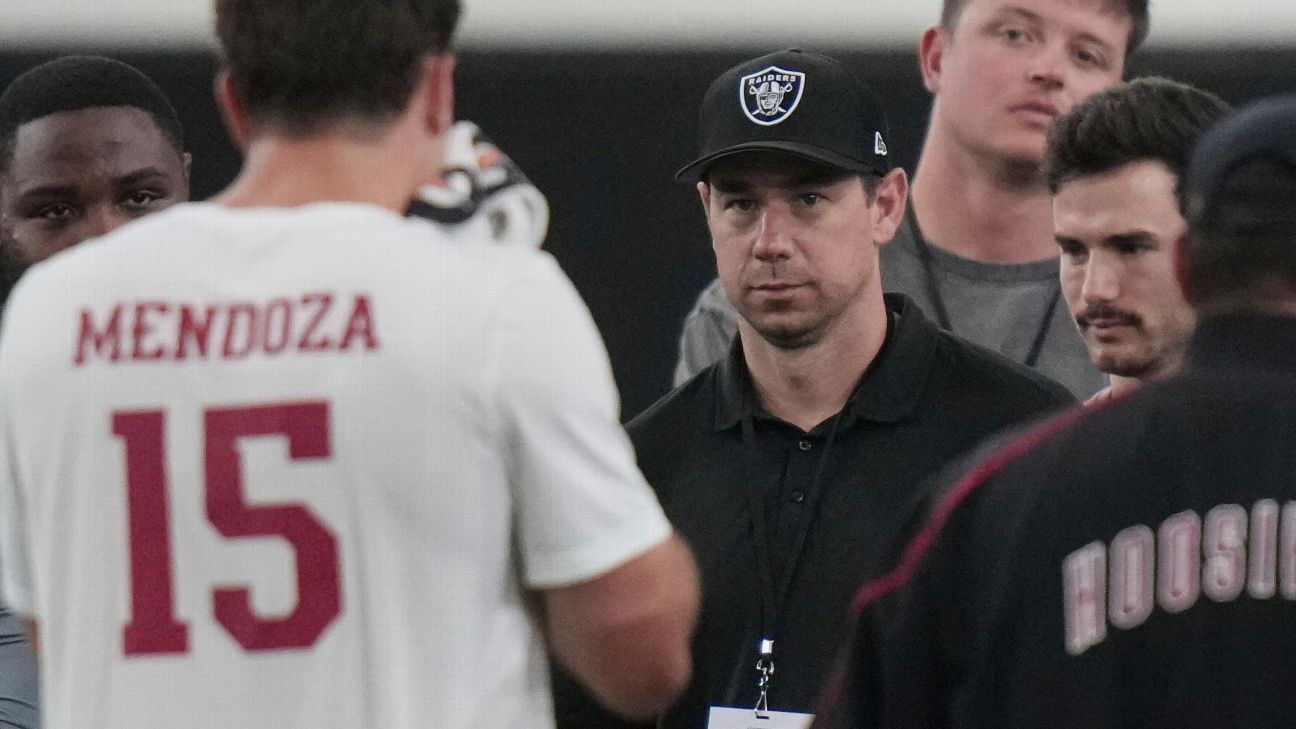
As the season unfolded, the dips arrived. Turnovers. Missed reads. They were normal hiccups of a freshman quarterback learning on the fly. Meanwhile, Fernando Mendoza -- Cal's starting quarterback for most of the previous two seasons -- had developed into a surefire first-round NFL draft pick and was on his way to winning the Heisman Trophy and leading Indiana to the top seed in the College Football Playoff.
Nothing in college football exists outside the quarterback transfer prism anymore. Every roster decision, coaching hire, NIL budget and depth-chart conversation is filtered through the same question: Who's the quarterback, and how long do we actually have him?
EVEN BEFORE TRANSFER restrictions were lifted, quarterbacks always moved at higher rates than other positions. Only one is on the field, and without a clear path to playing time, players were willing to sit out a year -- even losing a year of eligibility -- just to try their shot elsewhere.
Now, with the ability to transfer and play immediately, things have been accelerated. When the transfer portal opened last week, there were more than 100 quarterbacks on the move. Done correctly, the portal offers a fast track out of offensive irrelevance. The safest formula has proved to be the least imaginative: bring the quarterback with the coach.
This past year, John Mateer went with his offensive coordinator, Ben Arbuckle, from Washington State to Oklahoma. Devon Dampier did the same at Utah, moving with offensive coordinator Jason Beck from New Mexico. And in both cases, it worked: Each helped guide their team to a 10-win season, a year after the Sooners and Utes finished with losing records.
They were hardly unique. Bo Nix transferred to Oregon to reunite with offensive coordinator Kenny Dillingham, who coached him for a year at Auburn. Caleb Williams followed Lincoln Riley to USC and won the Heisman Trophy. Cam Ward thrived after moving with Eric Morris from Incarnate Word to Washington State. Dillon Gabriel reunited with Jeff Lebby, his former coordinator at UCF, when he transferred to Oklahoma.
When a player moves with a coach, it simplifies the evaluation. Michael Penix Jr. transferred to Washington to reunite with Kalen DeBoer, who had coached him as the offensive coordinator at Indiana. Ryan Grubb, UW's then-offensive coordinator and the current OC at Alabama, said because Penix already spoke the language, the transition was easy.
"Michael was in our system in Indiana. You saw him running our stuff and it was like, 'Oh wow he's not only going to be able to come in and do the things that we believe he can do, but being able to understand the system -- this is how we call this, this is going to go pretty quick,'" Grubb said.
It becomes harder to evaluate, Grubb said, if a quarterback had been operating in a completely different style of offense.
"If a player was running Tennessee's offense and then trying to come in and run ours -- and Tennessee's a really good offense. But it's like if they're trying to run our system, is that going to translate?" he said. "Just two really, really different systems, where I don't know if this guy's already been there for a couple years and he's entrenched, it's going to take a little bit of time.
"And if you're saying this guy's coming here to be your starter, you better be pretty certain that he has the capabilities mentally to run your system."
Penix's familiarity translated directly to production. At Washington, Penix threw for 4,641 yards and 31 touchdowns in 2022, then followed it with 4,903 yards and 36 touchdowns in 2023, turning the Huskies into a national contender almost overnight. Over two seasons, Washington went 25-3, reached the College Football Playoff National Championship game, and Penix finished as a Heisman Trophy finalist before being selected No. 8 in the 2024 NFL draft. Since the portal opened, multiple teams are following a similar path.
Rocco Becht has said he plans to reunite with Matt Campbell after Campbell's move from Iowa State to Penn State. Drew Mestemaker announced he would follow Eric Morris from North Texas to Oklahoma State. And AJ Hill committed to Arkansas, following new Razorbacks coach Ryan Silverfield from Memphis. The logic is the same: minimize uncertainty and shorten the time between arrival and impact.
Texas hasn't used that model, but offensive coordinator Kyle Flood sees the logic.
"I think if you asked any college coach, they would tell you, in a perfect world, you would love to recruit your own players, retain them and develop them over three, four, five years, whatever that looks like," Flood said. "But kind of like what I said before, that is not college football anymore. It is not.
"I think the art of recruiting is really the art of evaluation. It is not evaluating if he is a good player or not. That is not really the evaluation. The evaluation is does he have the traits to really excel at a high level in your system.
"Meeting them now, when they are in the portal, is not like meeting them in high school. It is really like your NFL top-30 visits where you say, 'Hey, I have to get this guy in a room and I have to find out does this guy want to be coached, does he believe in the things that we believe in, how great does this player really, really want to be.'"
DESPITE SAGAPOLUTELE'S CONSTANT refrain throughout the season that he wanted to remain in Berkeley, there is only so much trust that can be placed in that sort of talk.
After all, Sagapolutele had committed to Cal, flipped to Oregon, enrolled, spent time on campus in Eugene and then reversed course again to land in Berkeley. That's all to say, circumstances change.
As the season wore on, the skepticism about his future never fully disappeared, and when coach Justin Wilcox was fired, it was again front and center.
As general manager Ron Rivera began Cal's coaching search, the quarterback position was part of the discussion from the start. Rivera relayed to candidates he felt strongly they would be able to retain Sagapolutele and laid out the plan to do so. There were no guarantees offered. Rivera described a process that mirrored free agency as much as recruiting.
The pitch wasn't just about retaining one player.
"With a guy like that, people are going to want to come play for him and play with him, be a receiver, be a tight end, be a running back, be an offensive lineman," Rivera said. "Why? Because not only are the scouts going to come watch him, but they're going to see the other people around him."
After Tosh Lupoi was hired, the urgency turned concrete. One of Lupoi's first moves was to board a commercial flight to Hawai'i, where Sagapolutele was home on a brief visit. Lupoi met him face-to-face and quickly secured his commitment to stay.
Keeping Sagapolutele in place had a cascading effect. Retention became easier. Recruiting did, too. Receivers and skill players want to know who's throwing the ball. Stability at quarterback, even if temporary, creates momentum.
But nothing about it is permanent. These are battles won a year at a time now. If Sagapolutele takes the expected step forward next season, the speculation will return just as quickly. That isn't a judgment on him or on Cal. It's simply the reality of modern college football.