 2 months ago
99
2 months ago
99
Alice CuddyTyre, southern Lebanon

 BBC
BBC
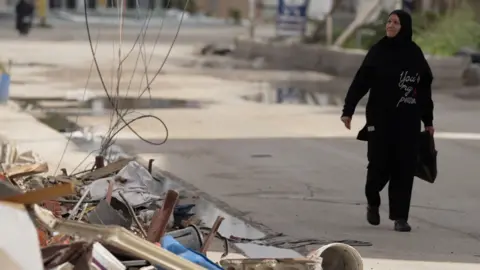
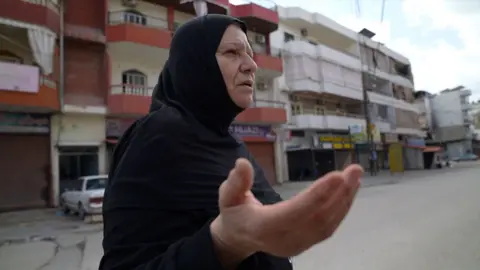
Neyfe Adib walked with her shopping past a destroyed building
An uneasy quiet has fallen on the streets of the usually bustling southern Lebanese coastal city of Tyre.
Israel has told civilians in the city – the fifth-largest in Lebanon and one of the oldest in the world – to leave their homes as its war with the Iran-backed Shia Muslim group Hezbollah intensifies.
The city lies about 19km (12 miles) from the Israeli border - the southernmost point the BBC has been able to reach since the war resumed.
Southern Lebanon is the heartland of Lebanon's Shia Muslim community, Hezbollah's main support base.
In Tyre, many businesses are shuttered and homes empty. But not everyone has left.
The civilians who remain – some unable to move, others defiant – are trying to carry on with their daily lives in the shadow of bomb sites.
"It used to be really crowded here," said Neyfe Adib, 65, as she walked with a bag of shopping past a destroyed apartment building, looking around at the now empty streets.
She said her family could not afford rents elsewhere in Lebanon, and she worried about moving her elderly parents and husband, who uses a walking stick, into a shelter.
"I have to stay here [so] it's either we die or we live," she said.
Shelters and food kitchens in Lebanon have told the BBC they are struggling to cope with the numbers of people displaced, and there are concerns from the United Nations and aid groups about the growing humanitarian crisis.
Israel's military on Tuesday reiterated evacuation orders covering southern Lebanon, telling civilians to immediately move north of the Zahrani river, about 40km from the border.
"Anyone present near Hezbollah elements, their facilities, or their combat vehicles is endangering their life," a spokesperson wrote on X.
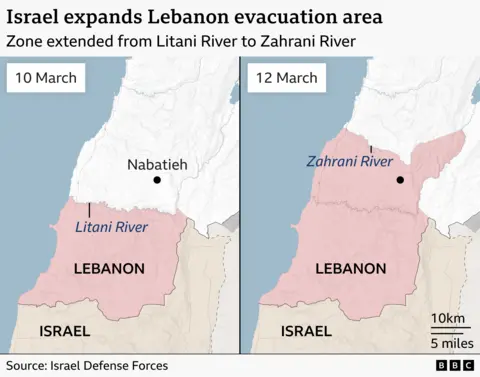
About a million people are estimated to have been forced from their homes in Lebanon since war resumed two weeks ago.
At least 912 people, including more than 100 children, have been killed in Israeli attacks in Lebanon, according to Lebanese authorities, while the Israeli military says two of its soldiers have been killed in southern Lebanon.
Lebanon was pulled into the conflict between Israel, the US and Iran two weeks ago when Hezbollah launched rockets and drones into Israel in retaliation for the assassination of Iran's supreme leader and repeated Israeli strikes since a ceasefire ended their last war in 2024.
Israel said Hezbollah's attack justified launching a new offensive against the group that would continue until it was disarmed.
Israel says its troops have begun "limited and targeted ground operations" against Hezbollah in southern Lebanon, targeting "key Hezbollah strongholds" with the aim of strengthening the defence of Israeli border communities. There are fears that this could lead to an Israeli occupation of the south.
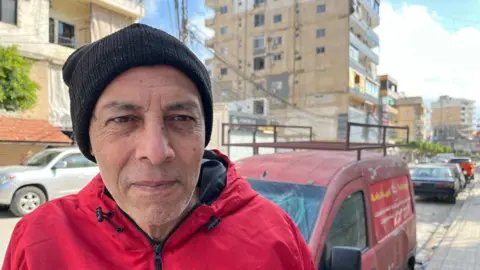
Khaled Othman said he was no longer able to make a living from his bakery
"From [the first Israeli invasion of southern Lebanon in] 1978 to now, I've never left. I'll never leave," said local baker Khaled Othman, as he stood at the roadside assessing the damage from a recent strike that the Israeli military said targeted Hezbollah infrastructure.
"My family are not here anymore. They are kids and elderly so they are in Beirut, but I stayed here".
He said he had "seen a lot" happen to Tyre in his lifetime, but had remained even as it was all but deserted in the last war between Israel and Hezbollah, which lasted over a year.
Khaled, 63, said he had briefly had to leave his bakery and home this month following warnings from the Israeli military of an impending strike, but moved 300m away (1,000ft) for safety and immediately returned to find his business intact but with shrapnel damage.
He said he was no longer able to make a living from his bakery because almost all his customers had fled. Israel's strikes in the city were not just targeting Hezbollah but "hitting civilians" too, he said.
"If they want to have a war with Hezbollah, have a war with Hezbollah… What do we have to do with this?" he asked.
Hezbollah have strong support in southern Lebanon, and Khaled – who stressed that he is "not affiliated with anyone" – said Israel's military campaign would not affect this.
"They can't force everyone to hate Hezbollah. Each person has a preference here in Lebanon - we have a mix," he said.
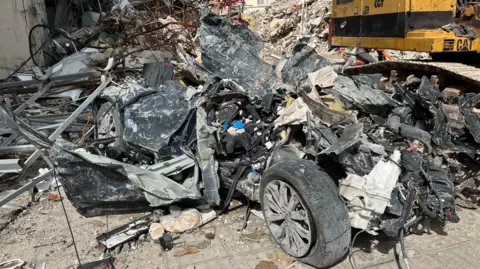
Destruction is visible in Tyre
In Tyre on Monday, Hezbollah's influence was tangible. The BBC required the group's permission to report in the city, and its operatives appeared wherever our teams went - though they had no control over our output.
Among the sites in the city destroyed in recent Israeli air strikes was a branch of the al-Qard al-Hassan financial institution, which is linked to Hezbollah and has been reduced to rubble.
Nearby, George Zevali was taking the cover off the pick-up truck he uses for his water delivery business so that Israeli soldiers would be able to see what he was transporting.
Like Khaled, he said he had sent his wife and children away to north Lebanon hoping they will be safer there, while he tried to keep working.
"There are no businesses here anymore. Only water, bread, vegetables – only [businesses] like this," he said. "I'm working to save money to give it to my family."
George, a Christian, said he felt there was "no safety" in Tyre anymore, but couldn't afford to give up his business and leave.
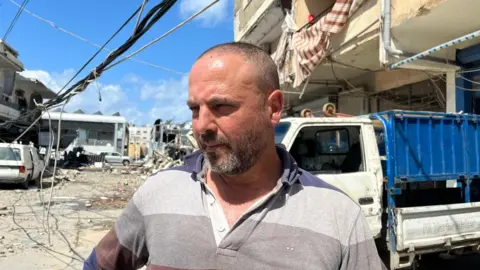
George de Vail has tried to keep his water delivery business running
Others though, from communities even closer to the Israeli border, have come to Tyre in search of relative safety.
A theatre is among the makeshift displacement camps in the city, with some 35 people living there, sleeping in the projector room and the auditorium.
Fatima Hakim said she had fled from her home after strikes but would not move any further north.
"Lebanon is our country, and this city is our city. No matter what they do, I'm going to stay in my home, in my area, in my country with my loved ones and friends. I prefer to die here than to die humiliated somewhere else," she said.
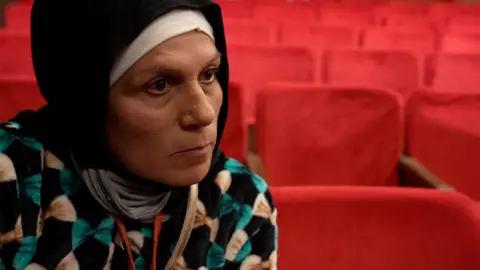
Fatima Hakim is sheltering in a theatre
As she walked with her children past the site of an Israeli strike, 56-year-old Basma Sadek said that for now things felt safer to her in Tyre than they had in the last war, when she fled to the north of the country.
She said Israel had generally warned of targets in advance, and that despite being ordered to evacuate, she did not fear for her own safety or that of her children.
"We are staying, steadfast," she said.
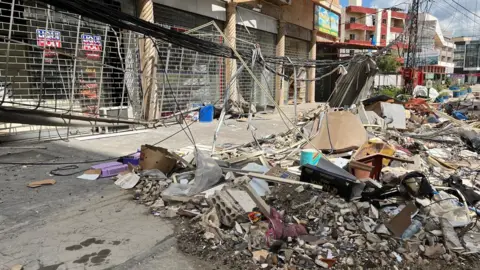
Destruction beside shuttered shops in Tyre