
 3 months ago
118
3 months ago
118

 University of Reading
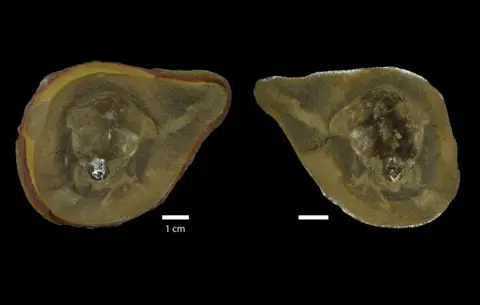
New technology has revealed teeth within the fossil, meaning it cannot be an octopus
A 300‑million‑year‑old fossil, previously thought to be the remains of the world's oldest octopus, has been identified as a different animal.
Using the latest technology to search inside the fossil, University of Reading researchers discovered tiny teeth that proved it was actually an animal related to a modern Nautilus, a multi-tentacled animal with an external shell.
Zoologists believe the animal decayed for weeks before it was fossilised and this led to the case of mistaken identity.
The fossil, named Pohlsepia mazonensis, had featured in the Guinness Book of Records as the earliest known octopus.
Dr Thomas Clements, lead author and lecturer in invertebrate zoology at the University of Reading, said: "It turns out the world's most famous octopus fossil was never an octopus at all.
"It was a nautilus relative that had been decomposing for weeks before it became buried and later preserved in rock, and that decomposition is what made it look so convincingly octopus-like.
"Scientists identified Pohlsepia as an octopus 25 years ago, but using modern techniques showed us what was beneath the surface to the rock, which finally cracked the case.
"We now have the oldest soft tissue evidence of a nautiloid ever found, and a much clearer picture of when octopuses actually first appeared on Earth.
"Sometimes, re-examining controversial fossils with new techniques reveals tiny clues that lead to really exciting discoveries."
 University of Reading
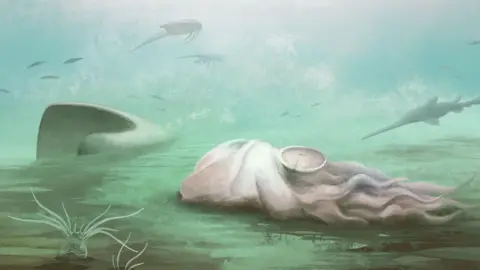
An artist's impression of what the animal would have looked like
The fossil was discovered at a site at Mazon Creek in Illinois, US, with the first analysis of it published in 2000.
Scientists thought the fossil showed eight arms, fins and other features typical of an octopus.
Synchrotron imaging, a modern technique that uses beams of light brighter than the sun, was used to scan the fossil, revealing new details within the rock.
The teeth revealed matched those of a fossil nautiloid that was found at the same site.
These findings mean that data now supports octopuses appearing during the Jurassic period, much later than thought.
Scientists now believe the split between octopuses and their 10-armed relatives happened in the Mesozoic era, not hundreds of millions of years earlier as previously thought.