
Anthony SlaterApr 1, 2026, 07:00 AM ET
ENTERING THEIR MARCH 2 game against the LA Clippers, the Golden State Warriors were two games above .500 but stumbling in the wrong direction. They had lost three of five coming out of the All-Star break, and their cushion over the Clippers for eighth in the West had been trimmed to 2½ games.
But they built a 17-point first-half lead.
"We had a game going," Warriors coach Steve Kerr said. "Draymond [Green] was all over Kawhi [Leonard]."
But momentum disintegrated quickly in the second half. Leonard and Darius Garland cranked up the production and the Warriors, without the injured Stephen Curry and Jimmy Butler, didn't have the offensive firepower to keep up.
This familiar losing script -- try hard but ultimately fail because of a lack of game-changing talent -- had frustrated Green to the edge of another boiling point. As fourth-quarter hope melted away, he thought about erupting at a referee, coach or an opponent in an attempt to change the inevitable, a favored tactic of his to shock his team's system.
"No," Green told himself. "It's not the thing to do."
In an Oklahoma City hotel lobby four days after the fact, Green is retelling this story to ESPN, using it as a prime example of his aging and required acceptance of the franchise's fading place in the NBA pecking order.
"I can raise the temperature level of a gym, an arena, a team like crazy," Green said, snapping his finger for effect. "Like that. Whenever I want to."
But his instinct for escalation doesn't line up with the reality of a team whose season has cratered. In early January, Butler tore an ACL. In late January, Curry vanished from the lineup because of an "unpredictable" knee issue that has forced him to miss 26 straight games.
That has left Green to deal with his own career mortality, surrounded mostly by a cast of underdeveloped young players in need of steady guidance through a pile of moral victories and unavoidable losses. It isn't an environment conducive to Green's antagonistic approach.
"Draymond is the most powerful force in the room every night," Kerr told ESPN. "When the team is right and he is right, he is just an incredible force for winning. He raises that temperature, our awareness, our alertness, our preparation."
But as Kerr explained, when the team is understaffed and overwhelmed, "that same temperature can be damaging."
"It ain't good for this team," Green said. "I had to learn that because, again, it's pulling away a piece of me. And that's -- by the way, just so we're clear -- that's a very elite piece of me. But that's aging. I think about this all the time."
Green is finishing his 14th NBA season, fighting off a physical decline and attempting to execute a near-impossible task -- control his passion while still needing all that outsized emotion to fuel an undersized interior game built on spirit and toughness. The clock has never been ticking louder.
"I remember Jeff Van Gundy said on a broadcast years ago that the hardest player to coach is the aging star," Kerr said. "It's especially hard for someone like Draymond who is that passionate and emotional about things. I look at it as my job to help him get to that finish line and be really proud and move on to the next phase."
EXPECTATIONS WERE HIGH for the Warriors coming into the season with a full season of Butler. ESPN's analytics model had them as a high seed in the West. They had acquired Butler at the previous February deadline, stormed into the playoffs with a 23-8 run, upset the Houston Rockets in the first round and appeared poised to challenge the Minnesota Timberwolves before a Curry hamstring injury.
But Butler and Curry went down and, even before the debilitating injuries, the Warriors didn't look completely like themselves.
In early November, the Warriors were down five in the fourth quarter to the rising San Antonio Spurs in an early season road game with outsized importance. To change the mood, Green started barking and bumping Victor Wembanyama before an inbound, challenging the most popular man in San Antonio in front of his people.
Wembanyama responded with a memorable after-the-whistle alley-oop on Green that went viral, a signature early-career example of Wembanyama's resilience.
But Green had ulterior motives. He was waving his infamous villain wand to spike the energy and vigilance of every person in a suddenly frothing arena, believing his fully stacked team was better built for that playoff-like clutch setting.
"You know when you get into a seven-game series, you always want him on your side," Curry told ESPN. "His voice, his presence, his competitiveness. The higher the stakes, the better he plays. That's just part of his skill set, his ability to create the will to win for all of us."
The Warriors responded. Curry scored 14 in the final seven minutes. Green found Butler for a massive layup in the final minute. They produced the necessary stops and stole a 109-108 road win, reminding the viewing public what a mix of Green, Curry and Butler can still do on the brightest stage.
"He's faced a lot of criticism [this season]," Kerr said. "But do you think we beat Houston in the first round of the playoffs [last April] without Draymond? Hell no. He remains hugely impactful on winning. But it's trickier than ever for him."
After two straight road losses in Portland and Phoenix in December, they were 13-15 and Green's turnover trouble had become an internal frustration. He had eight in a five-point loss to the Blazers and five in a one-point loss to the Suns.
This led to an uncomfortable conversation between Green and Kerr during the off days in between.
In the previous NBA decade that the Warriors defined, the Curry and Green high screen action served as the lifeblood of the offense. Green controlled much of the action. He has led the team in assists in seven different seasons.
Kerr long ago implemented an edict: Curry and Green could have their three or four turnovers per game. The reward was worth the risk. In this December conversation, it was the first time Kerr was telling Green it wasn't. Times had changed.
The negative impact of Green's turnover binges, Kerr told him, was partially about a changing league. The pace had quickened and these young opponents were thriving off transition opportunities. Turnovers feed that.
But it was also about this stage of Green's career, and life. He celebrated his 36th birthday last month.
"I don't feel a decline because what I do I can still do at very, very high level," Green said. "But I'm not as fast as I was. I don't jump as high as I did. I feel all of that, for sure."
The Warriors' offense has been shifting away from Green, prioritizing more traditional action for high-usage newcomers such as Butler and Kristaps Porzingis. Green needed to take less risks and, at times, be significantly less involved for the better of the team.
"It's not like it used to be, every night me and Steph was going to be in the pick-and-roll," Green said. "Some nights I'm in the corner. Some nights I'm finding space."
When Curry has been available this season, Green's two-man game with him remained exceptional. Within the flow, they find subtle ways to leverage Curry's gravity and Green's screen-setting and passing to exploit defenders. In their 823 minutes together, they outscored opponents by 95 points, posting an offensive rating of 118.0.
"I think he would tell you he's not going to take an average team and raise their level," Curry said. "But when it comes to a really good team, he's going to turn them into a championship team."
Green remains an on-court enhancer for the most important person in the franchise, and Curry's voice and support of Green still carries a whole lot of weight.
"There's always been and always will be a desire and a goal of ours to only represent one franchise," Curry said. "And I know he's still committed to that."
But Curry hasn't been on the floor in two months, which strips Green of his biggest weapon and spotlights his offensive off-ball weaknesses. He isn't an above the rim threat, powerful offensive rebounder or feared floor-spacer.
"We're actually trying to play a more traditional, modern style," Kerr said. "Step-ups, get the ball moving. I'm asking him to sprint to the corners. I'm asking him to crash [the offensive glass], which we didn't use to ask of him."
There have been inevitable flare-ups.
A few days after that December conversation about Green's turnovers, he got into a shouting match with Kerr on the bench during a home game against the Orlando Magic, leaving for the locker room before it escalated further. In a recent road game against the Washington Wizards, he was upset after a non-challenge and wandered around the court in frustration.
Green is an all-time additive winner. He has the greatest plus/minus season (plus-1,070 in 2015-16) in NBA history and his career plus-4,487 mark is 15th-best all time. The 14 players ahead of him are all current or future Hall of Famers.
But this season, the Warriors have been outscored by 124 points with him on the court, mostly because of the separation from Curry. That has led Kerr to go away from Green in the fourth quarter of several games, closing instead with Gui Santos and Al Horford or other combinations that have found success on any given night.
Curry speaks highly of the way Green has managed the down season, noting Green's leadership and saying, "he has been super consistent with his voice."
Green has accepted those choices without agitation, letting Kerr and general manager Mike Dunleavy know that he is willing to move to a bench role, if necessary, while still believing plenty of positive basketball remains ahead.
"It doesn't have to look a certain way for me," Green said. "I fear ever becoming one of those guys that everybody else know [their time is up] but me. I just never want to be that guy. Ego and entitlement can very much lead you to be that guy."
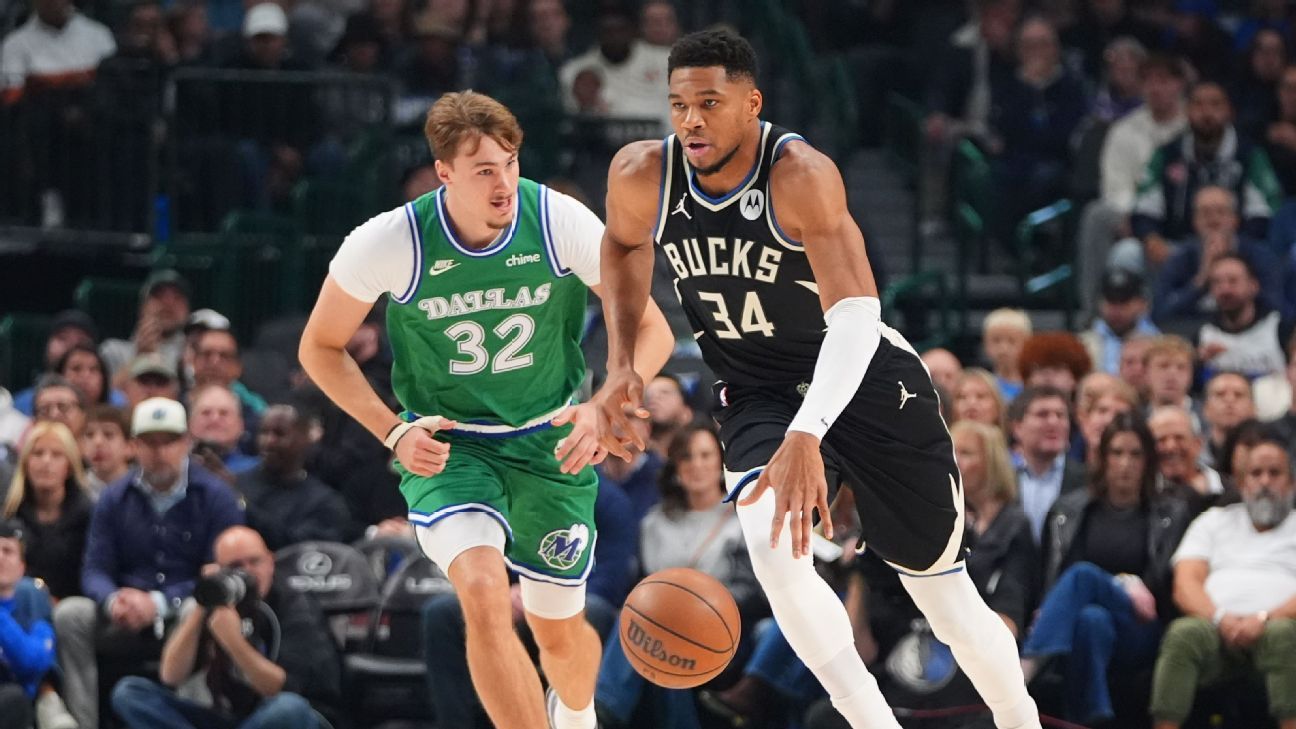
DESPITE THEIR POST-DEADLINE denials, the Warriors front office had Green's name included in conceptualized trades that would've landed them Giannis Antetokounmpo from the Milwaukee Bucks at the deadline.
Green was alerted to this reality a few days before.
"This is probably it," Green said he told himself. "And I got to be OK with that. You see so many people leave places bad and I just didn't want that."
The most recent pillar of the Warriors' dynasty to depart, Klay Thompson, didn't leave on the greatest terms or with the brightest feelings about the organization's decision-makers. Kerr and Green -- who could theoretically be entering their final month with the franchise -- desire an amicable end, whenever it comes.
"I'm a human being," Green said. "There was a second of me [at the deadline] that felt like, 'Damn, they really going to do that to me?'"
But he recalibrated quickly.
"I understand this business probably [as] good as any player," Green said. "I understand like, yo, this is Giannis Antetokounmpo. They not just about to trade me for a bag of peanuts. It would've almost been a point of pride.
"I'll be honest though. I didn't want to play for Milwaukee."
Dunleavy disputed the idea afterward that Green's name was in talks and said the rumors were forcing the franchise to "pick up the pieces."
But Green said he never had an issue and never demanded answers from Dunleavy or controlling owner Joe Lacob, who has always supported Green and would've needed to green light a Green trade
"You've been around me," Green said of his lack of subtle communication. "He would feel if he needed to talk to me. Everybody would feel if they needed to talk to me. They'd feel that s--- the day that it happened. No one ever felt that because there was never a f---ing need."
But their willingness to put Green in a deal with the Bucks cracked open the possibility that Green's 14-season career with the Warriors isn't guaranteed to stretch to 15. Dunleavy and Lacob are expected to again explore large-scale moves in the summer, team sources said, which would put nearly everything on the table.
"I didn't spend time on the conversation," Curry said. "But I guess Giannis is the only one that would've made sense. And I think, to his point, any team would've looked at that. But we never got there. I guess I'm the only one that is off the board, out of the conversation, but you have to be naïve to not understand the business side of it."
Green holds his own lever of control. He has a $27.6 million player option for next season, giving him and his agent, Rich Paul, a voice in the process.
Green was last a free agent in the summer of 2023. He had a player option for $27.6 million that he declined, lowering the salary on the first year of his new deal to $22.3 million -- saving the Warriors approximately $43 million in tax -- to help secure a four-year, $100 million deal with the player option he currently wields.
Green could opt out and test unrestricted free agency again this summer. League sources said a reroute to the Los Angeles teams were on his radar when the idea of a possible trade surfaced.
But the opt-out to test unrestricted free agency isn't a route team or league sources are predicting. The expectation is that Green will either opt in -- keeping him as a bulky $27.6 million expiring deal that the Warriors could either hold or move -- or work out a multiyear extension starting at a lower number, signaling a greater likelihood he finishes his career with the Warriors.
"I feel better defensively than I ever have," Green said, indicating recently he only views Wembanyama as a better defender than himself even at this advanced stage. "The numbers won't show with straight up steals and blocks. Stocks, which is what people look at. But I just do it a different way. I can't get the block shot all the time anymore, but I can cover it. I may not come up with the steal, but I make sure [the action is] gridlocked."
Green still has a goal ahead of him this season. His coaches and teammates believe he should be named to an All-Defense team for a 10th time, something only Kobe Bryant, Tim Duncan, Scottie Pippen, Kareem Abdul-Jabbar and Kevin Garnett have done.
"Jimmy got hurt and then my knee blows up," Curry said. "Didn't think I'd be out this long. But the biggest thing with Draymond is he's been available. I just hope that there's something to play for at the end that makes it all worth it. That's part of the reason I want to come back is to see that through."
Green said he doesn't plan to stick around on the end of the bench past his rotation days [Udonis Haslem-style] but believes he still has a few more seasons left as a winning contributor. Kerr agreed.
"But he has to reconcile all these forces -- the force of his personality, the force of his game and it's going to depend on circumstances," Kerr said. "He can definitely do it. It's just a matter of does he want to do it and are the circumstances right for him, for the team, for other teams, wherever it ends, whether it's here or elsewhere."