 1 month ago
54
1 month ago
54
Hazel ShearingEducation correspondent

 Getty Images
The government compared student loan repayments to a £30-a-month phone contract in a presentation to teenagers a decade ago, BBC News has discovered.
The presentation was part of a series of "student finance tours" delivered to thousands of schools between 2011 and 2017, by graduates who were asked to speak to pupils and parents on the then-government's behalf.
The graduates were told to "avoid words [or] phrases like debt", with one former presenter now telling the BBC he felt like he had "sold his soul to the devil".
The Department for Education (DfE) said the presentations were delivered under previous governments, and that current ministers had focused on making the system fairer.
The National Union of Students said the script for the presentation about Plan 2 loans - which have been heavily criticised this year over their high interest rates and changes to the repayment thresholds - had "aged poorly" and was "deeply misleading".
According to a government contract with Event Marketing Solutions (EMS) - a private company that hired graduates and delivered tours - the aim was to "convert" young people from disadvantaged backgrounds into "actual [higher education] applicants".
The BBC understands that the presentation, script and notes would have been either provided or approved by the Department for Education.
One script from 2016-17, seen by the BBC, stresses that applicants should do their research and tells them where to find further information. Where possible, graduates took questions after the presentation and the script refers to an accompanying leaflet, which the BBC has not seen.
However, the BBC has spoken to former presenters and interviewed two who say they feel the implications of taking out a loan were downplayed.
The revelations come as the government faces mounting pressure to change the repayment terms of Plan 2 student loans, which were issued in England between September 2012 and July 2023 and are still issued in Wales.
Ed, who was among the 2016 presenters, said he felt he was helping those who were thinking about going to university at the time, but now feels one part of the script in particular seemed like a "sales tactic".
In a section explaining that graduates would repay 9% of anything they earned above the repayment threshold, which was £21,000 at the time, it gives an example of someone earning £25,000.
"You'll pay 9% of £4,000. In case you're wondering, that works out at just under £7 a week – or just under £30 a month," it reads.
"I don't know about you but my phone contract costs about that which might help to put things into a context and point out that the monthly repayments are entirely affordable."
 Handout
Reflecting on the presentation he delivered, Ed says it feels like he "sold his soul"
Ed said he could see the example given in the script, which was accurate for Plan 2 loans taken out at the time, was designed to engage teenagers.
But he said the "minor life decision" to sign up to a phone contract is "completely separate" to the "huge life decision" to take out a student loan.
According to Student Loan Company figures, the average graduate now leaves university with debts of about £53,000, with repayments made via HMRC averaging £93 a month in the most recent data.
But with interest being added to the total debt each year, and any remaining balance being wiped at the end of the loan's term, many students never repay it in full.
Ed said he has struggled to afford his student loan repayments since moving to Australia in 2018. Still, he feels "lucky" to have gone to university before Plan 2 loans were introduced.
"I feel like I kind of sold my soul to the devil a little bit," he said.
Most people who go to university in England, Wales and Northern Ireland take out student loans to cover the cost of their tuition. In many cases - including in Scotland, where tuition for Scottish students is free - they take out loans for living costs as well.
But the repayment plans differ depending on where they live and when they went to university.
The amount graduates are allowed to earn before making student loan repayments will rise from £28,470 to £29,385 in April, but then remain at that level - rather than continuing to increase with inflation - for three years. That means graduates whose salaries rise with inflation will end up paying more.
The thresholds may have changed, but the repayment rate has not. So Plan 2 graduates who are currently earning £4,000 above the threshold will still repay 9% of that - the same £30 a month described in the 2016-17 script.
But those on higher salaries have to pay more. Anyone earning £50,000, for example, will be paying more than £160 a month.
Katie, who lives in London, applied for the job of delivering the government's presentations a decade ago because she wanted to help people from disadvantaged backgrounds go to university.
 Hazel Shearing / BBC
Katie says student loan repayments on a higher salary can feel like a second mortgage
She said examples of monthly repayments with higher salaries of £50,000 or £60,000 should have been given, too, adding: "I've got friends in that category and they refer to their student loan as their second mortgage."
The script tells students their loans will accrue interest, but certain information on how it's applied - including that as well as the Retail Prices Index (RPI) measure, there is an additional amount added of up to 3% depending on earnings - was marked on the script as not to be included in the presentation.
Supplementary notes to the script, also seen by the BBC, told presenters they should not "get bogged down in explaining the way interest is calculated" and advised them to "avoid words/phrases like debt, poor/poorer, free money, I can guarantee".
Katie said: "There's some real big facts in there that weren't conveyed to students at the time."
"It feels unfair, it feels unjust."
Amira Campbell, president of the National Union of Students UK, said the script had "aged so poorly" and the comparison to a phone contract was "deeply misleading".
She added that the tour was an opportunity to "have honest conversations", but the script "reads as a sort of brochure for student debt that makes it all look prettier and happier and lighter and more affordable than it actually is".
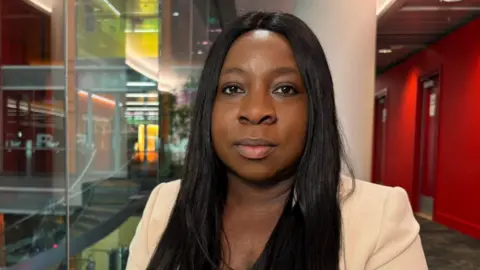
Funmi Olufunwa, a financial educator and consumer finance lawyer, said it was "strange" that some details about interest rates were marked "not for the presentation" because that is "one of the most fundamental pieces of information".
 Hayley Clarke / BBC
Funmi Olufunwa said the presentations should have given more salary repayment examples
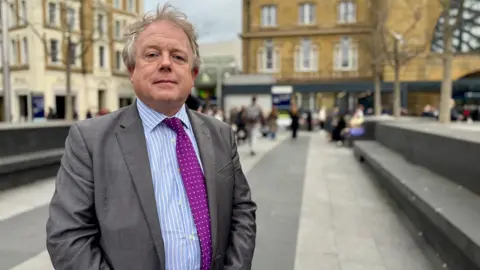
However Nick Hillman, director of the Higher Education Policy Institute, who advised the government when Plan 2 loans were being designed, said the tours proved the government did explain how the system worked to young people.
He said the script was "very defensible" and the phone contract comparison was "fair", since the script was designed to meet teenagers "at their level of understanding".
 Hazel Shearing / BBC
Nick Hillman said all the information included in the presentations was accurate
He said student loan repayments were "generally affordable" and payments for many people were "a few pounds a week".
"With the benefit of hindsight, one might have put other information in there. But there's nothing in there that's factually incorrect. There's nothing in there that would count as mis-selling," he said.
The DfE said: "These tours were delivered between 2011 and 2017 under previous governments.
"This government has focused on making the system fairer, including by reintroducing targeted maintenance grants to support students from lower-income backgrounds and widening access to higher education and high-quality training."
A spokesperson for the Student Loans Company said the student finance tours were "commissioned, contracted and led" by the then-government.
"SLC's role is to administer government student finance policy, supporting customers to understand their eligibility, how to apply, their repayment obligations and how repayments are processed," they said.
"We communicate this information and guidance, but we do not provide financial advice or promote student finance."
The EMS Group declined to comment.
Additional reporting by Ruth Green, Nathan Standley, Hope Rhodes, Hayley Clarke, and Emily Holt.