
Bill ConnellyFeb 16, 2026, 07:50 AM ET
- Bill Connelly is a writer for ESPN. He covers college football, soccer and tennis. He has been at ESPN since 2019.
IT CAN BREAK your brain talking about college football. Frame it just right, and it appears that the sport has never been as fantastic as it is right now. The TV ratings are excellent, and the games are as fun as you could hope -- even the bowls, which we've been proclaiming as dead for years. Plus, Indiana's national title is proof that, while the sport's blue bloods can still dominate, new brands can compete for the ultimate prize. In this regard, there's no open sign that college football has any worries whatsoever.
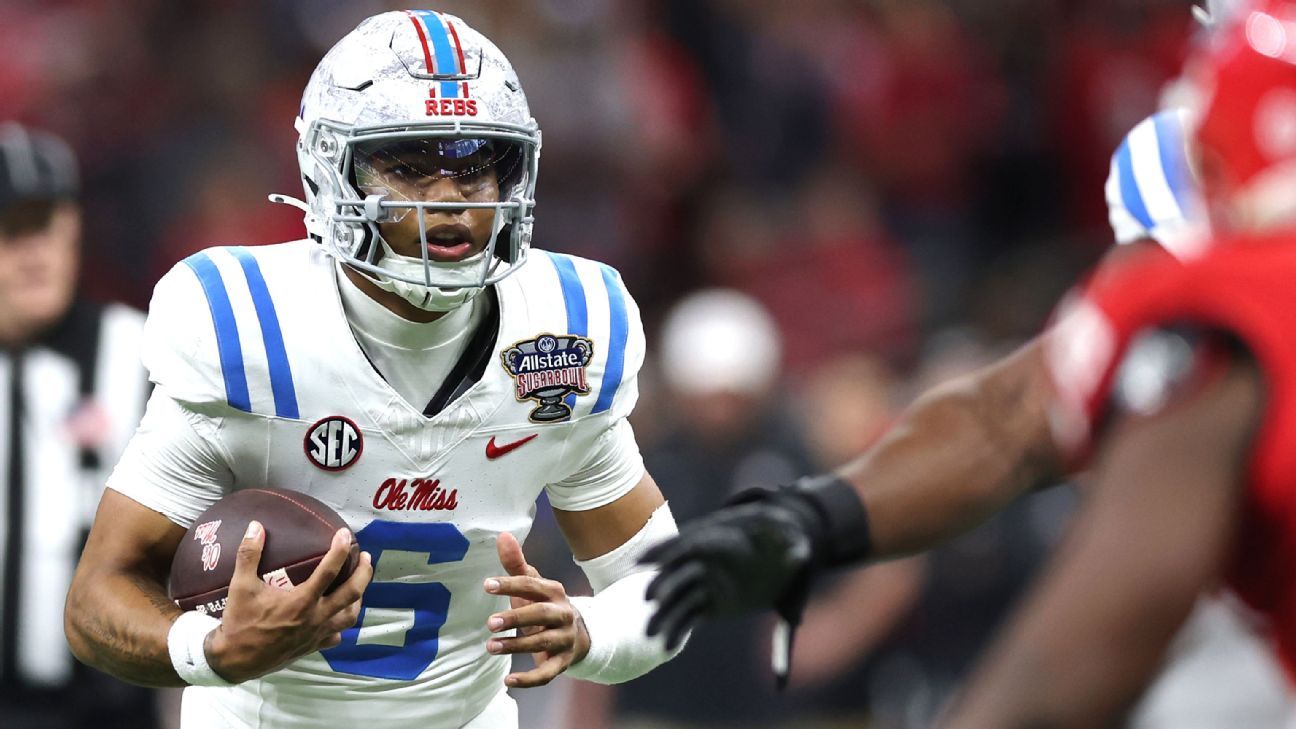
From another lens, however, the sport is on the brink of disaster. On Jan. 8, the day of the classic Miami-Ole Miss College Football Playoff semifinal -- and not long after a fantastic quarterfinal round -- The Athletic's Daily Pulse newsletter asked fans a simple question: "Do you like college football right now?" Even as a pulsating postseason was coming to a close, 56% of respondents chose, "No. It's a mess." Only 21% chose "Yes. The games are great," even though the games are undeniably great.
Now, this is just how things go. We like to grouse. No one really likes the way the NFL goes about its business -- fans are forever gouged for more money, the owners are mostly unlikable, and commissioner Roger Goodell is always serving as a dartboard for something or the other -- but the NFL's games are as popular as ever. And don't even get me started on the Premier League; its fans (and, often, writers) complain all the time, and its popularity has never been stronger, with the league citing record audiences for its season-opening weekend.
Still, warning signs are warning signs. In my 2025 book, "Forward Progress: The Definitive Guide to the Future of College Football," I spent a chapter laying out how sports fall from grace. There are lots of cautionary tales -- from NASCAR, boxing, baseball, college basketball -- and the overriding message is generally that (a) you don't know you're in trouble until it's too late, and (b) you aren't in nearly as much control of your future as you think. If something's a problem, you need to identify it before the storm clouds appear.
College football is working through a lot of short- or intermediate-term issues at the moment. Without collective bargaining or a change in employment laws, we're finding that NIL-based contracts with players are only semi-legitimate and enforceable. Tampering -- making contact with players who aren't yet in the transfer portal to try to pull them toward your school -- is rampant, and it doesn't appear that anti-tampering rules are particularly enforceable either. Rosters are changing significantly, too, which gives fans fewer opportunities to truly know and connect with their teams.
In theory, this is all temporary, and the sport might one day have a far stronger set of (enforceable) rules and regulations in this regard. We're clearly in a place of working from Point A to Point B, even if we don't know for sure where things will end up. (The sooner we get there, the better.)
In the meantime, the greatest story in recent college football history offers us a warning sign of its own. College football exploded in popularity in the 20th century, in part because of the sports version of manifest destiny, the American ideal of expansion and innate exceptionalism. The greatness and promise of the sport spread unabated as schools from throughout the country -- from the Ivy League territory, to Michigan and Ohio and, by the 1920s, the South and Southern California -- found they really enjoyed this sport and wanted to be the best at it. But with the way that money and access to power are flowing, that sense of manifest destiny might soon expire.
Indiana is the best thing that could possibly happen to this sport (but consolidation could have prevented it)
THE PROGRAMS THAT emerged as the best of the bunch in those early decades have spent the past half-century periodically threatening to close the gates behind them. In the early 1970s, Arkansas coach Frank Broyles was among the more vocal coaches and administrators in attempting to rally support for a "superconference" of 40 or so schools, potentially broken into four divisions.
"The spread is widening every year," he told local media in August 1973. "The Southern Cals and the Alabamas would schedule each other and then we will eliminate many of the problems we've got financially." And he of course claimed to be thinking about the little guy as he proposed a system that would clearly benefit his school. "If we don't do this in a hurry, a lot of schools are going to drop football entirely within the next three years." It would help the little guys, you see, because they could stop trying to spend so much money to keep up.
Meanwhile, in 1975, when Long Beach State president Stephen Horn began pushing a proposal to more evenly distribute the revenue from the NCAA's televised football deal, there weren't enough fainting couches to go around. The reaction among most major conferences was unified and defiant: Do this, and we'll pack up and form our own superleague.
From those initial discussions came something useful: The NCAA broke its membership into Divisions I, II and III in 1973, and within Division I, schools formed what are now the FBS and FCS subdivisions in the late 1970s. But the groupings remained large enough to reward new ambition. If Broyles and company had gotten their way, there's no way that Florida State, Miami or BYU, for instance -- teams that would win eight national titles between 1983 and 2001 -- would have made the cut. How would that have made the sport better?
While the volume has risen and fallen over time, talk of a breakaway by the big schools has never fully disappeared. Over the past couple of years we've seen a number of proposals, typically backed with the promise of private equity cash, to pool television rights deals and consolidate the teams in the top division. Here's one from late 2024, and just last month, the SEC's Greg Sankey told Yahoo that there are "limits to" the league's commitment to a national organization if rules aren't being enforced in ways they would prefer.
Through conference realignment and the media rights arms race, we've seen the playing field tilted further toward college sports' power conferences over the past 15 to 20 years. In 2008, according to the Knight-Newhouse College Athletics Database, Big Ten and SEC schools spent about 2.6 times more in total football expenses per team than what we would now call the Group of 5 (soon to be Group of 6) conferences. By 2023, it was 4.3 times more. Spending rose by 95.8% among G5 schools in that span, but it rose by 220.7% in the SEC and Big Ten. And this range ended before the latest round of realignment, which sent Oklahoma and Texas to the SEC and four teams from the Pac-12 to the Big Ten. That multiple has undoubtedly grown even further, in other words, and this has happened at a time in which NIL spending and freedom of player movement via the transfer portal has allowed talent to move upward at a rapid rate.
No one seems to think this era of consolidation, so to speak, is over. It soon might come from within. The SEC and Big Ten dominate financially, but when future media rights negotiations approach, many are guessing that the Ohio States of the world will leverage their way toward more of the financial spoils, likely using the continued threat of some foreboding "superleague" to force concessions out of the Minnesotas and Purdues. Indeed, when most of the Big Ten signed on to a potential private capital deal recently to make the world's richest collegiate conference even richer in the short term, it seemed as if the promise of a 20-year grant of rights, tethering the league's biggest names to its smallest, was one of the major carrots. It was only put on hold when two of the league's richer entities, Michigan and USC, pushed back.
None of us fell in love with college sports because of the amazing financial leverage, and Ohio State already has the most money and doesn't need to coerce its peers into giving it even more. But fear is the greatest motivator. Bigger brands just leveraged their way into a larger piece of the pie within the ACC, and the general ethos in every industry at the moment is, if the leverage exists, it must be deployed.
Again, though: Think of what a superleague would take from us. Never mind the far-off examples from the 1970s -- if a 20- to 40-team superleague had formed two years ago, it probably wouldn't have included Indiana and definitely wouldn't have included Texas Tech. Neither has a long-celebrated football brand, and heading into 2025 the two schools were 72nd (Tech) and 103rd (Indiana) among FBS programs in all-time wins. Indiana, in fact, was first in all-time losses.
The Hoosiers and Red Raiders are currently the sport's foremost progenitors of manifest destiny. Indiana is 27-2 since hiring Curt Cignetti two years ago and, in 2025, conquered a series of the most blue-chip-heavy rosters in the sport to claim its first national title. Texas Tech, meanwhile, has brazenly used a West Texas oil billionaire's money to bridge the sport's growing revenue gap then rode a celebrated transfer class to its first Big 12 title and the playoff's No. 4 seed.
Granted, their success only proves that manifest destiny applies to teams that are either (a) in the Big Ten or SEC or (b) have access to football-loving billionaires. But both IU and Tech reached their current heights not only because of spending but because of spectacular execution. Both schools brought in transfers who proceeded to play at a much higher level than they had at previous stops, suggesting that talent identification and development were as or more important than raw cash totals. That should give many other schools hope.
Indiana and Tech have given us extreme reminders that you never really know the future like you think you do and that changes in the sport -- be it a newfangled offensive trend or a change in transfer rules -- can create inefficiencies to exploit and alter the landscape for a little while. Sure, the balance of power usually returns to normal, but the picture gets scrambled more than we tend to recognize. And we would miss out on some incredible stories if we voluntarily shrink the size of college football's big tent.
The sport has always been at its best when well-represented
IMAGINE BEING A college football fan in the early 1980s. You know everything about your own team (and, perhaps, its conference), and you've seen all the big rivalry games with the NCAA's limited television package. But suddenly, on ESPN and elsewhere, you're discovering pieces of the college football universe you never knew existed. With the cork getting popped following the landmark NCAA v. Board of Regents case -- which essentially determined that the NCAA could not control and limit televised college sports -- here's what you would have seen from ESPN's 1984 live slate alone:
BYU's season-opening upset of No. 3 Pitt, which supercharged a national title run that also culminated on ESPN with the Cougars' Holiday Bowl win over Michigan.
No. 4 Texas beating Bo Jackson and No. 1 Auburn 35-27.
Boston College QB Doug Flutie throwing for six touchdowns against North Carolina.
Vanderbilt nearly pulling off a 28-point comeback against No. 12 LSU in Baton Rouge, then Iowa State nearly knocking off No. 2 Oklahoma as a 28-point underdog.
West Virginia fans rushing the field after a late comeback earned the Mountaineers their first win over Penn State in 25 years, then Navy coming within a last-minute field goal of beating Notre Dame for the first time in 21 years.
Thurman Thomas going off as Oklahoma State topped Missouri on the way to a surprising top-10 finish.
Texas A&M surging to a 30-0 lead in front of the third-largest crowd ever at Texas' Memorial Stadium and preventing the Longhorns from a share of the SWC title.
That doesn't even include Maryland's record-setting comeback win over defending champion Miami, Flutie's famous Hail Mary against the Hurricanes, or a number of shocking upsets of No. 1 and No. 2 teams. The 1984 season was the first to be saturated by television, and it was one of the wildest, most world-building seasons the sport has seen.
A lot of a national title game's TV ratings are determined by the score itself. Since the start of the BCS era in 1998, games decided by three or fewer points (or in overtime) have averaged 29.3 million viewers, while games decided between four and seven points have averaged 26.3, games between eight and 21 points have averaged 25.5 and games decided by 22 or more points have averaged 24.2 (22.8 if we take out the 2014 title game, which got a boost because of the first year of the CFP). If we control for the scoring margin -- creating a loose regression formula to determine expected viewers based on score -- we find that games with at least one new* team average 1.1 million more viewers than expected. Games with no new teams average 1.1 million fewer (1.9 without the 2014 outlier).
(* For these purposes, we'll define a "new" team as one that is either appearing in its first title game or playing for its first title in at least 20 years.)
This is all pretty small-sample stuff, and we know that big-brand games tend to do great in the regular season. But you can make a pretty easy case that a sense of discovery is fantastic for the sport. At the very least, new blood in the title game doesn't hurt anything -- just as the emergence of schools like Miami and Florida State in the 1980s certainly didn't. That's a pretty big revelation considering how much of the sport's recent machinations have favored known brands over everything else.
Next year comes the 20th anniversary of maybe the most celebrated upset in the history of college football: Boise State's 43-42 win over Adrian Peterson and Oklahoma in the 2007 Fiesta Bowl. The Broncos, just a decade removed from playing FCS ball, raced to a 28-10 lead early in the third quarter, but disaster struck late in the game: OU tied the game at 28-28 with 1:26 left, then took a sudden lead with Marcus Walker's pick six 24 seconds later.
Facing a fourth-and-18 in the closing seconds, Jared Zabransky completed a short pass to Drisan James, who lateraled to Jerard Rabb, hook-and-ladder-style, as defenders converged on him for a 50-yard touchdown with seven seconds left. In overtime, Peterson immediately put the Sooners ahead, but receiver Vinny Peretta threw a gadget-play touchdown pass to Derek Schouman, and on a 2-point conversion attempt, the Broncos pulled off what might be the only successful Statue of Liberty play of the past 50 years. Ian Johnson scored the game-winning points, then proposed to his cheerleader girlfriend on live television. It was the perfect college football experience.
Here, I'll give you a minute (or 21) to catch up on the extended highlights. I promise there are about 16 wild plays you've forgotten.
We're actually in the middle of a pretty amazing run of 20th anniversaries. Jan. 4 marked 20 years since Texas' famous win over USC in a perfect Rose Bowl. And in another year and a half, it will be the anniversary of the 2007 season, the messiest season in the sport's history. We should try to make a 30 for 30 about it.
In the 2005-07 range alone, the sport's biggest brands showed off their upside, countless fan bases got a rush of "maybe our team can do it" energy (primarily from 2007), and Boise State provided a jolt of "maybe anyone can do it" energy the sport had almost never seen. Whatever your favorite version of college football is, you saw it in that span.
As it turned out, this run set too high a bar. By 2010, Nick Saban's Alabama was becoming an all-conquering juggernaut, and the Big Ten had ignited a powerful round of conference realignment and a media rights arms race that hasn't really stopped. These power conferences grew larger and more powerful, and they eventually even devoured one of their own. The Pac-12 no longer exists in its original form, and the Big Ten and SEC command far more of the financial pie than anyone else. The sport has done everything it could think of to snuff out "anyone can do it!" energy, at least as far as mid-majors are concerned.
When Oregon smoked James Madison and Ole Miss beat up on Tulane in the first round of the College Football Playoff, it was heralded as proof that mid-majors can never again compete in big-time football, and, in Broylesian logic, it would be to their own benefit if they were to form their own subdivision, create their own national title and leave the big-boy game to the big boys. It's unfair to the Dukes and Green Wave to ask them to play these games, you see. We would be doing them a favor if we cut off their access.
We don't do this with other college sports. There weren't endless columns or TV segments questioning the tournament worthiness of Mount St. Mary's last spring when the Mountaineers got blown out by Duke in the first round of the NCAA men's basketball tournament. It's just accepted that they're there because that's how collegiate tournaments work and that, for all the blowouts, the minnows occasionally give us upsets that we talk about for decades. Even within college football itself, FBS is already the outlier in not including every champion in its year-end playoff, but we waited so long to give even five conference champions proper title access that full access seems as alien as playing the game with two footballs.
We also waited until the quality of the best Group of 5 teams was at a lower ebb to grant access. And it's pretty demoralizing that the conclusion many of the sport's loudest voices are drawing isn't, "Hmm, we screwed up the balance in the ecosystem, and we should do something about that." It's "We should just cut them off entirely, for their own good."
James Madison probably can't become the next Boise State. With the way that talent currently flows in this sport, it's possible that no one can. Indiana's title-winning team, in fact, not only included former JMU head coach Cignetti but also seven key former JMU players, including star receiver Elijah Sarratt, No. 2 tackler Aiden Fisher, All-America corner D'Angelo Ponds and two excellent defensive linemen, including title-game hero Mikail Kamara. All of those players would have come in awfully handy for the Dukes against Oregon, and if current spending disparities and player movement had existed in the mid-2000s, Boise State's own rise would have been much harder to pull off.
Still, talent flows in multiple directions in the portal, and if scouting and great execution can turn the sport's losingest program into its best, it can boost JMU as much as it hurts the Dukes, too. And the Boise bar isn't as hard to clear as you might think. At their peak, the Broncos ranked 13th in SP+ in 2006, 14th in 2009 (after slipping to 45th and 23rd in a pair of transition seasons), ninth in 2010 and sixth in 2011. Could a JMU or any other ambitious mid-major do that in the late 2020s? They probably couldn't rank sixth, but that's an average ranking of 18.3 over six years. JMU's average ranking has been 29.3 over the last three. Those numbers aren't particularly far apart, and in the past three seasons alone, even with the increasing spending disparities, six different mid-major programs (Boise State, JMU, North Texas, a pre-ACC SMU, Troy and South Florida) have finished a season in the SP+ top 30. North Dakota State is now joining the party, too, and the best Bison teams of recent years would have threatened a top-30 ranking themselves.
Keep this in mind, as well: As late as 2005, not even Boise State knew it could become Boise State. Fresh off of a sterling 11-1 campaign, Dan Hawkins' BSU Broncos began 2005 by getting utterly demolished 48-13 by No. 13 Georgia (a team worse than 2025 Oregon). The Bulldogs' DJ Shockley threw for 394 yards and five TDs, and Broncos defenders were simply unable to account for Georgia's speed advantages. Meanwhile, a BSU offense that had averaged 48.9 points per game the season before, turned the ball over six times and didn't get on the board until well into the second half. It was a classic "Oh, you think you're hot for beating Little Sisters of the Poor? You don't belong in the big leagues" pummeling.
Sixteen months later, BSU beat Oklahoma. And six years after their humiliation in Athens, the Broncos returned to the state of Georgia and thumped the Bulldogs 35-21 at the Georgia Dome in Atlanta. It was their fifth straight win over a ranked power-conference opponent. The embarrassment in Athens was a catalyst for growth, not confirmation of permanent inferiority.
JMU is just four years removed from the FCS ranks, and it earned a playoff spot as one of the five highest-ranked conference champions after wacky ACC tiebreaker rules resulted in Duke winning the league's title. The Dukes made the 51-34 final score look semi-respectable in garbage time against Oregon, but their shortcomings were laid bare. They enter 2026 with a pretty clear understanding of what most needs addressing if they want to continue moving up the ladder, and in a sport with a healthier dialogue, we might frame JMU's loss as a building block and learning experience, a la Boise State-Georgia.
This sport doesn't have a healthy dialogue, however. We hate an ambitious underdog. When we put them in their place, we expect them to stay there.
We still need manifest destiny
IN THE SHORT TERM, there really isn't any way to curb the sport's current financial realities. We know who holds the cards. I'd love to be able to propose some amazing, Division I-wide revenue sharing device that redistributes money in a way that tamps down outliers and allows for well-organized G6 programs to hold onto some of their talented players (and doesn't diminish the overall pool of money available to players). I'd love to talk about the potential benefits and drawbacks to the pursuit of the sort of unified media rights deal that an aforementioned West Texas billionaire is pushing (only, with more even revenue distribution). And man, if you want to have a conversation about the benefits and drawbacks of promotion and relegation, you know I'm down for it. But there probably isn't any way to get the SEC and Big Ten on board with a giant, private-equity backed superleague, or anything else, unless you give them all the same advantages they already have. We've given them all the power, and they aren't going to give that away out of pure generosity. That's why you don't give the elites everything they want in the first place -- it's really hard to take it back.
That doesn't mean that these conditions will last forever. Again: We never really see the future as well as we think we can. When we talk about Boise State-Oklahoma in the coming months, you'll probably hear a lot about how it was something that probably couldn't happen today. But no one thought it could happen then, either, especially as the Broncos were getting boat-raced all over Sanford Stadium. Boise State still found a winning formula, and perhaps JMU or another mid-major could, too. It's no less realistic than Indiana suddenly building the best team in the country.
So much of the sport's uniqueness comes from its open-endedness, its spirit of manifest destiny. This is a regional sport that became national because so much of the nation fell in love with it and wanted to become awesome at it. And that spirit appears to be the thing some are most willing to eliminate. Well, to hell with that. We should be doing everything we can to support and enable anyone ambitious enough to give top-flight college football a shot. The moment we officially close our doors to potential usurpers is the day college football ceases to be college football.