 3 months ago
142
3 months ago
142

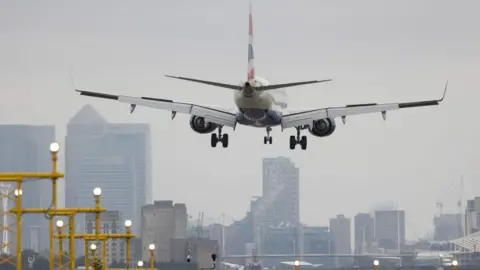 Bloomberg/Getty Images
Airlines say they are not currently facing problems with fuel
Theo LeggettTransport correspondent
Airlines will be able to cancel flights weeks in advance, without losing valuable take off and landing slots at busy airports, if they face fuel shortages this summer.
New contingency plans have been drawn up by the government to let carriers plan ahead, helping to avoid disruptive last-minute cancellations for passengers.
Ministers have also asked the UK's four refineries to maximise jet fuel supply, and are exploring ways to increase supplies from the US.
Airlines say they are not currently experiencing fuel supply problems, but experts have warned that disruption to deliveries because of the Iran war could bring shortages within weeks.
The UK imports about 65% of the jet fuel it uses, a significant portion of which comes from the Middle East under normal circumstances.
But the closure of the Strait of Hormuz means those supplies cannot get through.
The government wants to allow airlines to save fuel by adjusting their schedules in advance, for example by cutting one or two flights a day on a route where they have many services to the same destination.
Airlines are usually reluctant to do this because it would place at risk their right to retain their allotted take off and landing slots at airports like London's Heathrow and Gatwick.
Such slots can be worth tens of millions of pounds, but change hands only rarely.
The allocated slots over a summer or winter normally roll over to the following year, but there is one key condition: they have to be used at least 80% of the time, otherwise they can be snapped up by rival airlines.
In practice, this can encourage airlines to fly half-empty planes to keep the slots.
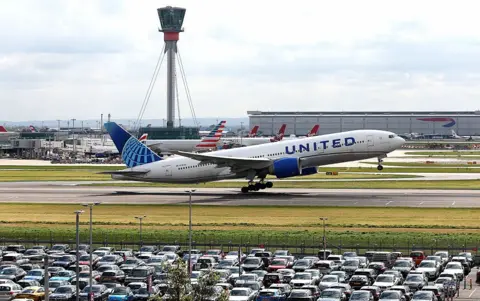 Getty Images
Take off and landing slots are particularly valuable at busy airports like Heathrow
The rules as they stand are contained in the Airports Slot Allocation Regulations 2025, which incorporated the EU's rules into UK law.
They are usually implemented by Airport Coordination Limited (ACL), an independent body managing slot allocation at UK airports and many globally.
Carriers have become increasingly concerned about what would happen to their slots if they have to respond to fuel shortages in the coming months.
In late April, the government said new ACL guidance for airlines made clear they would not lose their slots if a lack of fuel prevented them from flying.
Easing risk of last-minute cancellations
The new plan, being announced on Sunday, goes further by letting carriers hand back unused slots temporarily, while having the right to still use them the following year.
It is intended to allow them to axe flights at least two weeks in advance - anticipating potential problems rather than reacting to them.
The government believes this would reduce the risk of last-minute cancellations.
"We're preparing to give families long-term certainty and avoid unnecessary disruption at the departure gate this summer," said Transport Secretary Heidi Alexander.
"This legislation will give airlines the tools to adjust flights in good time if they need to, which helps protect passengers and businesses."
Airlines UK, which represents UK-based carriers, has welcomed the move.
Its chief executive Tim Alderslade said the plan would allow them to "avoid unnecessary flying and continue operating as efficiently as possible while protecting connectivity for passengers and trade".
The move requires legislation, in the form of a statutory instrument, and a short consultation is taking place this week.
The government says it is also looking at ways to "increase flexibility of jet fuel supply", including possibly allowing a US specification of fuel, known as Jet A, to be used in the UK.
Airlines in Britain and across Europe are obliged to use a different formula, Jet A1, which has a lower freezing point.
Jet A might help reduce the risk of shortages for UK airlines, but high demand and infrastructure challenges may make this a tall order.
What are your rights if you're disrupted?
Under existing rights, when flights are severely delayed or cancelled passengers are entitled to some support from their airline.
This includes being rerouted or granted a refund and being provided with "care and assistance", such as food, drink and overnight accommodation when necessary.
The rules also mean passengers are entitled to financial compensation in the event of severe disruption.
Airlines have lobbied for fuel shortages to be explicitly classified as "extraordinary circumstances", which would allow them to avoid making payouts.
So far, that plea appears to have fallen on deaf ears in the UK but the European Commission has suggested airlines may not be required to provide compensation if they can "demonstrate that the disruption was directly caused by the jet fuel shortage and that all reasonable measures were taken".