
 3 months ago
123
3 months ago
123
1 hour ago
Laurence CawleyEast investigations

 BBC
BBC
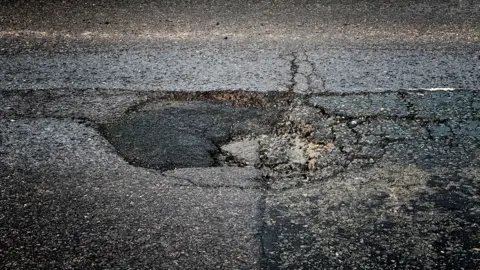
The BBC first started charting the fortunes of one of Turner Road's potholes during the frosts of February 2025
This pothole was merely one of more than a million that blight our roads.
Measuring 60cm (24in) wide and 10cm (4in) deep, it stood on a busy suburban route in Colchester.
Department for Transport (DfT) data shows potholes and other road defects have played a role in dozens of deaths and hundreds of injuries during the past decade, and opinion polls suggest they are among the top issues for voters.
Such concerns led Essex County Council's new Reform UK-led administration to declare a "pothole emergency", setting out funding to increase the number of repair teams from nine to 12.
This otherwise unremarkable pothole, which emerged from the crumbling ruins of a previous patch-up job, pre-dates that initiative, but how long would it take to be noticed, reported and fixed? And how long would that fix last?
To find out, the BBC spent more than a year monitoring it.
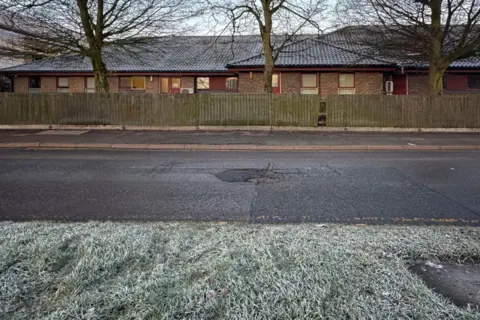
About 90% of traffic using Turner Road is cars or taxis
Despite being classed as a minor road, Turner Road is home to Colchester's hospital and a primary care centre. Various residential streets branch off on either side.
The BBC first started charting the pothole's ups and downs during the frosts of February 2025.
It began as a crack between two previous repairs, gradually getting deeper and wider as more of the road's surface collapsed and broke away.
Riders and drivers took increasingly elaborate swerves to avoid the wince-inducing jolts of a full-on pothole clunk.
Logs released to the BBC under Freedom of Information rules reveal it was first reported to Essex County Council in September 2024.
The pothole and a number of others in Turner Road were given a job number (2374931) and photographs were taken by highways workers.
Then, within two and a half hours during the hours of darkness on 21 February 2025, the road was closed off and repairs carried out.
Ringway Jacobs, the contractor, patched up the cavity with a 1sq m (10.8sq ft) and 10cm (4in) deep repair, crowned with a glossy black bitumen edge seal.
Once finished, the repair crew photographed their work and left.
But just eight weeks later, the edge seal was starting to wear away on the sides.
Within nine months, the patch repair had stretch marks, splits in the surface and, to its left edge, a new pothole had opened up.

David King first asked for the pothole - and numerous others in Turner Road - to be fixed in 2024
The logs revealed David King, Liberal Democrat councillor for the area, first brought the Turner Road potholes to the county council's attention and used part of his council budget to fund the repair.
Asked whether he felt he had got his money's worth, King said: "We can agree that I, and the ratepayer and resident, did not.
"We've all got different expectations – my expectation would be that a repair should last at least a year."
The BBC asked the county council what type of patching was used for the repair and how long it felt it should last.
A council spokesman said: "Make-safe repairs are short-term fixes to dangers on the roads while permanent repair patches are expected to last a year.
"The cost of each repair would depend on many factors, however the cost of carrying out a make-safe measure, not only being quick, is also economical."
The BBC asked four road surfacing experts how long a pothole repair should last.
All said the lifespan of a cold lay repair was anywhere between a single day, if a wheel turned awkwardly on it, to six months.
Three of the four said they disliked cold lay repairs and that a properly laid hot fill option, done to the proper depth and with a tack coat emulsion, should last years.
King said potholes were the issue most often raised with him as a county councillor, with new ones being flagged to him daily.
"Highways is the one thing that everybody experiences and it's the one thing that they have a view about and it's not pretty," he said.
"Up and down the country and up and down this road, there are hundreds, thousands of potholes and there's a real question about the quality of repair and value for money."
However, King believes potholes are a symptom of a longer-term lack of investment in the nation's roads.
"Many of our roads are wearing out, the potholes are the symptom, and we've got to address what lies underneath that," he said.
"This is a huge problem. It's an intolerable experience sometimes to go down some of the roads, like this one here. What a miserable experience."
To try to establish the scale of England's current pothole issue, the BBC trawled through every council's highways transparency report, revealing a huge variation in the average cost of repairing a pothole – from £20 to nearly £300.
In Essex, the figure was about £120.
The data also revealed how the number of potholes councils claim to have fixed has risen 25% from 1.47 million in 2020-21 to 1.84 million in 2024-25.
What it does not reveal, however, is how many have been patched and then fallen into disrepair within months, needing more work.
The Chartered Institution of Highways and Transportation said the lifespan of a pothole repair depended on the "quality of the patching" and other conditions.
What was clear, the organisation's chief executive Sue Percy said, was that proper highway repair management was more effective in the longer term, especially when considering the associated costs of potholes, including injuries, deaths and loss of productivity.
Whereas each pothole patch costs about £73 on average, re-laying that same area as part of a planned maintenance programme – in which a road is resurfaced – was about £50, Percy said.
"But the reality is, for most local authorities, they have to do the patching because of constraints on their funding."
And with greater traffic volumes, heavier vehicles, changes to the climate and backlogs in required highways, the growing problem of potholes is unlikely to be fixed quickly, she added.

Planned maintenance programmes work out cheaper than fixing potholes on an ad-hoc basis, according to Sue Percy
Is a pothole-free future at all possible?
Theoretically, yes, said Percy. But only with an extraordinarily large amount of investment in the highway network, a "modal shift" towards public transport, cycling and walking.
More realistically, however, the pothole issue is likely to remain a public bugbear. But it could be lessened, Percy said, by local authorities embracing technological advances.
"There's lots of technology that's coming through that I think can really help. But it's going to be challenging because our highways are a very large and ageing asset and we need funding that supports that as we go forward."
On Tuesday, the government issued councils with new reporting requirements aimed at making sure they are doing more to sort out their potholes.
It said it had given local authorities £7.3bn in long-term road funding to fight potholes.
Councils now need to demonstrate both how well they repair their roads and avoid repeat visits.
The government says the aim of these new measures is to encourage full road resurfacing rather than short-term patching.
Roads and buses minister Simon Lightwood said: "For too long motorists have been left incensed by short-term work being prioritised over genuine long-term repairs.
"For the first time not only will councils need to show just how many potholes they are filling in, but what they are doing to avoid going back to fix the same pothole time and again - something which understandably infuriates drivers."

The repair crew allowed the BBC to join them as they machine-patched vast stretches of the road over five nights
Days after the BBC approached the county council and Ringway Jacobs about the Turner Road potholes, a team from Essex Highways arrived with heavy machinery and lorryloads of fresh asphalt.
The BBC joined the crew as they machine-patched vast stretches of the road over five nights at the end of April.
Site manager David Ryan said the aim was to "take out the worst of the defects" and that soon there would be a surface treatment along the entire road to protect it for between seven and 10 years.
The pitted road surface was scalped by a 30-tonne machine planer and the debris swept out before a bitumen emulsion binder was sprayed ahead of the laying of fresh asphalt.
Finally, like the icing on a cake, the team rolled stone chips into the top of the asphalt.
"Once this is all done," he said, "all of the defects should be clear and we can look to the future to make sure it lasts a bit longer."
More from London and East investigations