 3 months ago
142
3 months ago
142
3 hours ago
Charlotte CoxSouth West Investigations

 BBC
BBC
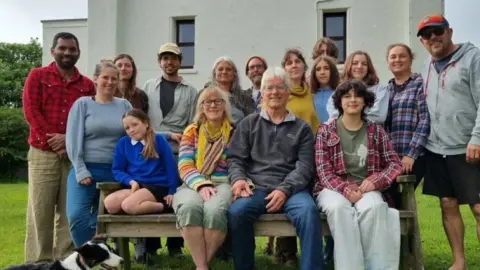
John and Nikki among 14 of of the other residents who have made Berry Park in Devon their home
When Nikki Little and John Porter retired, they considered buying a bungalow for just the two of them.
Instead, they invested in a £1m house tucked away on Devon's rugged and remote Hartland Peninsula - and looked for a community of like-minded people to join them.
Now they live with 17 other people, aged four to 70.
Co-housing is gaining popularity in the UK, says the UK Cohousing Network - in a post-pandemic world where loneliness, the housing crisis and costly care are forcing a drive for new solutions.
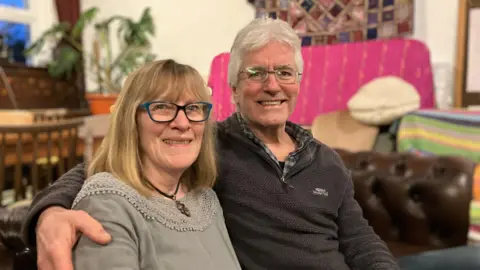
Nikki and John say there is always something to do at Berry Park
"In the future I was probably going to die first and I didn't want Nikki to be on her own," John explains.
"Because we're a childless family it just seemed like a natural thing to do - to form a community where Nikki could be looked after in a few years' time, after we've looked after this community."
Berry Park receives "weekly inquiries" from people considering the lifestyle leap to co-housing, in which residents live in owned or rented lodgings clustered around a shared space and common facilities like gardens, allotments and dining areas.
There are more than 120 co-housing developments either completed or in development and nearly 2,000 names on a national waiting list looking to join one, according to Owen Jarvis, CEO of the UK Cohousing Network.
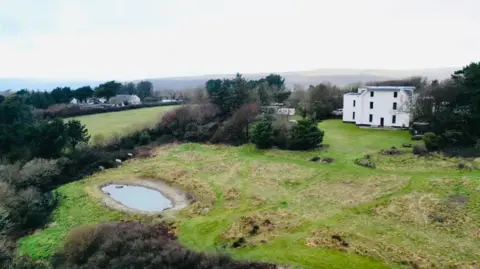
Berry Park near Bideford comes with six acres of land and the residents have built a pond which is already brimming with wildlife
"We also have landowners bringing forward sites and asking for people interested in developing co-housing on their land - that's probably the biggest recent change," adds Jarvis.
He says it is recognition of a growing desire among individuals to live in a "more neighbourly way" - a key motivator for many of the residents at Berry Park.
According to new figures from the Office for National Statistics (ONS), 8.6 million people - 30% of all households - were made up of a single person in 2025.
Nearly half (49.6%) of those people were aged 65 and older, an increase from 46.9% a decade ago. Almost one million of these over-65s are "often lonely", according to Age Concern.
In 2025, 779,000 people lived alone in the South West, accounting for 30.4% of total households and the region has a higher proportion of older people living alone than the national average.
The cost of lone living is higher too, according to ONS figures.
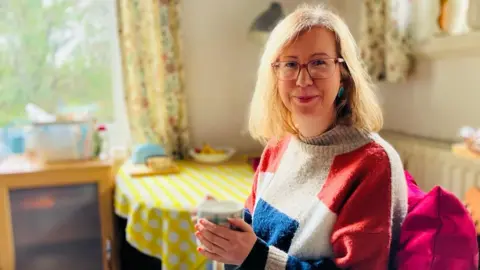
Lorraine Jones says she enjoys the "sense of community"
"I'm single, I don't have children. Here I have a family," says Lorraine Jones, 49, who moved to Berry Park in April 2025 from a single life in Bath.
"I feel like I've found my tribe."
Jones, a charity fundraiser, says she does not miss her solo life in Bath - where she could not have afforded land to grow on or the space to keep animals.
"There's a real sense of community and I've felt a reduction in loneliness.
"I intend to die here," she adds. "Not straight away I might add."
Most members found their way to the community online - there is a stringent joining process, with Zoom calls and visits followed by a trial three-month stay to make sure it is the right fit on both sides.
Households, most of whom have bought into the project, have separate accommodation with kitchen and bathroom facilities and have jobs which provide private sources of income - making it significantly different to more traditional communal living models.
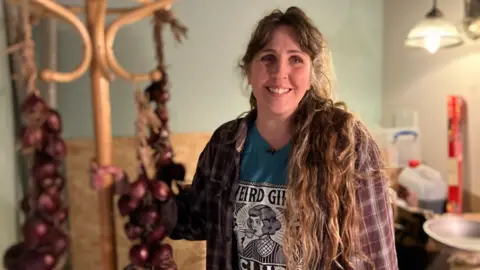
Josie is in charge of the storeroom, where allotment vegetables are preserved in jars and barrels hold rice and other stock foods
Berry Park was already divided into holiday flats when the founders - including John, Nikki and two other families - bought it about five years ago, forming a limited company in which members buy equity.
Communal washing machines line the utility room, bills are divided so each adult pays £115 a month and the storeroom is stocked with canned vegetables from the allotment.
Josie, a single parent of five, says she spends up to 12 hours a week on community chores: "There are weekends when it's cold and raining and I would love to stay in bed but it's my job to go and let the ducks out and feed them.
"There are going to be times when the last thing you want to do is contribute to a shared meal.
"Or someone is annoying you and you have to engage with that and find a way through it.
"Next time, you could be the one who's being annoying," says the 45-year-old homelessness outreach worker.
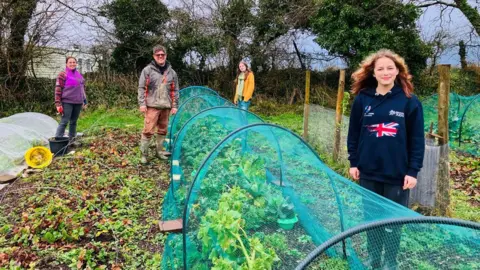
The community gets involved in various parts of life at Berry Park
Stonemason Steve, and his wife Rebecca are weeding one of the allotments, alongside their two children Wren and Lola.
Founder member Steve says the opportunity to live at Berry Park had been a "no-brainer": "[Our home] would be probably twice the price if it was next door with a little garden."
But the drive runs deeper: "We want to live in a more resilient environment.
"The future is going to be tough and we think living in a community will help with that."
According to ONS research 33% of Britons aged 16 to 29 reported feeling lonely "often, always or some of the time" - the highest of all age groups (17% of over-70s said the same thing).
London School of Economics research found the cost on the government is far higher for people suffering with loneliness.
Lola, 16, says always having other teenagers around is a definite plus, while her friends like visiting to enjoy community life.
Wren, 13, adds: "It certainly works for me and my family but I think it depends on what kind of personality you have, it doesn't work for everybody."
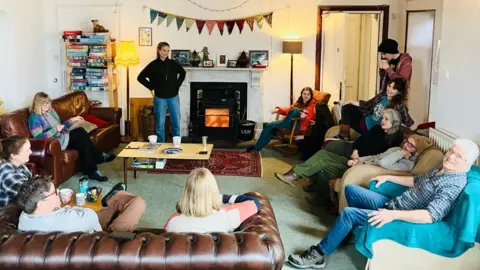
The group share a mortgage and divide the bills between them
About 40 miles away in Tavistock, Francesca Cassini, 70, and her group of friends, aged between 50 and 85, are meeting to discuss their own project aimed at growing old together in co-housing.
Cassini says: "I would like to live in a place where someone will notice if they haven't seen me for 24 hours and do something about it."
They say they hope to employ carers to be shared between residents when and if the need arises.
The group, currently numbering 12, envisages growing food to sell, holding workshops and retreats - and even setting up a "granny agency" to look after children.
Over three years, they hope to expand to 50 members, made up of "at least half women", with couples and families also welcome.
Cassini says funding the project will be a challenge and they are looking to pursue an investor model to provide low-rent properties.
Government funding, she says, would also be helpful.
"I don't have anyone who will look after me in my old age," she adds - recalling caring for her own mother.
"To create a community where we can actually live with other people who respect us and who recognise we have wisdom worth sharing is just an obvious thing to do."
Jeanette Kishori McKenzie, 83, looks across at her friends: "If you actually tune in you can feel the energy between us all is very easy, very flowing.
"And flow is what I want to live in," she says.
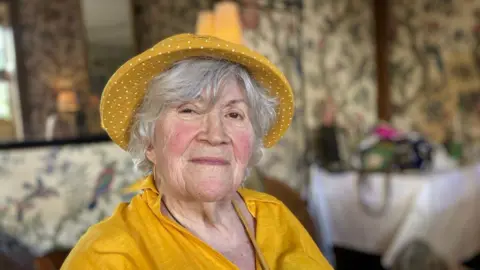
Jeanette Kishori McKenzie, 83, wants to live with friends where good energy can flow
Denmark was the birthplace of co-housing in the 1970s and has 400 communities, its Office for Housing says - 36% of which are social housing, and 48% of which are for seniors.
Its government has set up a unit to help guide citizens through legislation.
Dr Jim Hudson, from Bristol University, researches what can be learnt from Europe and their models of collaborative housing in relation to ageing and social care.
"People living together in those mutually supportive groups have been found to put less demand on those health and social care services.
"We found from our own research that co-housing meets so many problems in one local neighbourhood."
Daniel Capstick from Ecology Building Society says last year they launched a new mortgage product specifically for this "growing market".
"It's a challenge for these groups to get finance. For these groups to grow at scale they need a combination of government grant funding alongside mortgage finance funding," he says.
A Ministry of Housing, Communities and Local Government spokesman said they were investing £20m in community-led homes, relaxing size limits on community-led sites and making community-led housing a priority in the £39bn Social & Affordable Homes Programme.
"This is alongside researching the most effective way to enable community-led housing groups to access cash more easily," he said.