 2 months ago
127
2 months ago
127

 Getty Images
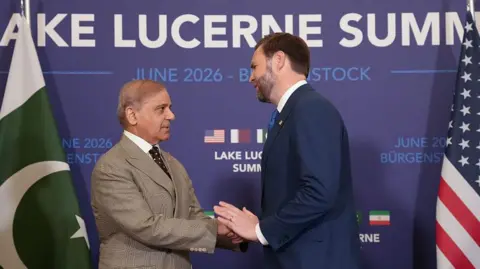
Vice-President JD Vance greeted Pakistan's Prime Minister Shehbaz Sharif ahead of the talks on Sunday
US and Iranian officials have arrived in Switzerland for direct talks after signing an initial agreement to end the war last week.
The deal includes a commitment to reach a final agreement within 60 days, as well as an end to hostilities on "all fronts" - including in Lebanon - and the reopening of the Strait of Hormuz.
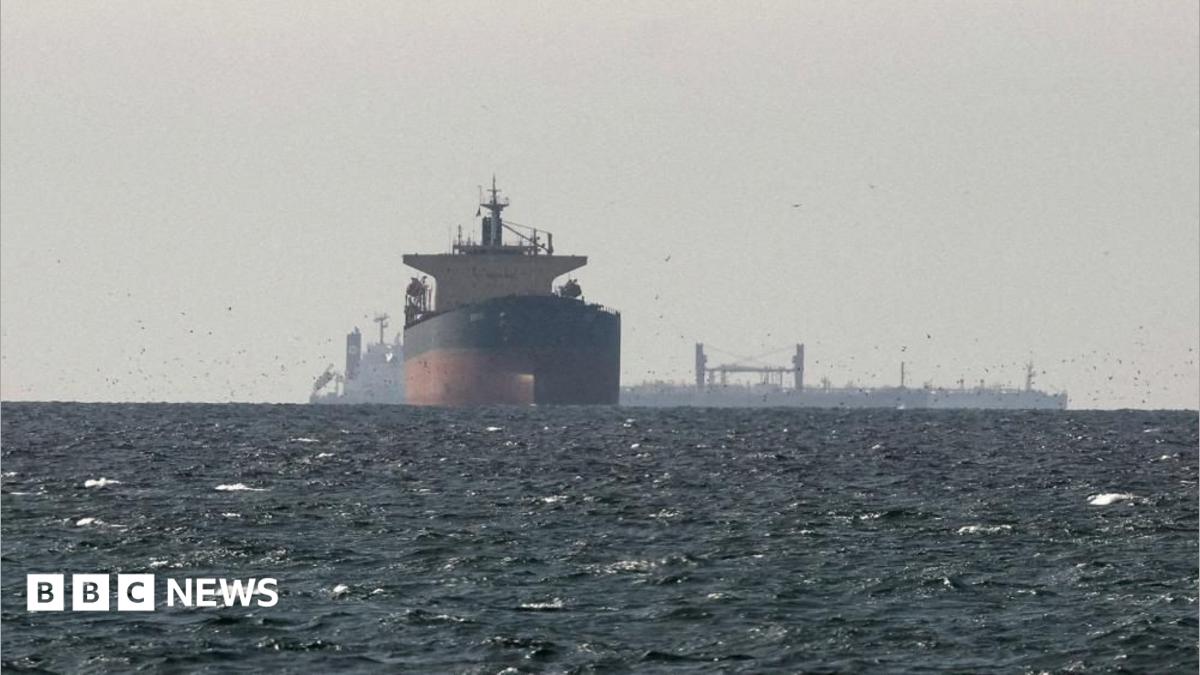
But ongoing clashes between Israel and the Iran-backed Hezbollah in Lebanon prompted Iran to announce it had shut the vital shipping route on Saturday - though tracking data shows vessels have continued to pass through it.
Vice-President JD Vance said the US hoped for progress on "the nuclear issue" and Lebanon, while Tehran said it would be "demanding that the other side fulfil its commitments".
Vance was joined at the Bürgenstock mountaintop resort by US President Donald Trump's son-in-law Jared Kushner and special envoy Steve Witkoff.
For the Iranians, parliamentary speaker Mohammad Bagher Ghalibaf and Foreign Minister Abbas Araghchi arrived in Switzerland late on Saturday.
The delegations were joined by Pakistan's Prime Minister Shehbaz Sharif and the head of the country's armed forces, Field Marshal Asim Munir.
 AFP via Getty Images
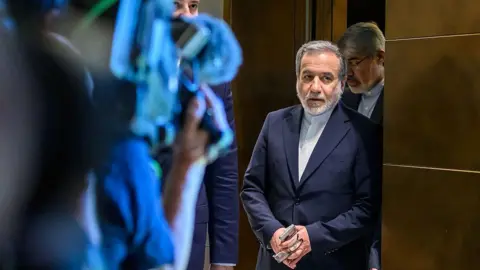
Iran's Foreign Minister Abbas Araghchi pictured arriving at the resort
The US and Iranian presidents signed the initial agreement earlier this week, aiming to end the war with immediate effect.
It also included a $300bn (£224bn) plan for Iran's "reconstruction", and the US terminating "all types of sanctions" on it.
But the issue of Iran's nuclear programme, the main reason stated by the US for the conflict, is still to be negotiated over an extendable 60-day period.
Deadly clashes have meanwhile continued between Israel and Hezbollah, the Iran-backed militia, despite the deal and a ceasefire the two sides agreed on Friday.
Israel has insisted that its conflict with Hezbollah is separate from the war on Iran, which it mounted alongside the US on 28 February.
Lebanon was drawn into the war shortly afterwards, when Hezbollah launched rockets into Israel in retaliation for a strike that killed Iran's supreme leader.
Israel responded by launching a bombing campaign across Lebanon and occupying around 5% of the country's territory in the south - hoping to drive back Hezbollah fighters from its northern border - and has said it has no intention of withdrawing.