 2 months ago
59
2 months ago
59

I understand the great debate over the falling out between Mohamed Salah and Arne Slot but let me make my own point as someone who managed for more than 30 years.
Both Slot and Salah are being paid enormous salaries by Liverpool, one to manage and the other to play.
They both have the responsibility to act in the best interests of the club, and nothing else should come into it.
Personal views about each other cannot, and should not, come into the equation - for manager or player. The club needs every one of its coaching staff and players to be united with one aim, which is to win football matches.
I have never known a manager pick a team that he believes will lose games and, at the moment, Salah is not playing because Slot does not consider him as being a starter in his best XI.
Slot, as a manager, understands that there can be only one singer, and one song being played, and that he conducts it.
As a player, Salah must look up to the stands and see two other great Liverpool goalscorers in Ian Rush and Kenny Dalglish, and recognise that even the greatest players come to a stage in their career where the club moves on.
At Liverpool, Salah has had a wonderful platform to show off his fantastic abilities. Over many years he has rightly become an Anfield legend and, if he leaves in the next transfer window, let's hope for all concerned that this spat can be washed away and fans can remember the fantastic memories he gave them.
Archive: Some of Mohammed Salah's best goals for Liverpool
'Management teaches you all about aspects of life's challenges'
Dealing with an unhappy player without it affecting your team is only one of the challenges that a manager will face.
Having been blessed to manage in all four divisions of English football, I have experienced many ups and a few downs on this front over the years.
Management teaches you all about aspects of life's challenges. Many top clubs now use psychologists as part of their management team, as do lots of different organisations outside football, but starting in the lower leagues enabled me to experience so many different situations that I never dreamed I would come across.
Starting off in the old third division also meant I was able to make mistakes on certain issues without being castigated by the media. This allowed me to formulate a balance and direction on how to deal with collective problems later on in my career, when I was under a greater spotlight.
As you move up through the leagues, the media attention on your players is enormous, as it is on yourself as well. Learning how to manage both takes years of experience.
During this time, I learned how to separate different personalities within the dressing room and how then to bring them together as one strong unit.
Being able to manage my time was always important, as I wanted as much individual time with my players as possible.
'Finding ways of getting the best out of your players'
I have always believed that your team's strategy, or playing style, is determined by the quality of your players.
Once you have an identity that suits your players, finding ways of getting the best out of them, week in and week out, is vital.
Players can be very insecure, or over-confident. They might be rock-solid characters, or a loose cannon. Taking the time to find out what makes them tick is priceless, and that determines either success or failure.
Part of that is addressing their issues away from football. For example, I have spent many hours dealing with players who have had gambling problems.
I hope I helped them in a way where the players involved always appreciated the need to understand the excessive nature of that illness, which can be controlled. When it was controlled they saw how much more enjoyment there was in their playing days.
Similarly, I was close enough to some of my players for them to share shocking experiences they had at home, as children growing up. I was able to direct them to people who, again, helped them clear their minds, so they could enjoy playing professional football again.
These situations away from football can affect players' characters and performances. Dealing with them in this way was only possible because of the strong bond created in a club environment and by building a relationship between the manager and players.
In all the clubs I managed, togetherness as a group was a vital aspect of our success, no more so than at Stoke when we got to the Premier League.
We had a group of players who loved being together. When the new training ground had been built it was a job to get some of them to go home.
It would get well into the afternoon and they'd still be there, drinking coffee, chatting, playing pranks on each other and up to stuff you wouldn't believe. They were a real group, a real team and that goes for the players who were outside the team as well.
Everybody bought into what we needed as a football club to be successful - it didn't matter if they were being picked or not. That's exactly what you aim for as a manager.
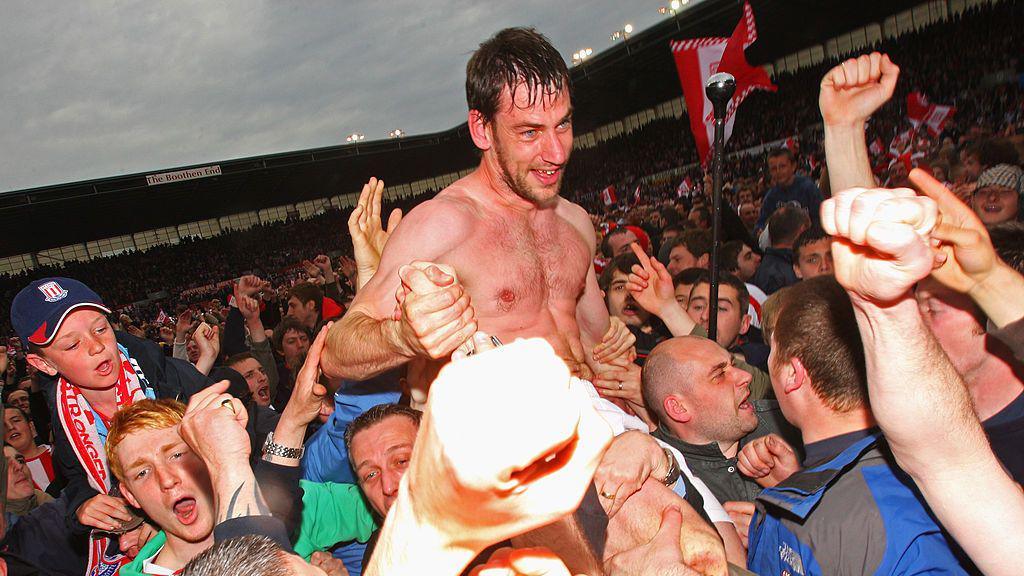 Image source, Getty Images
Stoke's Rory Delap celebrates with fans after winning promotion to the Premier League in 2008
'I wish I had dealt with some players differently'
There are also many occasions I now look back on and wish I had dealt with some players differently, in both football-related matters and their private lives.
I once tried to protect a new signing by asking my club's commercial manager to award him man of the match for our home games when he was not having the best of times to start with.
His confidence was waning a bit so for a full month, for every home game, he got the award - but he still couldn't find his form.
This culminated in him knocking on my door and pleading with me to stop giving him the award.
I dismissed him, and told him once he got going and showed the supporters his true worth, I would only then move on to another player!
That player later became a massive crowd favourite and was sold for over twice what the club paid for him, so I guess it worked in the long run - even if it didn't help him much at the time.
So, getting back to psychologists, I was once asked while working at one of my 10 clubs if we needed one. I responded by asking if the club didn't have one already!?
'You need strong characters everywhere'
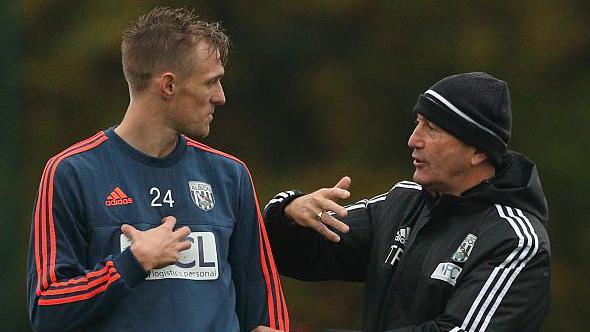 Image source, Getty Images
Tony Pulis made Darren Fletcher West Bromwich Albion captain after signing him in 2015
To build that special bond you want to have at all clubs, you need strong characters everywhere.
The spine of all the good teams I managed had that character. Those players were genuinely open to discussions with me individually, but I placed a lot of responsibility in that area on my captain.
I expected him to relay to me any issues the dressing room had, both as a group and individually.
I didn't have discussions about the team with committees, but I gauged as much knowledge as I could from every staff member who was working alongside me. That's something that is only possible when the whole club is working together and pointing in the same direction.
I had some wonderful kit men and women, who were again a great source of information for me, but my standouts were Winnie and John at Stoke.
Winnie was honest, direct and hard-working. She could swear like a trooper, but loved the lads and the club.
She would keep me informed of everything I needed to know if it affected the team or club, and was loyal to the point of giving me a telling off if I needed it.
This is the time of year where the King gives out medal awards for all sorts of working people, and if anyone needed recognition it would be Winnie's husband, John. Or Saint John as we knew him!
Is the top six stronger than before?
Just as a footnote, in last week's column I asked you whether the Premier League is better now than 10 or 20 years ago. There was a huge response, with some interesting comments.
One of the most popular comments questioned whether the clubs in the middle of the Premier League table are stronger now than a decade ago.
Let's apply that to the clubs higher up, too. I'd like to know specifically if fans of the so-called top six clubs - Arsenal, Chelsea, Liverpool, Manchester City, Manchester United and Tottenham - believe their teams are better now than in the previous 10 or 20 years?
What do you think? Let me know below.
Tony Pulis was speaking to BBC Sport's Chris Bevan.