 3 months ago
119
3 months ago
119
3 hours ago
Richard Baker,Isle of Manand Alex Blake,Isle of Man

 Manx National Heritage
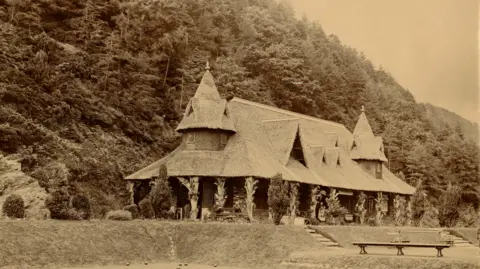
The original "Swiss Cottage" was built by a Liverpudlian businessman in the 1800s
It may come as a surprise to visitors to the Isle of Man to find nestled in a valley of waterfalls, rivers, and trees, a traditional Swiss style chalet.
But if you wander into Glen Helen in the west of the island, that is exactly what you will find.
While the facade of the building has changed from a cottage to a chalet in the past 200 years, its origins have a fascinating history.
Planning permission has been recently granted for a farm shop and deli to make the chalet its home, with the owners hoping to revitalise one of the Isle of Man's beloved beauty spots.
While many people on the island are familiar with the area, which is a popular place for walks and recreation, its history may surprise even the most knowledgeable of locals.
Matthew Richardson from Manx National Heritage explained that the "lovely natural Manx glen" appears to date back to the 1820s, but all is not as it seems.
"The whole thing is artificial, even the name Glen Helen is an invented name," he said.
It is thought the original name was "Glen Nelen" which was adapted over time.
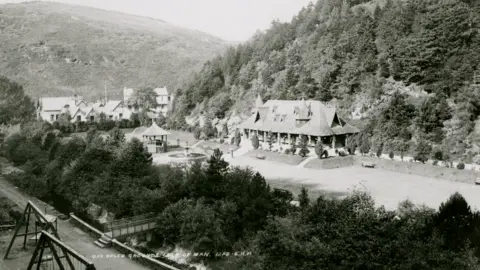
Richardson said the building, originally a 'Swiss Cottage' came about after the whole site was bought by "a Liverpool businessman named John Astley Marsden".
 Manx National Heritage
The now 'Swiss Chalet' began life as a 'Swiss Cottage' in the early 20th Century
Who was John Astley Marsden?
Marsden came to the island in the 1820s, after making his name in Liverpool as a brush manufacturer.
Richardson described it as "quite a common thing", for people to "make your money in the smoke and grime of Liverpool but you don't want to live there, and instead move out into the country".
When he first moved to the island, there was "just a little river running through a valley", Richardson said, so Marsden "created this artificial garden for himself".
 Manx National Heritage
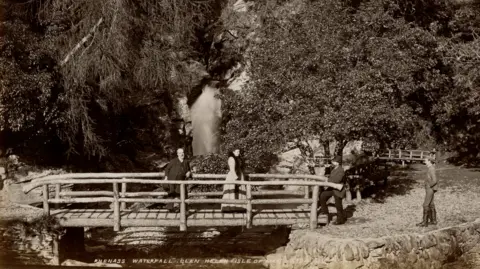
Glen Helen - with its Rhenass waterfall - has been a popular beauty spot for generations
"He planted thousands of trees, built these little walkways and ridges," he added.
While there had been a small waterfall when Marsden found it, Richardson said "he built a wall across the valley so the water would then drop 35 feet to create a more impressive sight".
Marsden had a "penchant for different architectural styles", Richardson said, where he had done something similar at a property in Merseyside coined "the Brush Castle".
The businessman however was never a permanent resident of the then Swiss Cottage, living there 10 years before selling it as a business, Richardson continued.
He explained that in the 1800s the Isle of Man was already "considered an exotic place to go".
By the 1840s, the Swiss Cottage became a restaurant alongside the visitor site, Richardson said, adding that when the railway arrived, the site had its "own omnibus which would take passengers from St Johns railway station to the glen".
It was claimed that in 1876, 33,000 visitors went to the site, Richardson said, being developed "just at the time the tourism trade exploded in the late 19th Century."
But over time that began to slow down and in 1958 the site was bought by the Isle of Man Forestry Board and "became a nationally-owned glen".
The chalet and glen continued to be popular with both tourists and locals and the building was used as a lodge and cafe for many years as part of the treasured national glen.
But in 2020 a fire destroyed the roof and much of the first floor of the building.
It thereafter remained obscured by fencing, seemingly derelict, until the chalet was handed a lifeline.
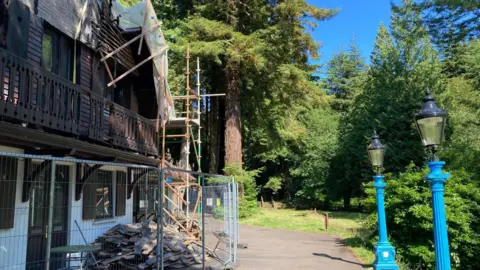
The building's future was uncertain for years as it was left in disarray
Matt Harrison is behind the Isle of Man Farm Shop Company, renovating the space into a shop and deli, focusing on local Manx produce.
Planning permission has now been granted and Harrison said he felt "absolute elation" getting approval to move forward, and they "came back and opened a bottle of Champagne with the staff" to celebrate.
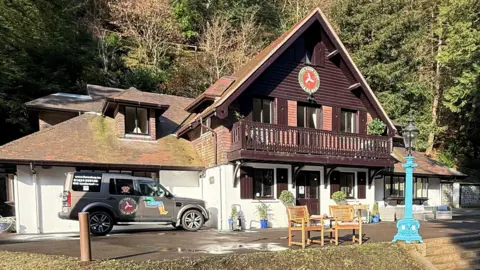 Isle of Man Farm Shop Company
The modern version of the building has now opened as a local produce farm shop
"We are a butchery, fishmonger, a deli for your fruits, veg, local breads, honies, jams, preserves," he said.
The exclusively Manx produce shop used 82 suppliers, producing more than 800 products, he explained.
Harrison said as well as food, they had a variety of other offerings, including from "a lady who goes to the beach every day to collect sea glass, she turns them into jewellery".
In the future he hopes to really capitalise on the unique location. He wants to hang a sheet from the chalet to project films into a summer open air cinema, and open a bistro where they could offer cookery classes.
Harrison said the location was really important to him, adding: "I've never viewed this as a shop, this is an experience".