 2 months ago
56
2 months ago
56
Craig WilliamsBBC Scotland News

 Mirrorpix via Getty Images
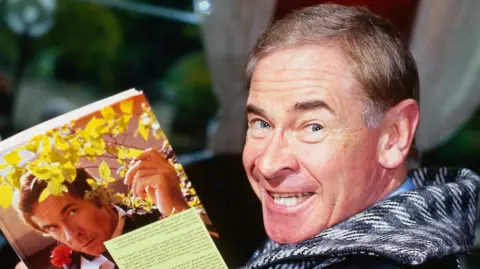
Stanley Baxter was for decades one of the biggest stars on British television.
His huge talent for comic sketches, mimicry and song was awarded with similarly huge budgets by grateful commissioners.
His lavish productions for ITV and the BBC brought in enormous audiences and were a staple of the schedules throughout the 1970s and 80s.
But times changed, and after twice being axed from his prime slots he retired from the medium which had made him a star.
His longevity - he has died at the age of 99 - was such that few under the age of 40 will remember who he was.
But for those who knew his work he was a much-loved reminder of a different age - when more than 20 million people would tune into a show and collectively understand and enjoy its references, jokes and songs.
He was born in 1926 in Glasgow and grew up in the city's west end.
His father, Fred, was a quiet insurance executive but the young Stanley inherited a love of all things theatrical from his mother, who encouraged his early attempts at impressions and songs.
A look back at the career of Stanley Baxter
Baxter's younger sister, Alice Dale, became an actor and writer based in Australia and it is clear Bessie was a big influence on both.
"I probably became an entertainer to please mother," he once said. "She was forthright, while father was a retiring man. I was more like him in nature but to please her I pushed myself forward."
She took him round church halls and family gatherings before he made his professional debut on the Scottish edition of the BBC's Children's Hour aged just 14.
The young performer from Glasgow was hooked but world events intervened.
During World War Two he was a "Bevin Boy", conscripted to work in the Lanarkshire coal mines.
He moved from there to National Service in Malaya, where he took to the stage with the Combined Services Entertainments Unit, putting on shows to boost troop morale.
It was during this period that he met Kenneth Williams.
He became a life-long friend of the future Carry On star, though Williams's published diaries reveal their relationship constantly veered between the confessional, supportive and rivalrous.
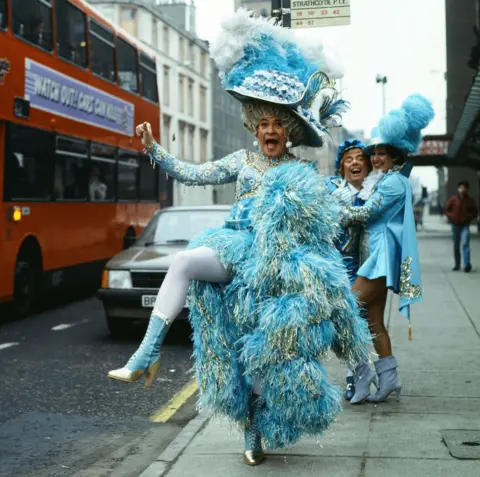
In the 1970s and 1980s, Baxter's shows became flamboyant and expensive
Back in Glasgow in the late 1940s, Baxter worked at the Citizens Theatre as assistant stage manager, played the Fool in Macbeth and appeared in Tyrone Guthrie's 1948 Edinburgh Festival production of The Thrie Estaites.
But he really found his feet and fame in variety theatre.
Over the coming decade he appeared with Jimmy Logan, Rikki Fulton and Jack Milroy on stage at Glasgow's Alhambra Theatre and on the radio show It's All Yours. Early on in his career, Baxter also became a notable panto dame.
Inevitably, London called.
He was cast in On The Bright Side, a comedy sketch show where he first performed what would become one of his most popular sketches.
'Parliamo Glasgow' was a spoof language programme where, instead of teaching Italian, Baxter's earnest presenter tutors the rest of the world in the language of his home city.
Altering words and adding the odd slang term, a typical example was: "Zarra marra onna barra, Clara?"
Baxter would say the phrase in a thick Glasgow accent before providing the translation:
"Is that a marrow on your barrow, Clara?"
That Baxter could pull this off without causing offence or appearing to patronise his Scottish roots for a wider audience was a testament to his brilliance as a performer.
The 1960s saw his TV career bloom.
The Stanley Baxter Show was a huge success on the BBC in 1963 and ran for eight years.
There were films too, such as The Fast Lady and Crooks Anonymous. But cinema comedies, with their need for proper stories and well-rounded, believable characters, never really suited Baxter's talents.
He was best at broader caricatures, impressions and sketch comedy and as his reputation and audiences grew, so did his ambition and control over his programmes.
 Getty Images
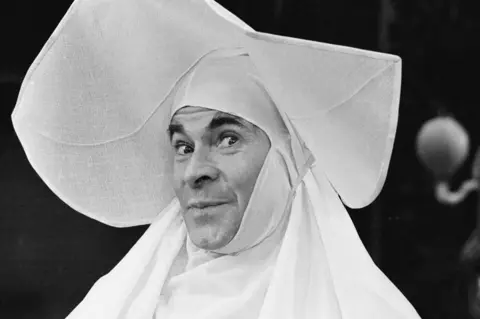
Baxter delighted in dressing up and drag was a regular feature of his act
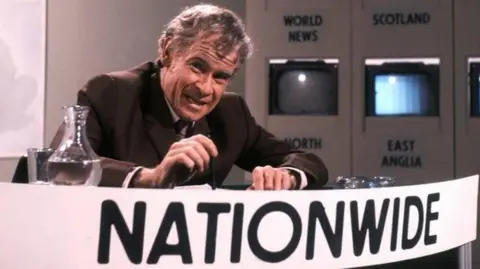
Baxter's programmes sometimes contained parodies of the television of the time
He moved to London Weekend Television (LWT) in 1973 with the Stanley Baxter Picture Show. In this series and the Moving Picture Show that followed, his speciality was parodying film and television favourites.
Baxter played most of the parts, bolstered by a riot of colour, fabulous sets, costuming and sharp scripts. He was an exacting performer who insisted on high production values.
That meant relatively few episodes were made, though they won multiple Baftas for Baxter. His portrayal of the Queen (always billed as The Duchess of Brendagh) was perhaps his most lauded impression.
After nine years of specials, he moved to a weekly slot with The Stanley Baxter Series in 1981, although a greater number of programmes per year did not equate to a drop in production values.
And while the high cost of his work was undoubtedly a factor in his subsequent sacking from LWT, his friend Kenneth Williams made a good point in a diary entry in 1981.
He wrote: "We watched the Stanley Baxter show on ITV and again I was struck by Stanley's obsession with the past; it was all about old films, film directors, film stories re-jigged, film personalities (Jimmy Durante etc.) & so was fine for the middle-aged but had nothing for the young."
The show was cancelled and he returned to the BBC with Stanley Baxter's Christmas Hamper in 1985 and Stanley Baxter's Picture Annual the following year.
 Getty Images
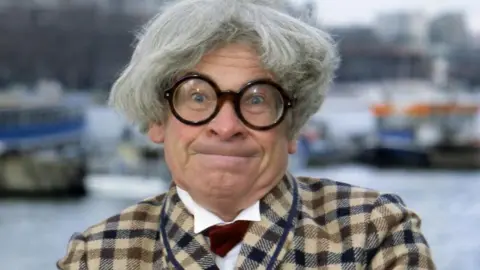
His final TV role was as the magician Mr Majeika
 Alamy
Alamy
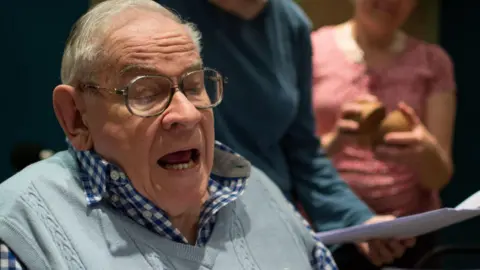
Fifty years on, he returned to BBC radio for a series of programmes
The big budgets and long production schedules were still a part of his process but times had changed and he was followed to the BBC by the man he blamed for his sacking from LWT - John Birt.
According to Baxter it was Birt who once again ended his contract.
He appeared in the children's show Mr Majeika before retiring from television in 1990, gracing the stage in Scotland as a panto dame for a few more years before finally hanging up his wig.
There were occasional specials for BBC Radio 4 and he appeared in a Christmas show on ITV in 2008, in which he introduced archive of his work and performed with guests who had been influenced by him.
Despite his ability to make people laugh, he always considered himself a character actor rather than a comedian.
Off-screen and stage he was something of a reluctant celebrity, giving few interviews and declining to appear on chat shows.
In 1993, he took legal action to ensure nothing about his private life would be revealed by the publication of his late friend Kenneth Williams's diaries.
Baxter had helped Scottish journalist Brian Beacom write a book about his life. He had intended that it would be published posthumously but appeared to change his mind in 2020.
 Getty Images
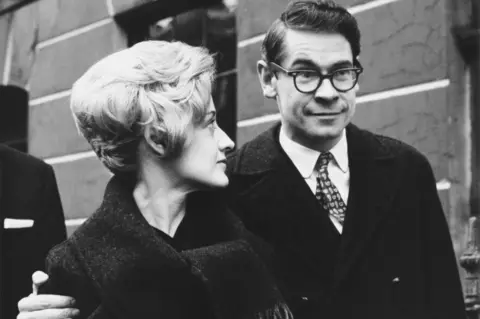
Moira stood by her husband when he was arrested in a public lavatory in 1962
The Real Stanley Baxter described his long struggle with his sexuality. At the age of 94, he confirmed that he had always been gay but had initially hidden the truth to avoid arrest in the years before decriminalisation.
In fact, he had been arrested in 1962 and contemplated suicide rather than see his career in ruins. The charges were subsequently dropped.
He insisted that Moira - his wife of more than 45 years - had been fully aware of the situation. She had even given her blessing to Baxter bringing boyfriends home.
The couple married in 1951 but by the 1970s were living apart. They never divorced and lunched together almost daily.
Moira died in 1997 and Baxter's long-term partner, Marcus, died in 2016.
Baxter never came to terms with his sexuality. He told Brian Beacom: "I never wanted to be gay and I still don't. The truth is, I don't really want to be me."
And he once spoke of his feelings about fame and the work of the actor, telling a journalist:
"All this rubbish about the man behind the mask. I've had it again and again and again. The mask is what's important."