 2 months ago
91
2 months ago
91
Kayla Epsteinand Anthony Zurcher,North America correspondent

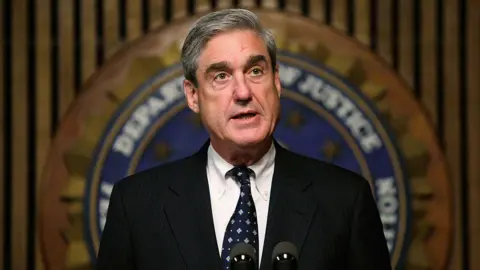 Getty Images
Robert Mueller, the former special counsel whose investigation into alleged Russian interference in the 2016 US election defined much of Donald Trump's first term in office, has died. He was 81.
The cause was not immediately known. CBS News, the BBC US partner, confirmed his death.
"With deep sadness, we are sharing the news that Bob passed away" on Friday night, the family said to the AP in a statement. "His family asks that their privacy be respected."
Mueller previously led the Federal Bureau of Investigation (FBI) from 2001 to 2013, taking the office just days before the 11 September 2001 terror attacks. He is credited with reshaping the FBI into a modern counterterrorism agency.
Mueller is survived by his wife of nearly 60 years, Ann Cabell Standish, their two daughters, and three grandchildren.
Mueller's special counsel inquiry put Trump's 2016 campaign under a microscope, drawing harsh criticism from the president.
The president on Saturday wrote on Truth Social: "I'm glad he's dead. He can no longer hurt innocent people!"
Mueller's former employers and colleagues praised him as a longtime public servant.
President Barack Obama called him "one of the finest directors in the history of the FBI" and commended his "relentless commitment to the rule of law and his unwavering belief in our bedrock values".
Former FBI director James Comey, who succeeded Mueller at the agency and whose abrupt firing by Trump led to the Mueller investigation said: "A great American died today, one I was lucky enough to learn from and stand beside."
In a statement, a spokesman for Mueller's former law firm, WilmerHale, called him an "extraordinary leader and public servant and a person of the greatest integrity".
Mueller was born in 1944. After studying politics at Princeton University, he joined the Marines and deployed to Vietnam in 1968.
As a lieutenant, Mueller led a platoon of troops, was wounded twice in battle, and was awarded numerous commendations, including the Bronze Star for valor and a Purple Heart.
After returning from the war he went to the University of Virginia, where he studied law and graduated in 1973.
In August 2001, Mueller was unanimously confirmed as FBI director by the Senate, and he served at the agency for more than a decade.
Mueller retired from the FBI in 2013, after serving under both a Republican president, George W Bush, and Obama, a Democrat.
But four years later, Mueller found himself at the center of a political maelstrom that consumed Washingtonan would later define his legacy.
His investigation into Russian attempts to influence the 2016 presidential election – and the potential involvement of Trump and his campaign – were a near daily source of intrigue and speculation for nearly two years, from May 2017 to March 2019.
The court filings of his special counsel's office were meticulously picked apart, with each new revelation a potential bombshell that could, depending on one's perspective, bring down a president or destroy a nation.
Trump condemned Mueller's inquiry as a "witch hunt" and a "hoax", and viewed him as one of his greatest political adversaries. Trump frequently said there had been "no collusion" between his campaign and Russia.
During the investigation, Mueller's team scrutinised Russia's actions as well as several of Trump's top campaign staff and allies. Despite his work frequently making headlines, Mueller himself rarely spoke publicly.
The investigation resulted in multiple indictments and plea deals with former Trump campaign manager Paul Manafort, as well as national security advisor Michael Flynn.
In the end, the 448-page "Mueller report" was thorough but ultimately inconclusive. It found that Russia interfered in the 2016 election in a "sweeping and systemic fashion", but did not establish that members of the Trump campaign conspired or coordinated in these activities.
His findings noted: "while this report does not conclude that the president committed a crime, it also does not exonerate him".
In February 2021, Mueller sat for a rare interview with MSNBC to recount key moments in his decades-long career.
Asked why he agreed to oversee something as politically daunting as his Russia investigation, he said: "I found that I've gotten tremendous enjoyment out of public service. And I find it hard to turn down a challenging assignment."