 2 months ago
116
2 months ago
116
Watch: Moment earthquake hits Venezuela and leaves buildings collapsed
ByHarry Sekulich and Joel Guinto
At least 32 people have been killed and 700 injured after two powerful earthquakes rocked Venezuela's capital city within seconds of each other on Wednesday, Interim President Delcy Rodríguez has said.
The second quake was one of the strongest tremors to hit the South American country in a century, at a magnitude of 7.5.
Buildings collapsed and residents ran into the streets for safety as the twin quakes struck.
Rodríguez declared a state of emergency and said airport, rail and transport services had been halted.
Rescuers are racing to find survivors who may be trapped beneath rubble, with fears the death toll could rise.
Where and when did the quakes hit?
Both earthquakes shook the capital Caracas - home to around 5 million people - at about 18:04 local time (22:04 GMT) on Wednesday.
The first was magnitude 7.2 and struck the state of Yaracuy to the west of Caracas at a depth of 22km, according to the US Geological Survey (USGS).
Thirty-nine seconds later, a stronger magnitude 7.5 earthquake struck nearby at a depth of about 10km.
While both epicentres were outside the capital, powerful tremors were felt across the city - causing buildings to shake and some to collapse entirely.
Interior Minister Diosdado Cabello said multiple states had been affected by the quake, and more than 20 aftershocks have since been felt across the country.
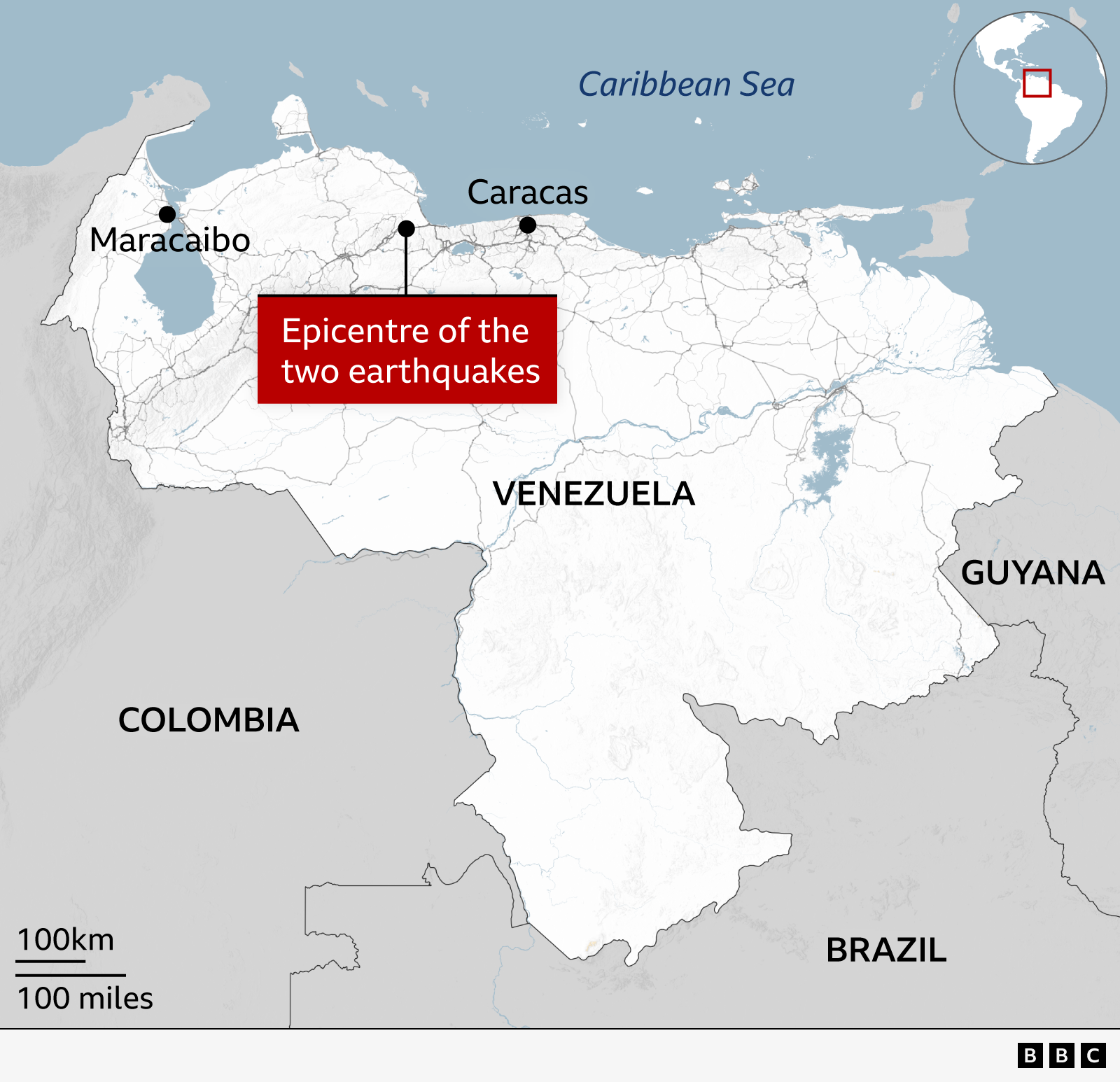
They have largely affected its northern coastline, including La Guaira, Aragua, Carabobo and Falcón.
The quakes hit while Venezuela was celebrating a national holiday, meaning more people would have been at home than usual.
Meanwhile, tremors were felt more than 1,000km (630 miles) away in the Colombian capital Bogotá.
Cabello said that in Caracas the worst-hit areas were the neighbourhoods of Los Palos Grandes and Altamira.
They were also among the worst affected in 1967, when the last major earthquake to hit the Venezuelan capital struck, killing 200 people and destroying buildings.
Rodríguez said at least 32 people had died and 700 others were injured.
She said she did not yet have information on the "hardest-hit region" of La Guaira, north of the capital.
It is likely that the toll will climb as rescue efforts continue.
The USGS said there was a 44% chance it could hit up to 10,000 and a 30% chance it could reach 100,000.
However, these figures are calculated based on previous earthquakes with similar characteristics and other factors such as the size and depth of each quake, so are not exact predictions.
Other factors play into the potential injuries and deaths, including the quality of the buildings and the time of day.
The area where the quakes struck is particularly vulnerable, the USGS noted.
It said many buildings there were made of reinforced brick masonry and adobe blocks, and the sheer force of the shaking meant a high chance of destroyed buildings and deaths.
US President Donald Trump referred to a "devastating number of deaths" in a post on Truth Social.
Photos and videos showed debris strewn on the streets. In some footage, people can be heard calling for help.
Chacao Mayor Gustavo Duque Saez told reporters that at least two buildings had completely collapsed in the area, which forms part of the greater metropolitan area of Caracas.
He said 18 people had been rescued alive and more than 500 emergency workers were on site trying to pull out more residents.
Fuel supplies into the city have been cut off and internet blackouts have also been reported.
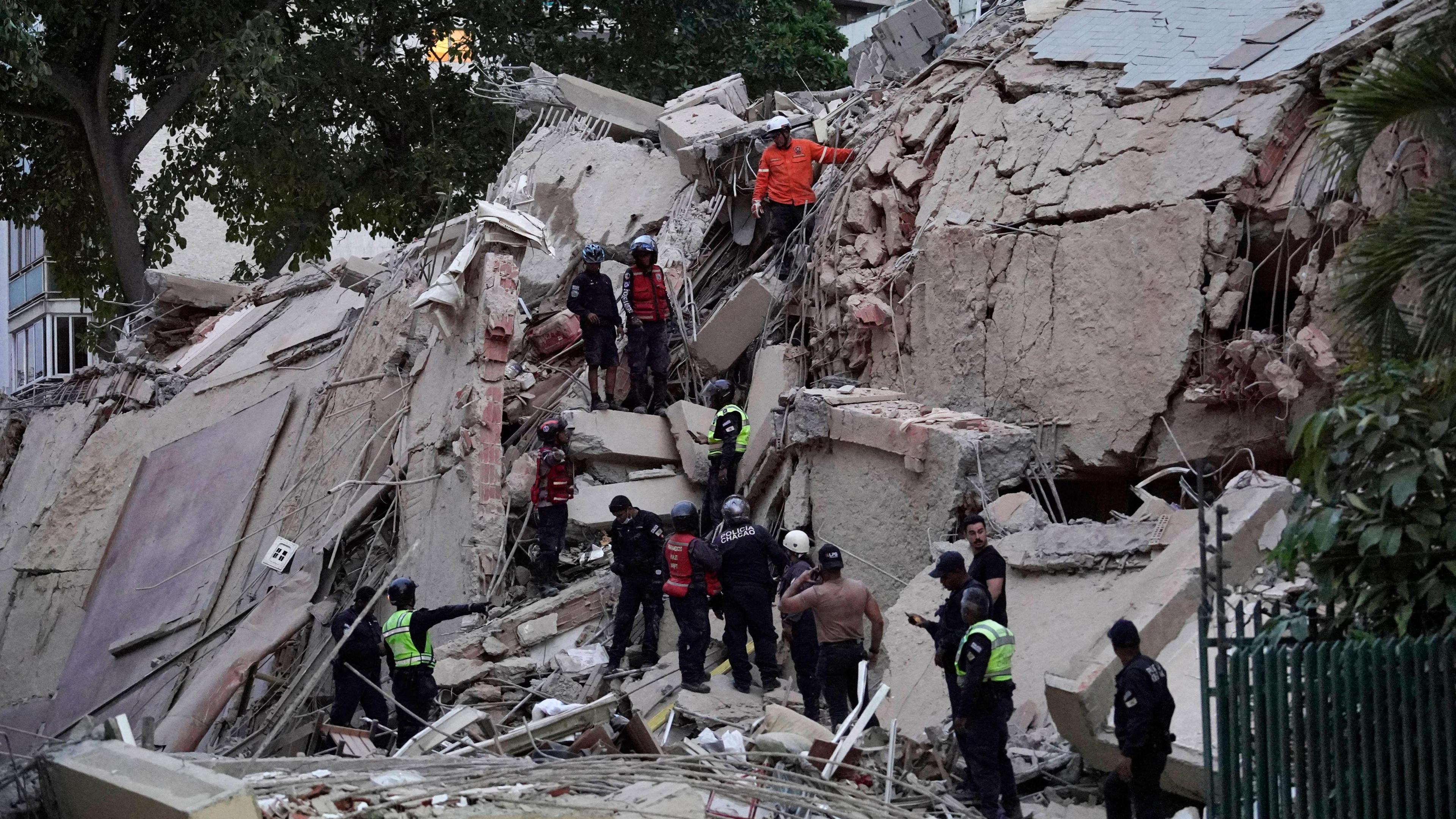 Image source, AFP via Getty Images
Rescuers search for survivors the ruins of a building in Caracas, Venezuela.
Venezuela's main international airport, Simón Bolívar International Airport in Maiquetía – located on the outskirts of Caracas – has also been closed due to earthquake damage.
Metro and train services across the country have also been suspended, and school classes are also paused for the remainder of the week.
Rodríguez's declaration of a state of emergency allows extra resources and personnel to be used for recovery efforts.
Many Venezuelans are spending the night on the street, with the country's interior ministry urging people to leave damaged homes over concerns of building stability and gas lines possibly being affected.
A tsunami warning was issued for the coast of Venezuela and the islands of Aruba and Bonaire, but was later cancelled.
How have the US and other countries responded?
US President Donald Trump said Washington was "ready, willing and able" to help and said he had instructed government agencies to "move quickly".
"We will be there for our new and great friends," Trump wrote on Truth Social, adding that "early reports are not good".
In the early hours of Thursday morning, Secretary of State Marco Rubio said the US was "immediately" deploying search and rescue teams, medical resources, and humanitarian assistance.
Rodríguez thanked Trump on X, writing that her country would "never forget the helping hand" extended by the US.
El Salvador President Nayib Bukele said his country prepared 50 tonnes of equipment and supplies, as well as 300 rescuers who are "ready to depart for Caracas".
The presidents of Ecuador and Mexico both said they would be sending aid, while Brazilian President Luiz Inácio Lula da Silva said his country would assess what assistance it could extend to its "sister nation".
The Dominican Republic would be sending specialised teams for search, rescue, and emergency care from its armed forces, President Luis Abinader said, and Chile's President José Antonio Kast Rist offered support with coordinating humanitarian aid.