 3 months ago
112
3 months ago
112
1 hour ago
Simon Atkinsonand Kelly Ng

 Getty Images
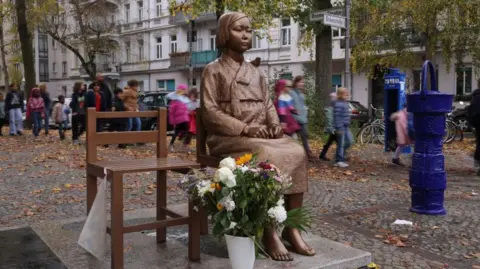
A file photo of a bronze comfort woman statue in Berlin, Germany, which has since been removed
Plans to erect a statue in New Zealand symbolising the so-called comfort women who were forced into sexual slavery by Japan during World War Two have been rejected.
The Japanese embassy had warned that the installation of the structure in a public garden in Auckland "could have a significant impact" on the diplomatic relations between the two countries.
The bronze statue, which depicts a girl seated next to an empty chair, was given to New Zealand by the Korean Council for Justice and Remembrance, a non-government group advocating against military sexual slavery.
More than 200,000 women and girls, most of them Korean, were forced into prostitution to serve Japanese soldiers during the war.
This estimate also includes women from mainland China, the Philippines, Indonesia and Taiwan.
In a statement to the BBC, Kim O'Neill, head of Land and Property Advisory at Auckland Council said that council staff had suggested the proposal be rejected "based on the results of the public consultation and feedback received, which demonstrated a lack of community support for the proposal".
The plan was then voted down by the Devonport-Takapuna Local Board.
Earlier New Zealand's government confirmed Japan had "made formal representations" on the issue, but that local government and communities made decisions on statues and monuments in public spaces.
"I am concerned that it will cause division and conflict within New Zealand's wonderful multi-ethnic and multicultural society and between Japanese and Korean communities peacefully co-existing in New Zealand," Japan's Ambassador to New Zealand Makoto Osawa wrote in a letter to the Auckland Council.
Japan "has no intention whatsoever of denying or trivialising the existence of the issue", he said, but added that authorities have over the years been "earnestly addressing" diplomatic issues with Korea.
Aotearoa New Zealand Statue of Peace, a local grassroots group that proposed the installation of the statue, said it was "unfortunate" that authorities rejected it.
"This is a loss for our local community and for upholding survivor voices.
"We are steadfast in our commitment to stand with survivors of gender-based and conflict-related violence, and carrying on the legacy of the grandmothers," the group wrote in a Facebook post on Tuesday.
Similar statues have been erected elsewhere in the world, the first of which went up in Seoul in 2011.