 3 months ago
107
3 months ago
107

 BBC
BBC
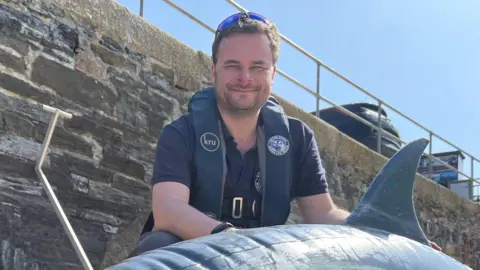
Dan Jarvis from BDMLR said people should not try to push stranded animals back into the water
More volunteers are being recruited to help rescue a growing number of whales, dolphins and porpoises washing up on UK shores.
The British Divers Marine Life Rescue, which specialises in the rescue and protection of marine wildlife, says extra volunteers are needed to assess, give first aid and refloat stranded animals.
Director of welfare and conservation Dan Jarvis said: "There is a general upward increase in recent years of strandings around the UK, and we're also getting busier - particularly after winter storms."
It is thought the increase is down to a number of factors including man-made hazards and growing public awareness, as well as an abundance of prey in coastal areas.
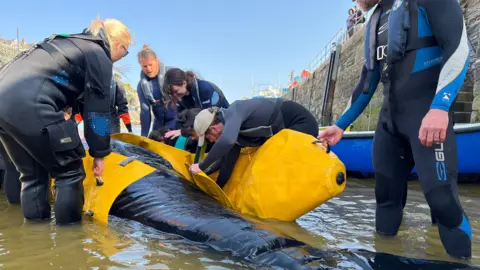
Volunteers learn how to use specialised equipment to help refloat live stranded whales
According to BDLMR data, in 2018, there were around 22 live standings recorded but by 2025 that number had more than doubled to 46.
In 2023 and 2024, the number of strandings of cetaceans (whales, dolphins and porpoises) peaked in the 60s for both years.
The figures represent incidents, some involving multiple animals.
Jarvis said: "Cornwall for example, is a very busy area with the volume of call-outs, but we also have other areas of the country where maybe we don't get many call-outs, but we also have very, very few volunteers.
"So when something does happen in that area, it's still important for us to have enough local resource with volunteers and equipment to respond."
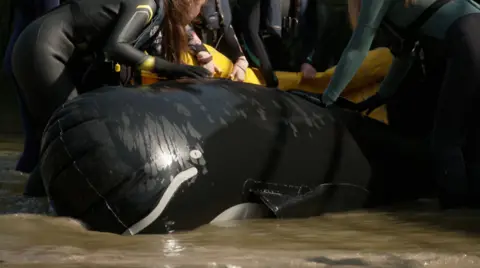
A two tonne model pilot whale is used in a simulation rescue in Newquay
The organisation runs regular training sessions using specialist equipment designed to help safely refloat stranded animals.
Whales are the most challenging to manage.
New recruits get to practise refloating an animal of that size using a life-sized two tonne replica pilot whale, which is filled with air and water.
The model is central to BDMLR's training and Jarvis said it was so realistic members of the public often try to help - or watch as the pretend whale is carefully manoeuvred onto a large mat, and inflatables are attached either side.
Volunteers then walk the pontoon system into deeper water and rock it to help the whale recover its muscle and blood circulation - a process that can take hours and involves co-ordinated teamwork.
Over the past eight years, volunteer numbers have increased from about 2,000 to nearly 3,500, but Jarvis said some coastal areas still lacked enough responders.
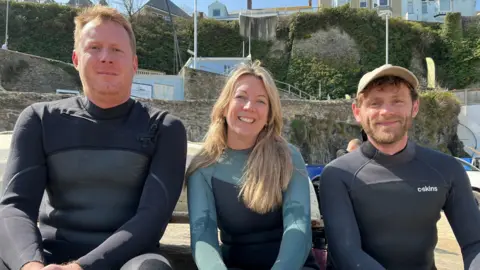
Volunteers James Merrikin, Cat Douglas and Curtis Clissitt completed their training in Newquay harbour
Volunteers are required to pay for a £150 Marine Mammal Medic Course run by the BDLMR.
After completing it they go on a register and wait to be called out to the next incident.
Cat Douglas, a youth work manager, said she joined a course in Newquay, Cornwall, to ensure she "could be a support rather than a hindrance", if she came across a stranding.
Police officer James Merrikin said he was more used to doing crowd management at strandings but it was "nice not having whatever I'm trying to help maybe attack me, it was very different to the day job".
Jarvis said volunteers often would not meet again until a real life callout "so it is bringing all of these people from very disparate backgrounds together to achieve something really quite amazing".
Once volunteers have learnt how to help rescue a whale, they move onto dolphins and also learn about injured seals.
Common dolphins and harbour porpoises are among the species most frequently affected by stranding, largely because they are more abundant in coastal waters, according to the BDMLR.
Bycatch remains a leading cause of their deaths.
BDMLR's head veterinary consultant, Natalie Arrow, said volunteers also received training in first aid techniques and personal safety was a priority.
"Marine mammals can carry zoonotic diseases which can pass from animal to humans so we have to wear protective clothing and when it comes to helping seal pups there's a risk of being bitten too so we try and teach safe handling techniques," she said.
 Steve Green
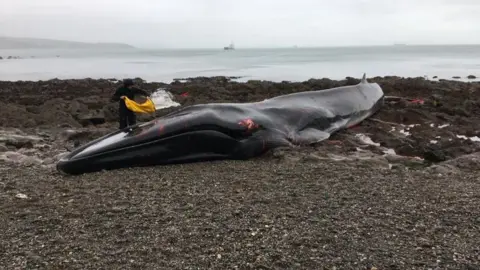
Volunteers deal with strandings like this Fin whale that was too big to refloat, but was made comfortable by water poured on its skin, after it beached at Parbean Cove in 2020
What to do when an animal strands
Members of the public are urged not to intervene directly, not to attempt to push the animal into the water and to stay clear of its tail.
The charity said people sometimes caused harm by rolling dolphins repeatedly, sometimes breaking their fins which meant they could no longer be refloated, or they can put themselves in danger.
Instead they should call the BDLMR.
Keep crowds and dogs away, keep noise low, and keep the animal cool and moist -ensuring no water enters the blowhole.
Jarvis said rescues could be tense but the outcome was worth it.
"It's nerve wracking," he said.
"When we refloat an animal, we're assessing it in the water for the first time. Seeing it swim off strongly is exhilarating - it means it has a good chance."