 2 months ago
77
2 months ago
77
Tessa Wong,Bondi beachand Tiffanie Turnbull,Sydney

 Getty
Getty
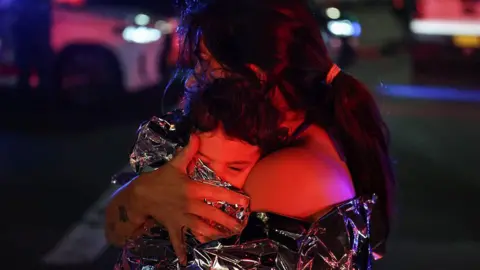
The shooting at Bondi beach targeted a Jewish Hanukkah event where many families were present
The first day of Hanukkah was a sweltering one in Sydney - a perfect afternoon to spend at Australia's most iconic beach.
More than 1,000 people were enjoying a festival marking the occasion at a grassy stretch in Bondi: kids careened around in facepaint, crowds snaked between food trucks, and many enjoyed live entertainment as they soaked up the last rays of sunshine.
Then, just before 7pm local time, shots rang out.
From a small footbridge - just metres from a children's playground - gunmen fired upon the fenced-in crowds. A car full of improvised bombs was parked nearby, though they never went off.
One attendee, who identified himself only as Barry, described watching people around him get shot as hundreds of beach-goers began screaming and running through the park to get away from the attack.
"It was pandemonium and chaos," he told the BBC.
One video showed a man - dubbed a "genuine hero" by state officials - leaping out from behind a parked car to wrestle a gun from one of the attackers and push him away.
"It was simply an unbelievable scene… in today's day and age, that families and kids on Bondi could be completely mowed down for being Jewish," Barry said.
 Getty
Getty
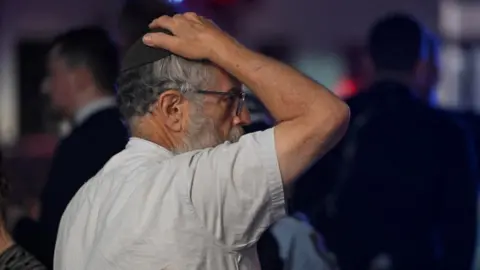
More than 1,000 people had gathered at the Hanukkah event.
At least 11 people have died and more than two dozen are injured, including a child. One gunman was also killed by police, another is in hospital in a critical condition, and police say they're investigating whether a third person helped stage the attack.
This is an unfamiliar, and devastating, shock for Australia - the deadliest shooting in this country since the Port Arthur massacre in 1996.
That attack, which killed 35 people, was a turning point, famously prompting the government to introduce some of the world's strictest gun control measures.
We've only had a handful of mass shootings since then, most of them horrific acts of domestic violence - not public attacks like today.
Swiftly declared a terrorist attack by police, it comes amid a rise in antisemitic attacks in Australia since the 7 October Hamas attack on Israel and Israel's subsequent offensive on Gaza.
 Getty
Getty
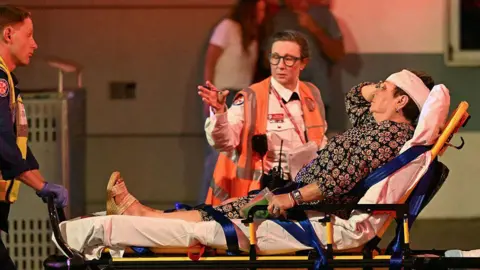
An injured woman is treated by emergency workers at Bondi beach
 Getty Images
Prime Minister Anthony Albanese called it an "act of evil antisemitism" and a "vile act of violence and hate".
But he's been accused by some - including Israel's Prime Minister Benjamin Netanyahu - of failing to address the upward trend of antisemitism here.
"The Australian government, which received countless warning signs, must come to its senses!" Israel's Foreign Minister Gideon Sa'ar wrote on X.
Alex Ryvchin, co-CEO of the Executive Council of Australian Jewry, told Sky News Sunday night that the "worst fears" of the Jewish community had been realised.
"It's been bubbling under the surface for a long time, and now it's actually happened."
In a statement, the Australia Jewish Association's Robert Gregory said many Jews would tonight be pondering whether they have a future in Australia.
"To be confronted with this horrific act of antisemitic violence during the Jewish festival of light and hope is shattering. In moments like this, we hold each other close," the Jewish Council of Australia said in a statement.
 Getty
Getty
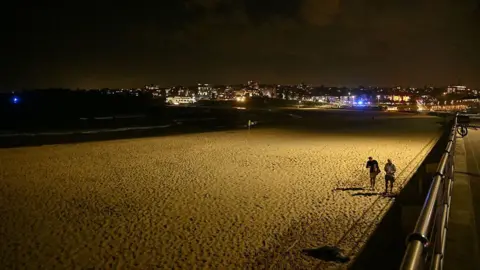
Bondi beach is one of the world's most famous beaches
There's a lot police can't - or won't - say yet. But they have declared this was a terrorist attack.
Who the gunmen are - how many of them even - and their motive is still unclear. They said one of the attackers was known to police, but wasn't on their radar for anything like this.
Officials wouldn't answer any questions about those who died either, out of respect for families who are still being notified.
"It's too early to give that information," was the most frequent refrain uttered at a press conference late on Sunday night.
But where NSW Police Commissioner Mal Lanyon couldn't offer answers, he tried instead to offer reassurance. Police are throwing everything at this investigation, he said.
He urged the community to remain calm, and avoid spreading misinformation online - including speculating on the victims and perpetrators of the attack.
"I want to make sure that there is no retribution," Commissioner Lanyon said.
Local politicians have also asked people not to share graphic footage from the attack on social media.
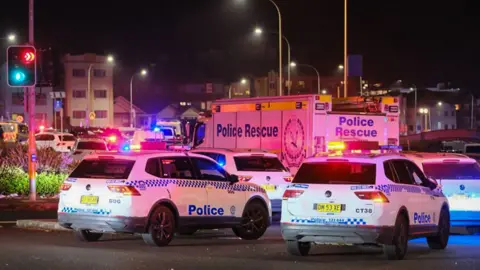
In the aftermath of the shooting, sirens were ringing through the city and the area surrounding Bondi swarmed with police cars, helicopters circling above.
There we found Fin Green, who was on FaceTime with his family in the UK when he saw the shooting unfolding outside his window. Unsure what was happening, he hid in his wardrobe for an hour and a half, until he felt it was safe to go out.
Danny Clayton, a broadcast journalist who was at the beach and witnessed the events from the Bondi Pavilion, said some people crashed their cars as they attempted to flee.
Many others in the area had similar stories. Restaurant worker William Doliente Petty said he was serving someone when he heard the gunshots. "The whole shop just stood up and we ran into the back exit."
Australia prides itself on being a merry, safe country and Bondi Beach has long been a symbol of that. But that image has been shattered and residents are in disbelief.
Sunday's attack also came less than two years after another nearby tragedy. In April last year, a deadly mass stabbing attack took place at nearby Bondi Junction. Shocked, many then uttered the same words we've heard over and over today too: "This sort of thing just doesn't happen here".
Additional reporting by Katy Watson and Tabby Wilson.