 3 months ago
138
3 months ago
138
44 minutes ago
Norberto ParedesBBC News Mundo

 Courtesy image
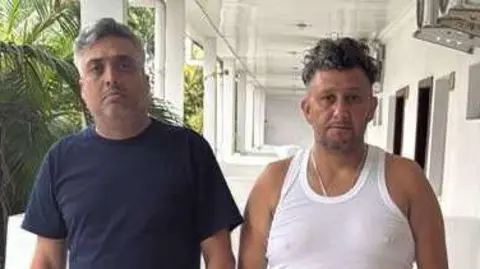
Carlos Rodelo (left) and Jorge Cubillos are among a group of 15 people from Colombia, Peru and Ecuador held in a hotel in DR Congo
For eight years, Jorge Cubillos worked to build a new life in the US, after fleeing threats in his home country of Colombia.
He says he had a work permit, and had been granted protection from deportation under Article 3 of the UN Convention Against Torture (CAT).
But suddenly Cubillos was put on a flight to the Democratic Republic of Congo, some 10,700 km (6,700 miles) away from his wife and four children in Florida.
"I never thought I would end up in Africa. I thought they were just threats," he told BBC Mundo.
Speaking by telephone from his hotel room in the Congolese capital, Kinshasa, he says he has no idea what the future holds.
Cubillos is one of a group of 15 migrants and asylum seekers from Colombia, Peru and Ecuador deported from the US to the central African country last month.
While the US authorities say they were deported because they were in the country illegally, some of them told the BBC their asylum applications were pending and so they did have the right to stay.
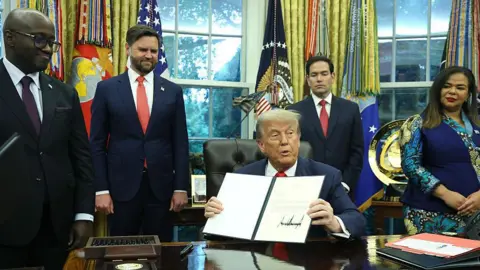
They are the first to arrive in DR Congo under a controversial agreement with third countries signed by US President Donald Trump's administration.
His promise of mass deportations was central to his re-election campaign.
Another of the deportees, Carlos Rodelo, says he only learned of his final destination just hours before the flight took off.
"When they told me they were sending me to the Congo, I told them I didn't even know what that was or where it was."
He says he spent eight months in detention in Louisiana before being deported - despite a court previously ruling he could remain in the country.
The Trump administration has defended its deportations to other so-called third countries as being lawful and mutually beneficial to both countries.
DR Congo says it agreed to accept migrants from third countries because it was committed to human dignity, the protection of migrants' rights, and international solidarity.
The Congolese government says the migrants' stay in the country is temporary and that their care and support is being paid for by the US.
The BBC has asked the US State Department for comment.
The migrants and asylum seekers interviewed by BBC Mundo say the conditions are unacceptable, with frequent power cuts and a lack of drinking water.
"We have fever, vomiting and diarrhoea. They tell us it's normal and our bodies are just adapting to Africa," Cubillos told the BBC shortly after arriving.
They have now been in the same hotel for a month but say little has changed and they are still getting sick.
"We have not been given any information about how long we will be here or when we will be leaving. We're constantly ill and don't want to eat the food provided, as it makes us feel worse. Our health is deteriorating. We're receiving medical assistance, but it isn't enough," Cubillos says.
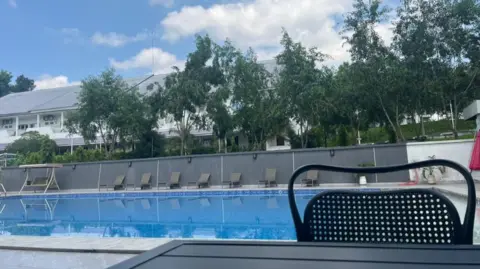
The mid-range apartment hotel where they are staying is on the outskirts of Kinshasa, near the international airport in the Mikindo district, one of the poorest in the city.
However, the deportees can make use of its football pitch, tennis court and an Olympic-sized swimming pool. At least two police officers stand guard outside and the BBC was denied permission to enter.
 Emery Makumeno / BBC
The US authorities are paying for the deportees' stay, according to DR Congo
One member of staff told the BBC they have sometimes played football with the deportees.
"I was worried about them being criminals. But, with time, I have come to understand that they are just like our own citizens, also trying make a living outside the country."
"They are all good people and they have started picking up a few words in Lingala [the main language in Kinshasa]," they said.
Pressed by the BBC about the swimming pool and other facilities at the hotel, Cubillos said that although from the outside it might look like they are living pretty well, that was not the case. "We've only used the pool once, on a really hot day. Most of the time, we're stuck in our rooms."
He added that, stuck in an unfamiliar country, thousands of miles from home, where the main languages are French and Lingala and few people speak English or Spanish, there is just "nothing to do".
"We spend our days shut in, alone with our thoughts, our problems, and the constant worry about what's going to happen to us."
Despite being told they were free to leave the premises, the Latin American deportees say that is not the reality, and even if they could, there is "nowhere to go anyway".
The group says they have been allowed out just a few times, accompanied by security guards, to see parts of the city or to go shopping.
All of those sent to DR Congo deny committing any crimes in the US.
Marta - whose name has been changed for fear of reprisals - says the "lack of information" and not knowing what is going to happen, is also affecting them "emotionally and psychologically".
She tells BBC Mundo she was detained less than two months after she was released under a supervision order in February, after a long legal battle during which she spent 14 months in detention. She says she has never been accused of anything other than contravening immigration laws.
When US Immigration and Customs Enforcement (ICE) agents showed up at her Texas home to verify her address and take her to an immigration office to be fitted with a GPS monitor, she did not suspect anything - until they put handcuffs on her.
Marta describes being held in solitary confinement for almost two days at one point.
"They locked me in a room. They didn't give me food or water. It was very cold," she says, adding that her family didn't know where she was.
And after being vaccinated against yellow fever and transferred to Louisiana, she was told she had a flight to DR Congo the next day.
 Getty Images
DR Congo is not the only African nation to accept third-country deportees from the US - others include Ghana, South Sudan and Eswatini
Human Rights Research Institute (IRDH) director and human rights lawyer Hubert Tshiswaka says the agreement between DR Congo and the US breaks international commitments on refugee protection.
"There is no legal basis to bring people from other countries to the Congo, especially from the United States," he tells BBC Mundo.
Marta says there is a lot of "misinformation" online, with some calling them criminals who "deserve what's happening" to them, but "that's not right".
According to Tshiswaka - and the group - they have done "nothing wrong here, so there is also no legal basis for holding them in detention".
BBC Mundo has contacted ICE for comment.
"Here I am, in the Congo," Marta says. "How do I feel now? I feel that our human rights have been violated."
"We feel completely adrift. We don't know what's going to happen to us."
Even the journey to Kinshasa was "inhumane", the group says.
"We spent more than 25 hours tied at the waist, hands, and feet, with a paper bag that had an apple, some chips and a bottle of water inside," Cubillos says. "It was terrible."
Rodelo says that a Maryland judge granted him protection under The UN Convention Against Torture (CAT) in February 2025.
Months later, when he was summoned to an immigration office to sign documents, he was detained.
"Three ICE agents were literally hiding, waiting for me," he explains.
When he told them he had approved asylum and CAT protection, Rodelo says: "They told me they were taking me one way or another."
During his detention, he says he filed additional protection requests, but was deported before a federal judge could rule on them.
According to the DHS, Rodelo had been issued with a "final order of removal for violating the terms of his parole" in February, the month he says he was granted CAT protection.
"[The] Trump administration is utilising all lawful options to carry out the largest deportation operation in history, just as President Trump promised," the statement said. "Anyone who has been deported received full due process."
 Getty Images
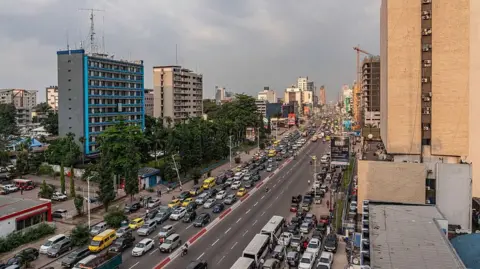
Kinshasa is one of the most populous cities in Africa, with a population of about 18 million
One Colombian woman who asked to stay anonymous, says she is unsure she would ever want to return to the US, where life has become "scary".
"After everything that's happened and everything I've suffered, who can assure me that I won't go through this again and that in the future they won't send me to another country?" she asks.
Cubillos say the deportees are being given two options - stay in the hotel, or go back home.
He adds that one Colombian couldn't cope with the situation any longer and has decided to go back home, at his own expense.
But he says this is not possible for most of them.
"If I had to choose between the Congo and Barranquilla [in] Colombia - where I'm from - I would choose Barranquilla, because here I'm not doing anything," he says.
"But going back to Barranquilla would put my life at risk," he adds.
"Asylum seekers are at risk in our countries."
Additional reporting by Emery Makumeno in Kinshasa
 Getty Images/BBC