 2 months ago
60
2 months ago
60
Claire Kendalland Judith Moritz,special correspondent

 BBC
BBC
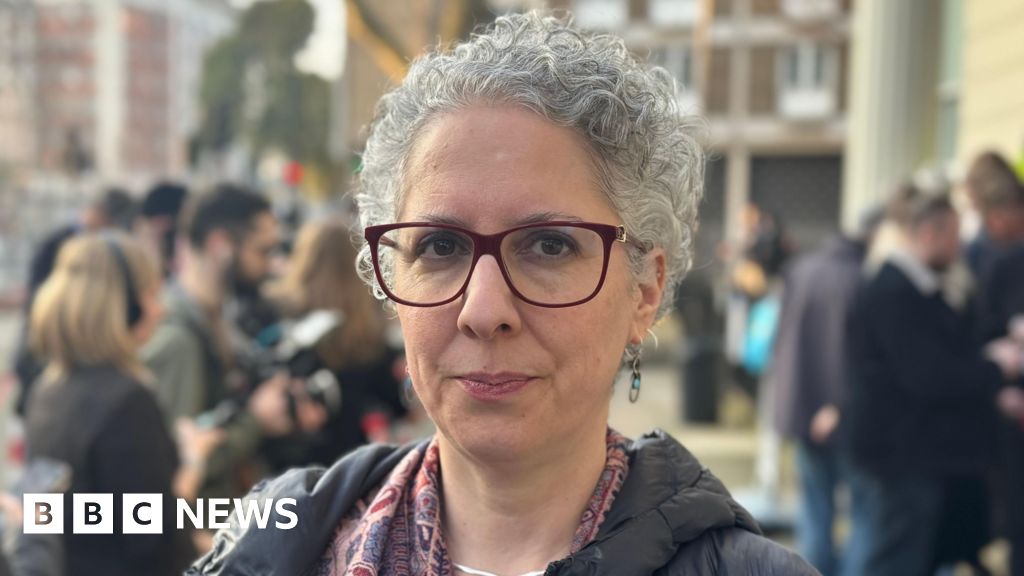
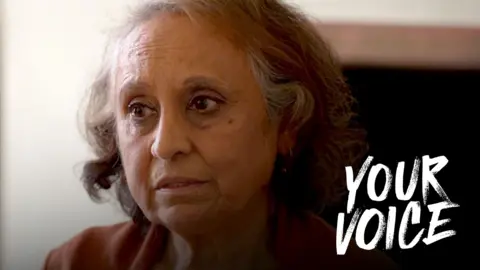
Mina, whose son died last year, says she felt she had to battle the system
Hundreds of parents have contacted the BBC about their struggles with getting support for adopted children - as charities call for a government review.
The response came after we reported last month that more than 1,000 adopted children had been returned to care over five years. Dozens of adoptive parents told us they had been blamed for the difficulties of often traumatised young people.
Mina, who contacted BBC Your Voice about her son who died last year from alcoholism, said: "You're just a lone person battling, trying to battle the system."
The charity Adoption UK said it had raised the issue with England's children's minister this week, calling for permanent funding for therapy and a wider review of the support available.
Mina was one of 700 people who contacted the BBC in response to the story, many of whom said they were adoptive parents who had struggled to get help for their children or had been blamed for their emotional and behavioural difficulties.
She and her husband adopted their son Leighton at the age of three, after he was removed from his birth mother when he was 18 months old. He struggled all his life with his mental health and addiction, she says.
"He turned all this pain inside, like I'm not worthy, I'm not lovable," says Mina. She believes his distress over his adoption led to his heavy drinking and death from liver failure at the age of 26. "He couldn't understand why."
Even as a four-year-old, Leighton would have periods of "deep depression" but his parents' concerns were brushed off by social workers, Mina says. When he was older, she adds, he would self-harm and began taking drugs and abusing alcohol.
She says social workers blamed her and her husband for Leighton's struggles, insisting "it must be something happening at home".
"There's a perception that once a child's adopted, they'll live happily ever after, and there is no platform to complain or to even have your voice," Mina says.
Mina's local authority did not respond to a request for comment.
Children's charity Coram - one of several organisations to call for greater support for adoptive families or to raise concerns about the blaming of parents in response to our story - says the adoption system is "under exceptional strain".
"It's shocking to discover again that adoptive parents, are experiencing blame as the first response when they seek help. That should never be the case," said CEO Dr Carol Homden.
She says "adoption remains an extremely important part of our care system and highly successful for the majority of children" but when children have been removed from their birth families for their own protection, "we need to recognise that they will need potential support for life and ensure that our services are there in a timely and sufficient way".
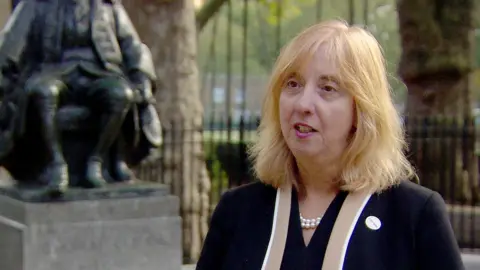
The adoption system is "under exceptional strain" says Dr Carol Homden from Coram
Coram also runs the largest body representing children's social workers, CoramBAAF, which has joined the call for a review of adoption support, saying: "We must get this right for the children at the heart of this."
James - not his real name - told us he was reassured to learn he was not the only parent to have gone through something like this and now feels he "owes it to our adopted son" to speak out himself.
He says he adopted a child who had severe foetal alcohol spectrum disorder (FASD) - a condition caused by drinking in pregnancy that can lead to physical and mental problems.
As he grew older, James says, his adopted son's behaviour was sometimes violent because of his condition.
'Heavily blamed'
One social worker suggested they should live in separate homes, says James, with one parent living with their adopted son and their other children staying with the other parent in the family home. A social worker also admitted, he adds, that social services staff had not been trained to deal with FASD.
"We took on a child knowing there'd be issues. We didn't expect everything to go perfectly because it doesn't. But when you ask for help, they need to help," he says.
Eventually, he felt his adopted son was no longer safe to live with the other children - James told us - and he arranged for him to be accommodated in care again.
James says they struggled to remain in contact with him.
"It was almost like, me and my children, that we weren't to exist anymore because we'd been heavily blamed," James says. "We were literally removed from from his life. They were more bothered on him seeing family pets than step-siblings."
His local authority said it could not comment on individual cases, but pointed to research which it says shows that outcomes for adopted children are "overwhelmingly successful".
The government says adoptive parents do "an incredible job providing a loving and supportive home" to vulnerable children, and while those arrangements do sometimes break down, support is in place to keep them together where possible.
We also heard from some parents who did receive good support and who say it made a huge difference.
Emma and her husband Geoff says they adopted their daughter, who needed extensive help, when she was nearly six. The local authority had an established relationship with a family therapy provider which specialises in adoption, Family Futures.
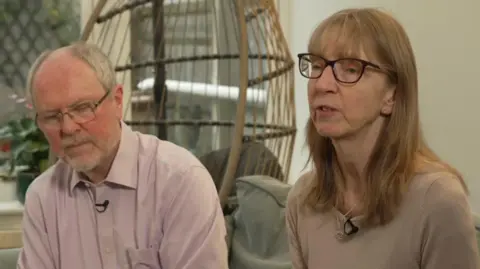
Emma and Geoff said specialist family therapy was a huge help to their daughter
"They understood that adoption and therapy need to go together," she says. "When we asked for some help they were very keen to give it. They realised if they don't do it now, things get worse, children go back to care and it all falls apart."
Adopted children who have been moved first into foster care, and then into an adoptive family, struggle to feel safe, says Emma, and the family therapy was aimed at addressing that.
"If you imagine being a small child and being put from pillar to post with different people and then you arrive virtually into a stranger's house, you are going to be very scared," she adds.
Geoff said it took about 10 years of seeing a therapist, on and off, before their daughter trusted them.
Without that support, he says he can't see how she would have been able to achieve as much as she has now that she is 21, having moved into supported living accommodation and still keeping in touch with her parents.
"We used to think that we couldn't imagine how she could ever leave home," says Geoff. "Now she's able to live away from us. She's got a place where she feels she belongs."