 3 months ago
132
3 months ago
132
3 hours ago
Fan Wangand Yan Chen

 AFP via Getty Images
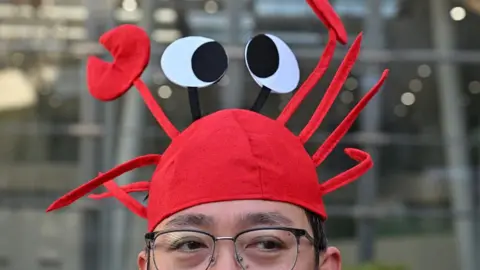
AI agent OpenClaw sparked a frenzy in China in March, with users "raising lobsters" - training the tool to suit their needs
"Are you a lobster?" is the first question Wang had for the BBC.
He had been so consumed recently by the AI assistant OpenClaw - which in China has earned the name "lobster" - that he wondered if he was talking to AI, rather than a journalist.
After being assured I was indeed human, the young IT engineer explained how he had "fallen deep into" AI and, especially, OpenClaw.
Driven by encouragement from the very top of China's leadership, the world's second-biggest economy has embraced artificial intelligence, sparking both curiosity and concern.
OpenClaw, built by Austrian developer Peter Steinberger, is an example of how this is playing out.
Because it is built on open-source data and tech, the code is available to those who want to customise it to work with Chinese AI models. And that is a huge advantage, because Western models such as ChatGPT and Claude are not accessible in China.
So OpenClaw stirred up a frenzy as more people experimented with its code.
Wang was one of them. He did not want to share his full name because of his side gig running an online shop selling digital gadgets on TikTok, which is banned in China.
When he first saw what his "lobster" - built on OpenClaw's code and altered for his use - could do, he said he was stunned.
Uploading products to the TikTok Shop is a grind: adding images, writing titles and descriptions, setting prices and discounts, signing up for campaigns, and messaging influencers. Usually he can manage about a dozen listings a day.
His "lobster", which he was still testing, can do up to 200 in just two minutes, he claimed. "It is scary, but also exciting. My lobster is better than I am at this. It writes better, and can instantly compare my prices with every competitor - something I would never have time to do."
OpenClaw had already exploded in the global tech community - Nvidia CEO Jensen Huang called it "the next ChatGPT" and its developer Steinberger recently joined OpenAI.
But the enthusiasm that turned OpenClaw into something "trendy" was "uniquely Chinese", said Wendy Chang, from the MERICS think-tank.
 AFP via Getty Images
Ordinary people lined up outside the headquarters of Tencent and Baidu for free customised versions of OpenClaw
Wang called OpenClaw "the AI era's answer for ordinary people".
Chinese tech giants seemed to agree because they were releasing apps built on OpenClaw. From the southern tech hub of Shenzhen to the capital of Beijing, hundreds of people - from secondary school students to retirees - were lining up outside the headquarters of Tencent and Baidu for free customised versions.
Many were curious to find out more about the "lobsters". Some users online said they used them to invest in stocks, claiming their "lobsters" analysed the best times to buy and sell, and even did the deed, despite the risk of costly errors. Others said the tools were great for multi-tasking and saving time.
Famous comedian and author Li Dan told millions of his followers on Douyin that he was so immersed in OpenClaw that he talked to his lobster in his dreams. Fu Sheng, chief executive of Cheetah Mobile, relentlessly shared how he "raised his lobster" on social media - a phrase users adopted to describe training the assistant for their requirements.
China's AI moment has been in the making for some time.
When the Chinese app DeepSeek burst onto the AI scene early last year, it seemed to catch a lot of people by surprise. It was also an open-source platform, developed by home-grown engineers from elite Chinese universities. And it came on the back of years of investments in developing crucial technology, including AI - which has only continued in the wake of DeepSeek's success.
What DeepSeek showed was the Chinese entrepreneurial appetite for seeking out opportunities in research and innovation, despite curbs on the import of advanced tech. And it also proved how eagerly people were willing to adopt open-source platforms.
So the stage was set for OpenClaw.
Its popularity did not escape the Chinese government. Several counties and cities provided incentives to encourage entrepreneurs to apply OpenClaw in their businesses - the eastern city of Wuxi offered up to five million yuan ($726,000; £549,000) for manufacturing-related applications, such as robots.
"Everyone in China knows that the government sets the pace, and the government tells you where the opportunities are," said Rui Ma, founder of the Tech Buzz China newsletter. "It's practical for most people. That's probably a better plan, to just follow the government directive than to really try to figure it out on your own."
Once Beijing signals its priorities, the market follows. In the past few years, tech companies - large and small - have rushed into the AI race, supported by subsidised office space, cash rewards and loans.
From manufacturing to transport, healthcare to household electronics, companies are seeking to integrate AI into their products and operations. "That's the spirit of AI Plus," Chang says, referring to China's national strategy to integrate AI across industries. "Take AI, apply it everywhere."
The competition is fierce. In what Chinese media have dubbed the "Hundred Model War", more than 100 AI models have emerged since 2023, with only 10 still in contention.
 VCG via Getty Images
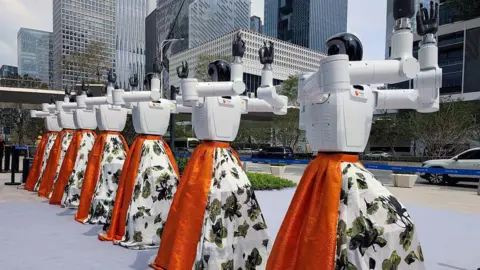
From manufacturing to household electronics, Chinese firms are seeking to integrate AI into their products and operations
Chinese AI platforms still lag behind Western competitors, experts say, though the gap is narrowing. That is why, for Chinese officials, promoting OpenClaw is a strategic move, according to Jenny Xiao.
But much of the initial hype has cooled as users begin to reckon with the costs involved - interacting with the agent requires spending tokens - as well as security concerns.
Last month, Beijing's cybersecurity authorities warned of serious risks linked to improperly installing and using OpenClaw. A growing number of government agencies have since banned staff from installing the tool. Soon, the trend shifted from offering to install the service to removing it.
Such contradiction is not unusual in China's top-down system, Ma says. Local governments often compete for approval from Beijing by ushering in tools that align with what the Communist Party leadership wants, and then pedal back as challenges arise.
"It's disorder with control," Ma says, adding that Beijing's intervention doesn't necessarily signal discouragement.
For one, AI startups could address a major challenge: youth unemployment rate of more than 16%. Many government incentives tied to OpenClaw - some with subsidies of up to 10 million yuan - mention "one-person companies", or start-ups run by an individual, with the help of AI.
"Who's the most likely to build a one-person company? Probably young people who face a tough job market," Xiao says.
And the fear of falling behind is acute in China, given the intense competition over jobs.
"Some say that in 2026, if you don't 'raise lobsters', you've already lost at the starting line," reads a commentary published by state newspaper People's Daily.
"It is genuinely terrifying," said Jason, an IT programmer whose team is only hiring those who have experience using AI tools. "It's mostly people leaving, with very few new hires coming in."
Wang agrees that it's a scary time - "everyone could be replaced" - though he doesn't seem overly worried himself.
"I probably won't need to work, and this could become my full-time job," he said, referring to his TikTok business.
What if the "lobsters" can run their own shops, squeezing him out? "I'll use AI to find another business."