 3 months ago
111
3 months ago
111
Ghoncheh Habibiazad Senior reporter, BBC Persian

 AFP via Getty Images
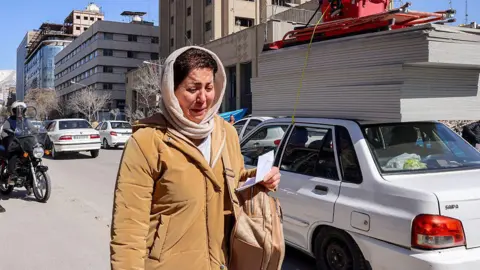
Residents in Tehran reported continued strikes on Monday and Tuesday (file photo taken on 3 March in Tehran)
People in Tehran are stocking up on essentials as uncertainty over how long the war might continue grows in the Iranian capital.
Locals have told BBC Persian they are worried about the availability of groceries and price increases, as explosions continue to sound around the city.
"We need to stock up because we don't know for how long it's going to continue," one resident of Tehran, Nasrin, said. "We're worried that we might run out of essentials if we don't."
Prices in Iran were already high before this most recent conflict. Cost-of-living pressures and international sanctions sparked nationwide protests in December, which led to a brutal crackdown from the Islamic Republic regime.
US and Israeli strikes over the past few days have worsened the situation, according to some residents who have managed to find fleeting internet connections amid internet blackouts to speak to BBC Persian.
International news organisations are often refused visas to Iran, which severely limits their ability to gather information about what's going on inside the country. Internet blackouts make the situation even harder to report on.
One person based in Tehran, called Pouya, said prices have gone up since the war broke out on Saturday.
"I was just checking [the prices] - rice is now at 625 tomans; it was 530 before the war," he said.
He added that the items most adversely affected are potatoes.
Iranian state news outlets have reported that "in line with the government decision to prioritise the provision of essentials", the export of all food and agriculture products has been banned "until further notice".
Internet packages have also risen in price, according to Shayan, a resident of the city of Karaj, about an hour's drive from Tehran.
"It's very difficult to get online now," he said, adding that the price of internet packages via Elon Musk's Starlink has increased "enormously".
Omid, a 26-year-old in Tehran, said "people are becoming slightly uneasy about how long the situation is dragging on".
He said he had assumed the US and Israel would target certain individuals like Ayatollah Ali Khamenei, who was assassinated on Saturday, and that the attacks "would be over by now".
But he said he had heard more explosions in the city early in the afternoon on Tuesday and due to the continued strikes he had stocked up on essentials.
However, not all shops remain open. "There is a greater security presence on the streets, but the streets themselves are empty," he said. "Some shops have closed, particularly those near the affected areas."
Other residents reported hearing and witnessing explosions in the capital on Monday and Tuesday.
Another city resident, Maryam, said she was near the area hit by missiles on Monday night.
"The attacks last night were terrible," she said over text message. "Our house was shaking."
Some residents said they had fled Tehran due to attacks on the capital.
But Maryam said she intended to stay.
"Some people have left Tehran, but we're staying at home," she said. "If we don't get killed, we'll remain here as long as there's a call for protests in the streets, and then I'll go out with my family to join them. I'm very glad that these officials are being targeted. We're enduring the strikes until they're all gone."
Around 787 people have been killed in Iran since the US and Israel launched strikes at the country on 28 February, Iran's Red Crescent Society said.
There is still significant upheaval, with the Israeli military saying it hit Iran's presidential office on Tuesday, as well as other infrastructure targets.
Videos verified by the BBC of explosions to the east of the capital, in Pardis, have also been captured.
Iran has carried out widespread retaliatory missile and drone attacks, targeting Israeli government and military sites in Tel Aviv and elsewhere.
Strikes have also been reported in countries hosting US bases - Qatar, Bahrain, Jordan, the United Arab Emirates (UAE) and Kuwait - and US-allied Oman and Saudi Arabia.
Iran has been accused of widening its attacks to include other targets in recent days, including on shipping, civilian sites - including hotels in Dubai - and the US embassy in Saudi Arabia's capital, Riyadh.