
 2 months ago
86
2 months ago
86
Pallab GhoshScience Correspondent

 Kevin Church
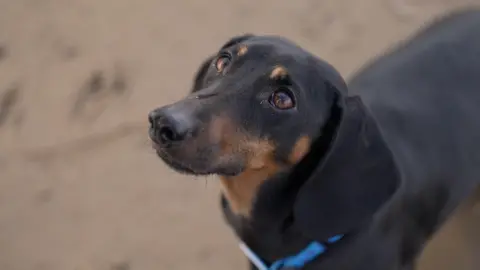
Genetic evidence shows the earliest known dogs lived closely with their human masters
A fragment of a jawbone found deep underground in a cave in Somerset has rewritten the story of when and how dogs became our best friends.
DNA analysis shows the jaw belonged to one of the earliest known domesticated dogs and that people lived closely with them in Britain 15,000 years ago, thousands of years before farm animals were domesticated or cats padded into our homes.
The discovery pushes back the time that the first dogs evolved from their wolf ancestors by around 5,000 years.
It also suggests that the friendship between the very first dogs and stone age humans was there almost from the very start, according to Dr William Marsh of the Natural History Museum.
"It shows that by 15,000 years ago dogs and humans already had an incredibly tight, close relationship – and this tiny jawbone, which seems like such a small thing, has helped to unlock the whole human story of how that partnership began."
The first dogs were descendants of grey wolves that lingered around human camps at the end of the Ice Age, scavenging leftovers and slowly becoming tamer.
Over time, people started using these animals to help with hunting, guarding and tracking, turning them into working partners rather than wild predators.
After hundreds of generations of human breeding, the dogs that emerged had shorter muzzles, smaller teeth and an enormous range of sizes, from lapdogs to hulking guardians.
 Kevin Church/NHM
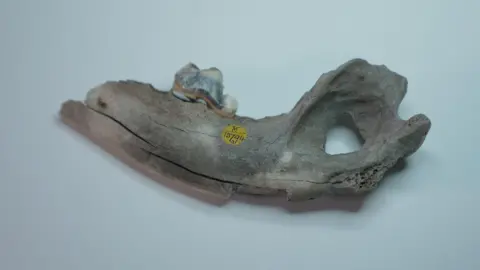
It may not be much to look at but this battered fragment of 9cm bone has transformed the story of dogs and humans
Marsh made the discovery by accident during his PhD project. The jawbone was found in excavations from the 1920s in Gough's cave in Cheddar Gorge, now famous for storing its famous cheese.
It had been tucked away in a museum drawer for decades as it was thought to have been an unremarkable specimen. But the young researcher came across an obscure research paper published ten years earlier that raised the possibility it might have belonged to a dog.
Marsh carried out a genetic analysis of the jawbone and found to his shock and delight that it was indeed from a dog, making it the first unambiguous evidence that dogs existed thousands of years earlier than previously confirmed.
Scarcely believing the test results, Marsh told his friend and scientific collaborator Dr Lachie Scarsbrook, from the University of Oxford and LMU Munich, who takes up the story.
"William tells me: 'I found dog from the early stone age,' and I'm like, 'No you haven't — every other dog has been a wolf,' but he's super confident of it.
"He then shows us his results, and we're like, '(Gosh), this guy might have actually found a dog that far back in time."
Scarsbrook's actual language was more colourful than we can publish, because he knew just how important his friend's big breakthrough could prove.
 Kevin Church
The dog lived with humans in this Somerset cave 15,000 years ago
With the jawbone from Gough's cave now confidently identified as being from a dog, this allowed its genetic signature to be used to test specimens of a similar age from across western Europe and central Anatolia in modern Turkey, the large Asian peninsula that makes up most of the country.
They all turned out to be dogs.
"We've spent years trying to make sense of ancient samples whose DNA sits between wolves and dogs," Scarsbrook told me. "Everything sat in no man's land because we simply couldn't tell where dogs truly began.
"Then this little jawbone turns up and it is the key to then identifying other ancient dogs all across Europe that had just been sitting under our noses this whole time," he told BBC News.
According to Dr Selina Brace of the Natural History Museum, the tests not only showed that the dogs were genetically similar – which means that the dogs' ancestors must have travelled across Europe with their masters, but that they ate the same food as their human owners.
"We know from their diet that they either shared fish in Turkey or the same meat and plant diet in Gough's Cave. So what this would suggest is an incredibly close relationship between humans and dogs."
"And isn't that amazing? 15,000 years ago, we see that level of companionship that we still see today. That's a really long relationship."
There has been archaeological evidence of small dog‑like animals from Late Ice Age caves in Germany, Italy and Switzerland that look like dogs and, in some cases, were buried alongside humans, suggesting a close relationship at about the same time.
But this new research is the first to use detailed DNA testing to show that the animal from Gough's Cave really was a dog, and that it was part of a very early population of dogs that had already spread across much of western Europe and Asia.
 Lars Larsson.
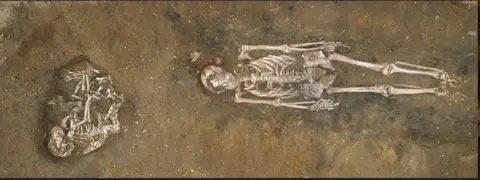
A dog buried alongside its owner human in a cave at Skateholm in southern Sweden, around 7,000–5,000 years ago, revealing the close bond between people and their animals even then.
A separate study, also in Nature, shows that the pets lying on our sofas today all descend from a single ancient dog population, which had already spread around much of the northern world by the end of the Ice Age.
Dr Anders Bergström of the University of East Anglia and the Francis Crick Institute and his colleagues discovered this by analysing the DNA of more than 200 dog and wolf remains from caves and sites across Europe and the Near East, from Switzerland and Sweden to Turkey and Armenia.
When they read the DNA, they found that some of the earliest European dogs – slightly younger than the Gough's cave find – are clearly the same kind of dog as those seen in Siberia, East Asia and beyond, all tracing back to a shared ancestor, rather than a separate European domestication that later vanished.
"Wherever dogs were first domesticated, they had already reached Europe by at least 14,000 years ago and they go on to contribute quite substantially to the dogs we see today," Bergström told me.
Earlier work by researchers at the Crick's ancient DNA lab hinted that the first dogs may have emerged somewhere in Asia. Bergström's colleague Dr Pontus Skoglund is now analysing ancient wolf DNA from across the globe to pin down that historic moment. Scientists think it was not a single pet wolf but a long, gradual shift as some wolves adapted to life around human camps and, over time, evolved into dogs.
"That was a remarkable event, right? Someone chose to build a bond with this dangerous predator," he told BBC News.
"If we can find out where and when the first domestication happened, we will also know which human group was involved, the archaeological and ecological circumstances that first made this happen?"
These discoveries have amazed Ciara Farrell, who is head of culture and heritage at the Royal Kennel Club.
"As a dog lover, I think every dog lover knows that feeling where your dog is almost speaking to you. And that is a relationship that's developed over many, many years and it's unique to dogs and humans."