 2 months ago
63
2 months ago
63
Victoria GillScience correspondent

 Getty
Getty
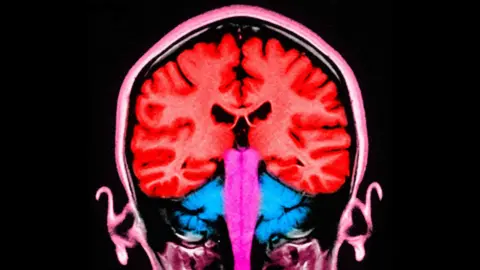
Scientists have discovered how to make people less selfish - at least temporarily - by stimulating two areas of their brain.
In a new study carried out at the University of Zurich, 44 volunteers were asked to decide how to split an amount of money between themselves and an anonymous partner.
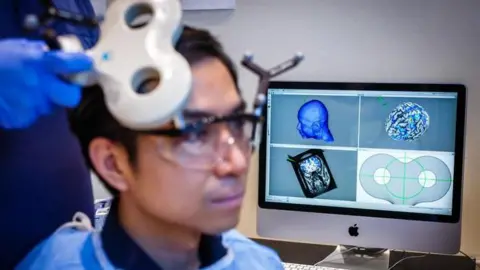
During the experiment, an electrical current was applied to the frontal and parietal areas of the brain - situated at the front and towards the back. When these areas were stimulated at the same time, the participants gave away more money.
"The effects were not huge, but they're consistent," said Prof Christian Ruff, one of the lead authors who carried out the experiments.
"Statistically, we really see an increase in their willingness to pay."
As well as revealing something about the mechanisms behind fundamental human behaviour, the findings, researchers say, could be useful in treating some brain disorders.
"There are people who have profound problems with social behaviour, because they can't take other people's perspective into account and are constantly behaving selfishly," Prof Ruff told BBC Radio 4's Inside Science. "That's when we could use this."
In the case of this experiment, the effects were short-lived.
"To really change behaviour in the longer term, you would have to do it repeatedly," said Prof Ruff. He compared the potential effects to going to the gym. One workout will not improve your fitness, "but if you go to the gym twice weekly for a period of two months, your body changes. This is the same."
 Nicolas Zonvi
This new discovery builds on their previous study, which monitored brain activity while participants played the same money-sharing game.
In that study, the researchers pinpointed the two brain areas that appeared to be "talking to each other" - with brain cells firing at the same frequency - when players gave away more money.
Those two brain areas are known to play a role in decision-making and in empathy, or distinguishing the feelings of others from our own.
When a more selfless decision was made, the empathy region and the decision region appeared to communicate.
So for this study, the researchers wanted to find out if they could use electrical stimulation to "nudge" people towards more selfless decisions.
One anonymous volunteer, who tried out the brain stimulation test, said the experience felt "like a warm shower or small drops of rain" on the scalp.
"Immediately after starting the stimulation, I was making the decisions displayed on a screen. At no time did I have the sensation that the stimulation was impacting my decisions."
Identifying this selfless decision brain activity, in multiple people, strongly suggests that altruism is hardwired in our brains; that it evolved to make us take care of others.
Being able to influence and change that mechanism, Prof Ruff explained, "is what makes this discovery clinically relevant".
Prof Ruff's co-author, Dr Jie Hu from East China Normal University, said: "What's new here is evidence of cause and effect.
"When we altered communication in a specific brain network using targeted, non-invasive stimulation, people's sharing decisions changed - shifting how they balanced their own interests against others."
But should we be concerned - or unsettled - by an experiment that influences behaviour in this way? Prof Ruff says "absolutely not".
"This is medically regulated specifically for these experiments," he explained. "It goes through an ethics committee and people give informed consent, which they can withdraw at any time.
The neuroscientist compared that to the influences on our behaviour from social media and advertising. "There you have no control over what you're exposed to [and how your brain responds to it]," he said.