 3 months ago
127
3 months ago
127

 Getty Images
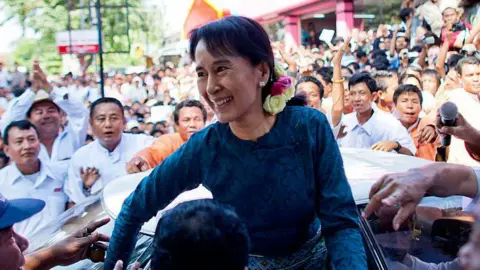
Former Myanmar leader Aung San Suu Kyi, who has been held in detention since a military coup in 2021, has been moved to house arrest, the country's state media reported.
Little has been heard from the 80-year-old Nobel laureate since she was arrested on the day the armed forces ousted her elected government more than five years ago.
She was charged with a raft of criminal offences, including corruption. She denies all of the accusations and rights groups have condemned the series of secret trials as a sham.
Having spent nearly15 years in detention between 1989 and 2010, Suu Kyi was once seen as a beacon for human rights, a principled activist who gave up her freedom to challenge the ruthless army generals who have ruled Myanmar for decades.
Her personal struggle to bring democracy to Myanmar (also known as Burma) made her an international symbol of peaceful resistance in the face of oppression.
But her decision later on to defend Myanmar against charges of genocide over the military's atrocities against Muslim Rohingyas badly tarnished her saint-like international image.
Suu Kyi is the daughter of Myanmar's independence hero, General Aung San.
He was assassinated when she was only two years old, just before Myanmar gained independence from British colonial rule in 1948.
In 1960 she went to India with her mother Daw Khin Kyi, who had been appointed Myanmar's ambassador in Delhi.
Four years later she went to Oxford University in the UK, where she studied philosophy, politics and economics. There she met her future husband, academic Michael Aris.
After stints of living and working in Japan and Bhutan, she settled in the UK to raise their two children, Alexander and Kim, but Myanmar was never far from her thoughts.
When she arrived back in Yangon in 1988 - to look after her critically ill mother - Myanmar was in the midst of major political upheaval.
Thousands of students, office workers and monks took to the streets demanding democratic reform.
"I could not as my father's daughter remain indifferent to all that was going on," she said in a speech in Yangon on 26 August 1988. She went on to lead the revolt against the then-dictator, General Ne Win.
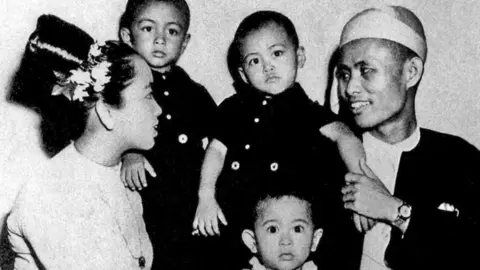 History/Universal Images Group via Getty Images
A photo of Aung San (right) with his wife Daw Khin Kyi and their children including Suu Kyi as a baby (front centre) in 1947
Inspired by the non-violent campaigns of US civil rights leader Martin Luther King and India's Mahatma Gandhi, she organised rallies and travelled around the country, calling for peaceful democratic reform and free elections.
But the demonstrations were brutally suppressed by the army, which seized power in a coup on 18 September 1988. Suu Kyi was placed under house arrest the following year.
The military government called national elections in May 1990, which Suu Kyi's NLD convincingly won - but the junta refused to hand over control.
Suu Kyi remained under house arrest in Yangon for six years, until she was released in July 1995.
She was again put under house arrest in September 2000, when she tried to travel to the city of Mandalay in defiance of travel restrictions.
She was released unconditionally in May 2002, but just over a year later was imprisoned after a government-backed mob set upon her entourage in the north of the country.
She was later allowed to return home - but again under effective house arrest.
At times she was able to meet other NLD officials and selected diplomats, but during the early years she was often in solitary confinement. She was not allowed to see her two sons or her husband, who died of cancer in March 1999.
The military authorities had offered to allow her to travel to the UK to see him when he was gravely ill, but she felt compelled to refuse for fear she would not be allowed back into the country.
During this period, her international stature grew amid widespread sympathy for her predicament and admiration for her advocacy for non-violent protest.
In 1991, Suu Kyi was awarded the Nobel Peace Prize, while still under house arrest, and hailed as "an outstanding example of the power of the powerless".
A film was made about her life by French director Luc Besson, while songs were written in tribute to her courage by bands such as U2.
Suu Kyi was sidelined from Myanmar's first elections in two decades on 7 November 2010.
But six days later the government released her from house arrest, in a move hailed by the international community. Thousands of jubilant supporters celebrated at the gates of her house, where she addressed the crowd calling for unity in Myanmar. Her son Kim was allowed to visit her for the first time in a decade.
As the military-backed government embarked on a process of reform, Suu Kyi and her party re-joined the political process.
They won 43 of the 45 seats contested in April 2012 by-elections, in an emphatic statement of support. Suu Kyi was sworn in as an MP and leader of the opposition.
The following May, she left Myanmar for the first time in 24 years, in a sign of apparent confidence that its new leaders would allow her to return.
In 2015, Suu Kyi led her National League for Democracy (NLD) to a landslide victory in Myanmar's first openly contested election in 25 years, ending decades of military-backed rule.
The landmark win sparked hopes of further reform under the NLD steered by Suu Kyi, who took on the title of state counsellor as she was barred by the constitution from becoming president.
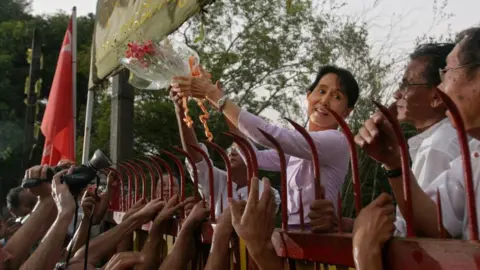 AFP via Getty Images
Huge crowds greeted Aung San Suu Kyi on her release from house arrest in 2010
When she was Myanmar's state counsellor, her leadership was partly defined by the treatment of the country's mostly Muslim Rohingya minority.
In 2017 hundreds of thousands of Rohingya fled to neighbouring Bangladesh due to an army crackdown sparked by deadly attacks on police stations in Rakhine state.
Myanmar is now facing a lawsuit accusing it of genocide at the International Court of Justice (ICJ), while the International Criminal Court has investigated the country for crimes against humanity.
Suu Kyi's former international supporters accused her of doing nothing to stop rape, murder and possible genocide by refusing to condemn the still powerful military or acknowledge accounts of atrocities.
A few initially argued that she was a pragmatic politician, trying to govern a multi-ethnic country with a complex history.
But her personal defence of the army's actions at the ICJ hearing in the Hague was seen as a new turning point for her international reputation.
At home, however, "the Lady", as Suu Kyi is known, remains wildly popular among the Buddhist majority who hold little sympathy for the Rohingya.
During her time in power Suu Kyi and the NLD government also faced criticism for prosecuting journalists and activists using colonial-era laws.
While there was progress in some areas, the military continued to hold a quarter of parliamentary seats and controlled key ministries including defence, home affairs and border affairs.
In August 2018, Suu Kyi described the generals in her cabinet as "rather sweet" and Myanmar's democratic transition, analysts said, appeared to have stalled.
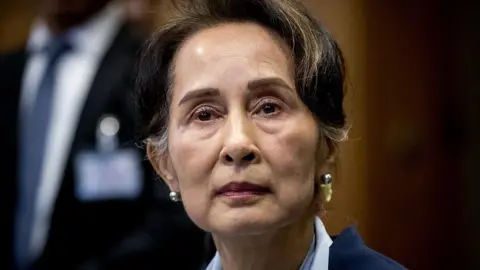 AFP via Getty Images
Aung San Suu Kyi went to The Hague in 2019 for the hearing on the Rohingya genocide case
Despite some criticism of their performance in government, the NLD remained hugely popular with the people and clinched yet another decisive victory in the 2020 election.
In the early hours of 1 February 2021, just hours before the NLD was due to begin its second term in office, Suu Kyi, along with President Win Myint and other party leaders, was arrested in a military coup.
It triggered widespread demonstrations, leading to a crackdown by Myanmar's military on pro-democracy protesters, activists and journalists. A civil war erupted, which continues to be bitterly fought to this day.
At that time, Suu Kyi faced a series of charges ranging from violating Covid restrictions and illegally importing communications equipment such as walkie-talkies, to voter fraud and corruption, all of which she denied.
The UN called her trial a "sham" that would only "deepen rejection of the coup".
She was found guilty and sentenced to a total of 33 years, which since then has been reduced several times.
On 30 April 2026, the military showed an undated picture of her on TV and said it would be moving her out of jail and put her under house arrest. But her son Kim Aris voiced scepticism about the announcement.
While Suu Kyi still remains popular with many in Myanmar, her long-held belief in non-violent struggle has been rejected by those who have joined the armed resistance, who argue that they must fight to end the military's role in Myanmar's political life.
There is more criticism of how Aung San Suu Kyi governed when she was in power than before. Many younger opposition activists are now willing to condemn how she handled the Rohingya crisis.
As she enters her 80s, with uncertain health, it remains unclear how much influence she would have, were she to be released, even if she still wants to play a central role.
But her long struggle against military rule has made her synonymous with hopes of a freer, more democratic future.