 3 months ago
113
3 months ago
113
17 minutes ago
Adam MandevilleBBC News NI

 PA Media
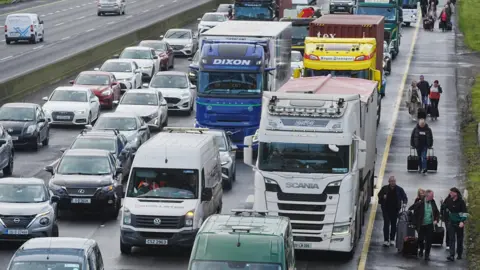
People were seen making their way on foot with their luggage to bypass the heavy traffic on Dublin's M50 northbound towards the airport on Thursday
Dublin Airport passengers are being advised to allow extra time for their journeys a day after people were seen walking with their luggage along a motorway amid ongoing road blocks due to fuel protests.
Travel across parts of the Republic of Ireland has been affected for the fourth day in a row on Friday as vehicles, including tractors, block roads.
Slow-moving convoys have been protesting against high fuel prices caused by the US and Israeli war against Iran.
Gardaí (Irish police) said on Friday that they "continue to engage extensively with those taking part in fuel protests across the country".
As well as blocking roads, protesters are in place at fuel terminals in Foynes in County Limerick, as well as at Galway Port and a blockade continues at the Whitegate Oil Refinery in east Cork.
The Irish Health Service Executive called for all approaches to medical facilities to be kept clear for people to access treatment.
Irish Minister for Agriculture Martin Heydon and Minister of State Timmy Dooley will meet representative bodies on Friday.
Dooley told Irish broadcaster RTÉ it was his understanding that invitations had been extended to such bodies but that who they brought along was for them to decide.
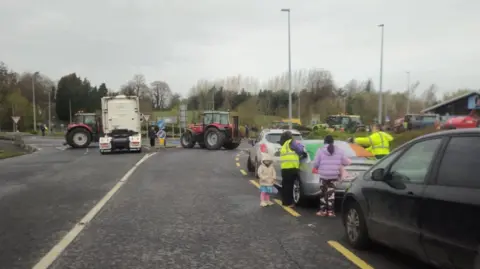
Protests have been taking place across Ireland, including in Monaghan where tractors are blocking access to a roundabout
Minister for Defence Helen McEntee said that the government will meet about seven representative bodies on Friday, and that it is her understanding these groups are the same bodies the government has met in recent weeks.
The Irish Minister for Justice, Jim O'Callaghan, said there would be "legal consequences" for some protests.
"It might not arise today or tomorrow but people have licences to drive vehicles, those licences will be affected."
In a statement on Thursday, a gardaí spokesperson said the force was "moving to an enforcement phase" unless those blocking access to critical infrastructure "desist and disperse".
They said blockades were putting food, fuel, clean water and animal feed supplies at risk.
Fuels for Ireland said that 100 garage forecourts had run out of fuel, mainly in Munster and the west of Ireland.
Its chief executive, Kevin McPartlin, told RTÉ that the number could be five times that by Friday night, adding that 50% of the country's new supply was being kept behind barricade lines.
Allow X content?
This article contains content provided by
X
. We ask for your permission before anything is loaded, as they may be using cookies and other technologies. You may want to read
and
before accepting. To view this content choose ‘accept and continue’.
The BBC is not responsible for the content of external sites. X content may contain adverts.
On Thursday, Taoiseach (Irish prime minister) Micheál Martin told RTÉ that the blocking of roads and infrastructure was "not a fair form of protest".
McEntee claimed the actions of some protesters was "now crossing into criminal behaviour".
Sinn Féin leader Mary Lou McDonald called for the taoiseach (Irish prime minister) and tánaiste (deputy PM) to "pick up the phone" to protesters.
What have protesters said?
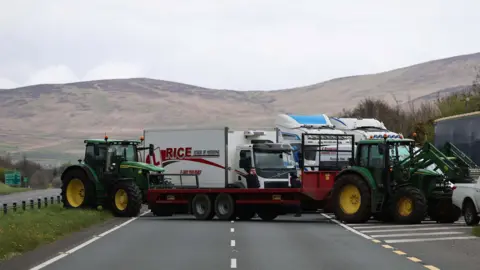 PA Media
Protests have took place across the country on Thursday, including on the N1
"There's not one farmer in Ireland or Northern Ireland that wants to be out protesting. They have enough to do."
Maguire added that he wants the Irish government to stop taxing fuel.
Mark Hegarty helped organise a large protest in Bridgend, County Donegal on Thursday evening, where he said "hundreds and hundreds of lorries, tractors, vans and cars" blocked the road.
Hegarty told BBC Radio Foyle's North West Today programme he felt compelled to take part in the demonstration after the government "threatened to bring the army in on" protesters in the Irish capital. He said they were being "crippled with fuel prices".
"Whenever the government turned their backs on them, told them they weren't going to help them, go home, that's when people really got fire in their belly," he said.
The slow-moving convoy was on the road for more than four hours, but Hegarty said that instead of holding the protest during rush hour, it started at 19:00 local time to minimise disruption.
Deputy Vice President of the Irish Road Haulage Association Eugene Drennan said "green" policies introduced by the Irish government in recent years had been "too big" and "too quick".
Drennan said his association would not be accompanied by protesters during its meeting with the government on Friday.
He added that, while his organisation is not calling for protests to end, they would like to see an end to blockades as they are "hurting people".
Which roads are affected?
The M50 northbound is closed at the M1/M50 interchange, with the motorway also closed southbound at the same interchange and as far as Junction 4 - Ballymun.
The M8 is closed in the southbound direction at Junction 10 - Cahir at the N24 slip.
The M18/N18 southbound is closed at Junction 14 - Barefield at the R458 slip.
The M9 is closed in the northbound direction at Junction 9 - Kilkenny and is also closed northbound between Junction 4 - Castledermot and Junction 3 - Athy
Transport Infrastructure Ireland has said road closures are "currently impacting Counties Clare, Limerick, Tipperary, Laois, Offaly, Kildare, Galway, Cork, and Dublin".
Why are the protests taking place?
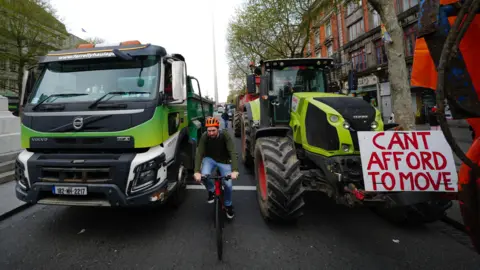 Brian Lawless/PA Wire
Vehicles parked on O'Connell Street in Dublin on the second day of a protest against rising fuel prices
The conflict in the Middle East has caused rapid price rises for both petrol and diesel.
Diesel in the Republic of Ireland has risen from about €1.70 (£1.48) a litre to €2.17 (£1.89) on many forecourts in recent weeks and petrol is now up to 25 cents more per litre at many pumps, RTÉ reports.